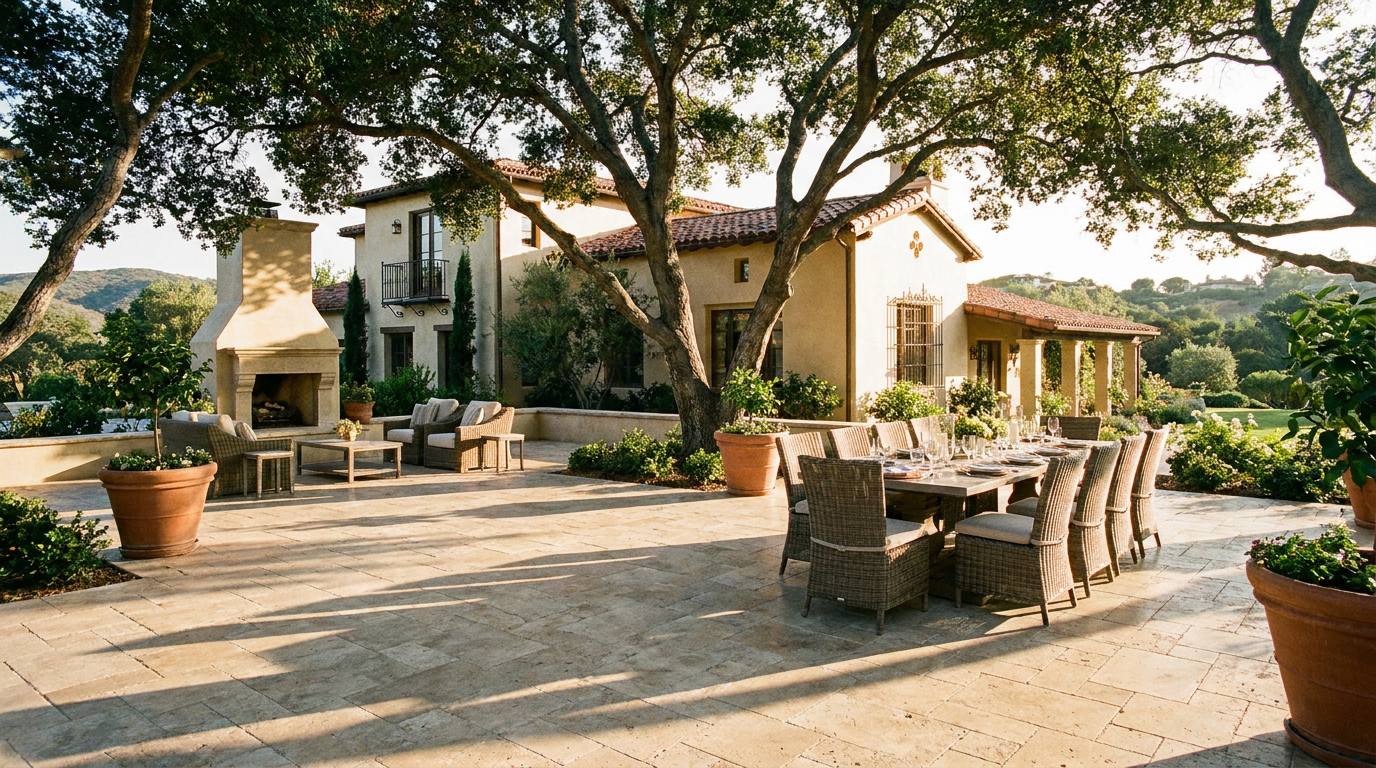
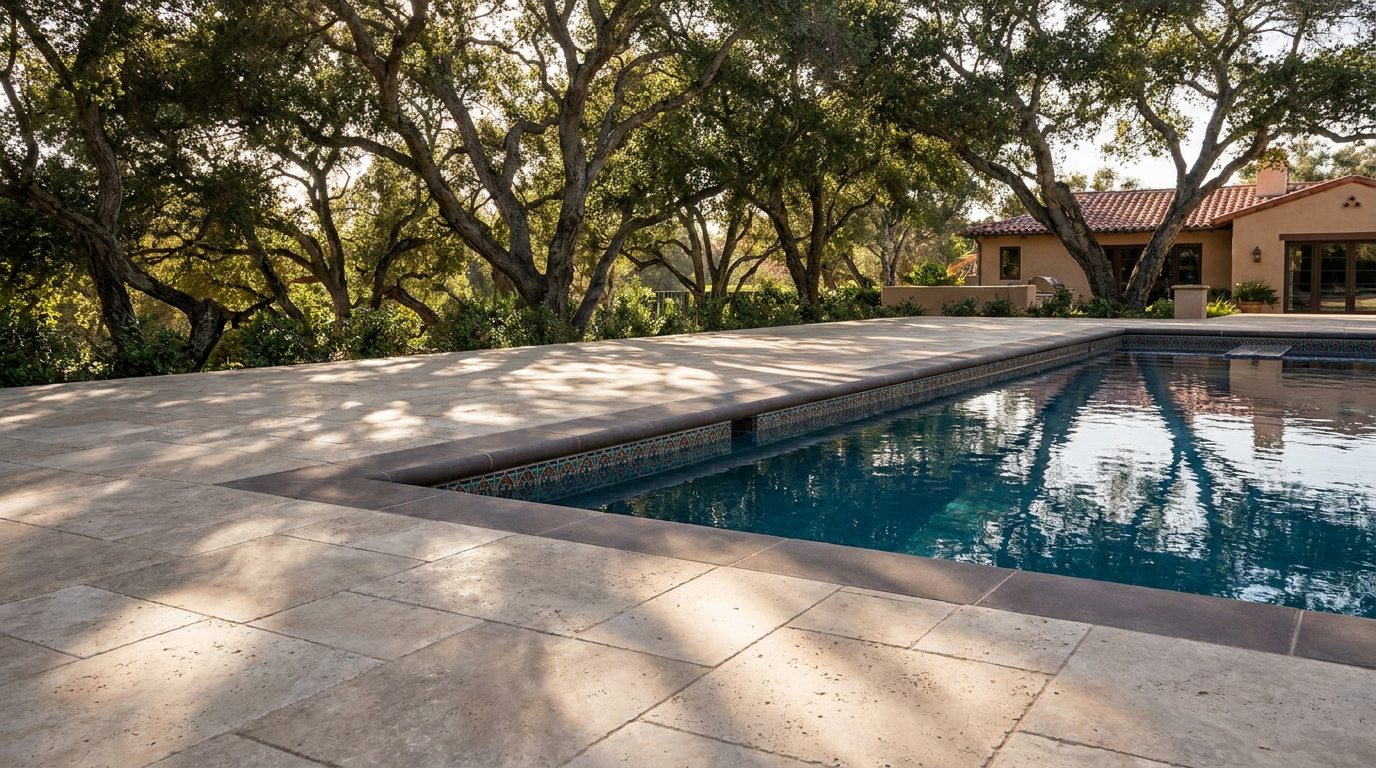
A pool deck in Rancho Santa Fe is not a material selection exercise alone. It is a CDRC submittal, an oak root-zone problem on many properties, and a design decision that has to read correctly against the Spanish Colonial vocabulary the Covenant has held since the 1920s. Get any one of those three wrong and the project either does not get built or does not belong on the site.
What the CDRC Looks For
The Covenant Design Review Committee reviews every exterior change on every Covenant property — including pool decks, coping replacement, and any hardscape within view of a neighbor or the public right-of-way. For pool-deck work, the relevant items in a CDRC submittal are material samples, coping profile and finish, any proposed changes to the pool shell surround, and the way the deck surface relates to adjacent patios and planted areas.
The material the committee responds to positively is the material the Covenant was built in: travertine, clay tile, cut limestone, and natural stone that carries a warm undertone — cream, buff, terra cotta — consistent with the Lilian Rice-era Spanish Colonial palette. Tumbled or chiseled edges read as correct. Contemporary large-format porcelain in a cool grey does not, in most cases. Board-formed concrete is acceptable where the architectural character of the home has already earned a more contemporary reading — but that is a small share of Covenant properties.
Coping is where many pool-deck projects are slowed or rejected. The coping profile and material need to resolve the transition from the pool shell to the deck surface in a way that reads as part of the same design language, not as two separate decisions that happen to meet. Bullnose travertine in a matching or complementary tone to the deck surface is a reliable choice. Cast concrete coping in a color that does not coordinate with the deck reads as suburban regardless of the deck material around it. The CDRC will ask you to reconsider it.
The Oak Root-Zone Complication
On Covenant properties with mature coast live oak canopy — which describes most of them — the pool shell often sits within or adjacent to protected root zones. That reality shapes what can be done with the deck.
Trenching for new electrical conduit, drainage runs, or gas lines through a root zone is not an option without an arborist’s sign-off, and in many cases that sign-off will not be granted for direct trenching at all. The more important constraint for existing pools is compaction: running heavy equipment over a root zone during a deck demo and replacement damages roots that the tree may not visibly respond to for several years. That lag between cause and visible damage is the reason it happens so often — the connection is not obvious until the tree begins to decline, by which point the project is long finished and the crew is long gone.
A pool-deck replacement near established oaks requires fencing the root zones before any demolition begins, limiting equipment access to paths that avoid the protected zones, and hand-setting material in areas adjacent to the canopy. The arborist is a project consultant, not a one-time sign-off, on these properties. That scope adds time and cost, and it is the correct way to protect what is almost certainly the most valuable non-structural element on the property.
Material Choices That Hold Up in Rancho Santa Fe
Travertine is the most common choice on Covenant pool decks, and it earns its place. The material reads as historically appropriate, it holds its appearance well in the inland climate, and in a tumbled or chiseled finish it provides the slip resistance that a pool-adjacent surface requires. The specification detail that matters: travertine should be sealed appropriately for pool-adjacent use, with particular attention to the fill material in the pores — an unfilled travertine at pool edge is a maintenance liability in a wet environment.
Clay tile, particularly in a Saltillo or reclaimed Mexican tile format, carries the same Covenant-appropriate character and works well on covered pool-deck portions where it will not be exposed to heavy foot traffic after water use. On fully exposed deck areas, the COF (coefficient of friction) rating is a material selection driver as much as aesthetics.
Cut limestone in a warm beige or cream tone — a material commonly sourced from Texas or French quarries for San Diego projects — is a premium choice that holds up in the inland climate and reads as undeniably correct inside the Covenant vernacular. The cost premium over travertine is real; the material board result is also different.
Cost Range
Pool-deck work in Rancho Santa Fe runs from roughly $40,000 for a confined replacement on an existing shell with a straightforward material choice, up to $150,000 or more when the shell perimeter is large, the oak root-zone work is significant, the coping replacement is full-perimeter, and the scope includes drainage replumbing and coordination with the adjacent patio surface.
The wide range reflects the reality that Covenant properties are not uniform in either shell size or site complexity. A pool tucked under a mature canopy with root zones on three sides of the shell is a categorically different project from a pool on an open sun-facing slope where the deck replacement is a straight material and labor conversation.
If the shell itself has age, the pool-deck replacement is also the right time to assess the coping bond beam, the plumbing access points near the deck surface, and whether any drainage replumbing makes sense while the surface is already removed. Addressing those items during the deck replacement rather than after the new surface is set is almost always the less expensive path.
Related: Pool Decks & Poolside Hardscape · Patios & Hardscape · Projects in Rancho Santa Fe · Pool Deck Materials in San Diego · Pool Coping Options