
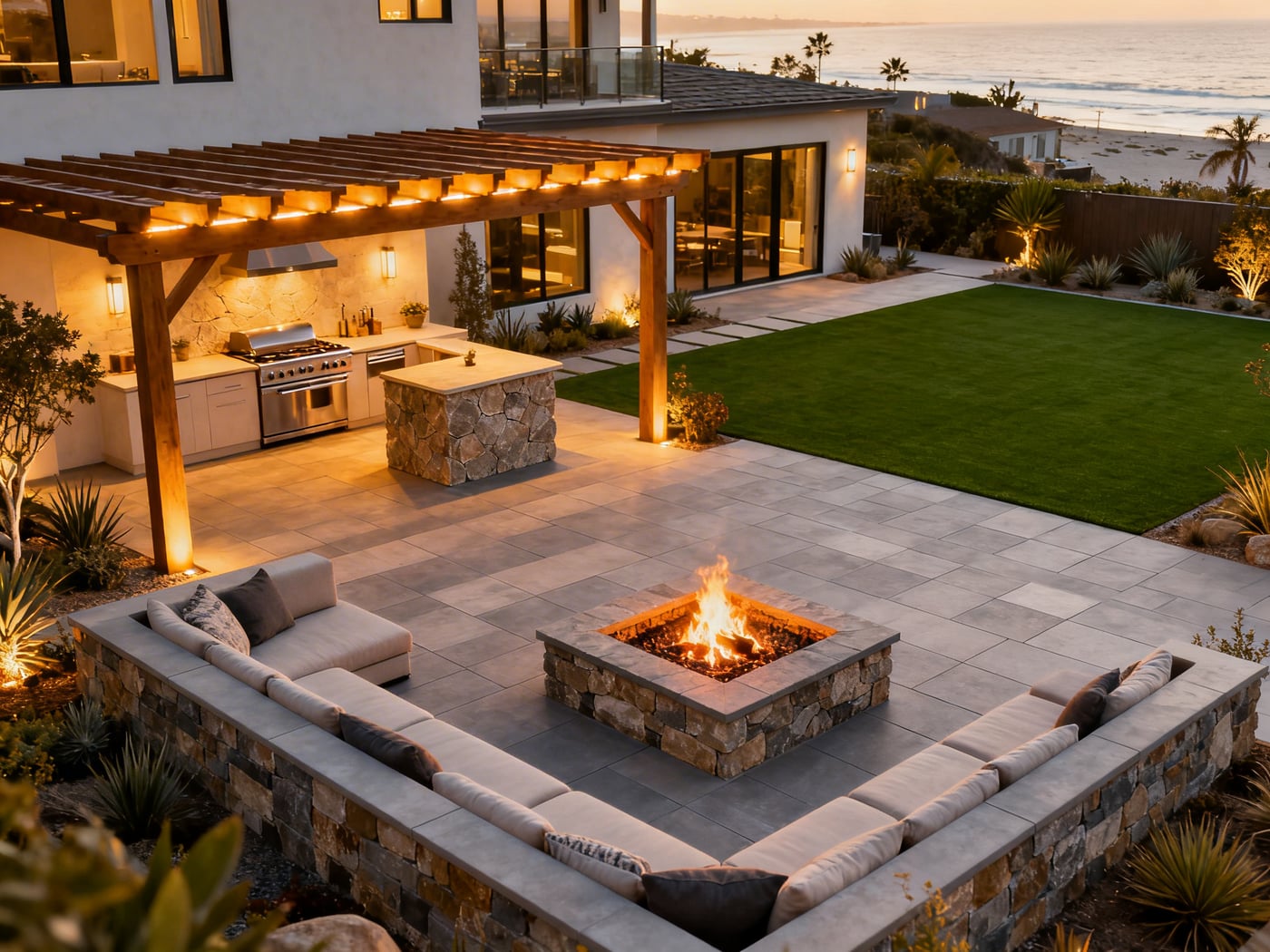
A yard that sounds like Coronado
Six in the morning, the air holds salt before it holds anything else. The Hotel Del sits pink at the edge of your sightline from the back patio, the fog still sitting on the Strand, and somewhere down Orange Avenue a bicycle bell is the first sound of the day. A neighbor walks a dog past the low boxwood hedge. The coffee is outside before you are.
Coronado is a small island with long memory. The streets are flat and the lots are modest and the houses carry their decades on purpose — a Queen Anne turret catching the morning light, a Craftsman porch set back behind a mature magnolia, a Spanish Revival with tile that has weathered a thousand marine-layer mornings. Fences are low. Hedges are the real walls. The back of the house is where the day actually happens, because the front of the house belongs to the street.
The homeowner who calls us here is usually not a first-time owner. They have been in the house long enough to know exactly where the afternoon shade lands and exactly which corner of the yard the sprinklers have been fighting for a decade. They have watched the finishes on two earlier attempts at the patio fail at the same joint. They know the zoning paperwork, or their neighbor does. They are not looking for a fast answer. They are looking for the right answer, once, by someone who understands that a Coronado yard is a specific kind of room — quiet, coastal, old in the best sense, and asked to hold up to a climate that does not forgive shortcuts.
By design, not by dispatch. That is how we work, and Coronado is the kind of address that rewards it.
The property profile
Coronado is an island city of roughly thirty-two thousand people, four and a half square miles of land, and a housing stock that runs from the 1880s to last Tuesday. Typical residential lots sit between 0.1 and 0.3 acres — small by San Diego County standards, meaning every square foot of yard is doing real work and there is no slack in the plan for a wasted corner.
The architecture is unusually diverse for a neighborhood this size. Victorian and Queen Anne houses anchor the older streets. Craftsman bungalows fill out the mid-blocks. Spanish Revival, Mission Revival, and a thoughtful run of mid-century homes line the cross-streets. Newer infill construction arrives on occasion and has to read as Coronado — which is to say, it has to defer to its neighbors.
Values in this market typically run from the low $5M range to $30M-plus on the Strand and the waterfront. The owners are not one profile. Some are multi-generational Navy families whose grandfather bought the house on a commissioned officer’s salary. Some bought in the last decade and are carefully earning the right to live here. The work we do has to read right to both. A garden that announces itself is the wrong garden for Coronado. A garden that settles in and looks like it has always been there is the one.
Soil, climate, and what the salt actually does
The soil under Coronado is sandy fill set over native beach substrate. The drainage story is generally simple — water leaves the surface quickly — but the material story is not. Salt air is aggressive, persistent, and indifferent to warranties. It is the single variable that drives most specification decisions on the island.
Metals are where the consequences show up fastest. Standard painted steel will chalk, blister, and rust through within a handful of years on a waterfront property; on an inland block it fares a little better and still underperforms. Stainless steel in a marine grade (316, not 304) holds up. Architectural bronze ages honestly and keeps its structural line. Aluminum with a quality powder coat is a reasonable middle path for lighter elements.
Planting has to be chosen the same way. Coastal-appropriate, salt-tolerant, wind-rated — species that do not mind a horizontal afternoon breeze or the fine spray that reaches further inland than most people expect. A Mediterranean palette usually reads right. A tropical palette usually does not.
Permits, the Historic Resources Commission, and the coastal overlay
Coronado is its own city with its own government. Projects go through the City of Coronado Community Development Department, which handles building, planning, and the design-review process. For most outdoor remodels, that is the first and primary jurisdiction.
Two extra layers matter here, and both are common on this island.
First, the Historic Resources Commission. Properties designated as Historic — and a meaningful percentage of Coronado’s older homes are — go through Commission review before exterior alterations move forward. The process is serious and the timeline is longer than standard. Expect additional weeks, occasionally additional months, for work that touches the envelope, the street-facing elevations, or certain site features on a designated parcel. We run that process as part of our scope, not as a surprise you discover on week three.
Second, the California Coastal Commission overlay. Certain parcels — particularly those closer to the waterfront and on the Strand — fall inside coastal jurisdiction and require review under the California Coastal Commission framework. Whether your parcel is affected depends on the specific address, and we confirm that at the start of the project before any drawings go to the city.
We plan for the longer process. We would rather begin slowly than apologize later.
Design character — let the period lead
The fastest way to build a yard that will feel wrong in Coronado is to ignore the house it sits behind. A modernist garden on a 1905 Queen Anne is an argument with the architecture. A tropical installation on a Craftsman bungalow reads like a rental. The period is not a constraint. It is the brief.
Hardscape tends to work best in natural stone, traditional-format pavers, or porcelain pavers rated explicitly for coastal exposure. Concrete is appropriate when it is handled as finish work rather than as a slab. Walls and edges read better in brick, stucco, or hand-set stone than in poured smooth concrete for this housing stock. Painted cedar and high-grade teak are the honest choices for fences, gates, and overhead structures; both age gracefully in salt air if they are specified and finished correctly. Where a project wants a longer life-cycle than cedar, we will specify Accoya or a marine-grade hardwood.
Color wants to stay quiet. Coronado gardens in heritage palettes — soft whites, warm off-whites, greens that read against the fog, muted terra cottas — outperform the bold palette that looks sharp in a magazine but loud in person. Lighting should be understated: warm color temperature, fully shielded fixtures, wash before flood. The goal is a yard that reads as inevitable, not decorated.
Where SDLR fits in Coronado
This is the kind of work we were built to do. Historic, coastal, small-lot, thoughtful — Coronado projects reward a firm that plans carefully and a crew that does not leave.
We run the City of Coronado process and, where it applies, the Historic Resources Commission review as part of our scope. We prepare the drawings, we present to the Commission, we respond to comments, and we sequence procurement around the review timeline so we are not paying for material that sits on a truck waiting for a sign-off.
One crew handles the entire outdoor footprint — grading, hardscape, structures, kitchen, lighting, planting — start to finish. Our Field Lead is on site, and either Gio or Mike is personally involved in every project. You have both cell phones from the first call.
And ten months after completion, we come back. The 10-Month Walk-Through is built into every project, no invoice. We walk every square foot of our work with you, after a full wet winter and a full warm September, and anything the seasons have exposed gets handled on our dime. That matters more on a salt-air island than it does anywhere else in the county.
Services we deliver in Coronado
Each service below is a dedicated chapter of our work. Every one is available as part of a full remodel, and most are available as standalone scopes on the right project.
- Full backyard remodels
- Outdoor kitchens and BBQ islands
- Patios and hardscape
- Fire pits and fireplaces
- Pergolas and shade structures
- Retaining walls and seating walls
- Artificial turf installation
- Landscape lighting
- Pool decks and poolside hardscape
- Drainage and grading
Frequently asked — Coronado
How long does the Historic Resources Commission process take?
It varies with scope and with the Commission calendar, but on a designated property you should plan for the review to add weeks and occasionally months to the front of the project. We prepare the Commission package as part of our design scope, present it ourselves, and respond to conditions in writing. The added time is a feature of doing the work correctly — Commission review protects the character that made you buy on the island in the first place.
What materials actually hold up to Coronado salt air?
For metals: marine-grade stainless (316), architectural bronze, and high-quality powder-coated aluminum. For wood: high-grade teak, clear vertical-grain cedar properly finished, and Accoya for long life-cycle pieces. For stone and paving: dense natural stone, porcelain pavers rated for coastal exposure, and quality travertine or limestone detailed with the salt load in mind. What we avoid: untreated mild steel, cheap powder-coat finishes, and any wood species that does not have a coastal track record. Salt does not negotiate.
My lot is small. How do we plan a real outdoor program on a Coronado footprint?
By designing the whole footprint as one room, not by stacking features. A tenth-acre Coronado yard that tries to fit a lawn, a pool, a kitchen, a fire feature, a pergola, and a play zone will feel cramped and read as cluttered. A tenth-acre yard that chooses two or three experiences and commits to them fully will feel generous. Our design process starts by asking what a good evening actually looks like for your household — and planning from that, not from a feature checklist.
How do I know if my parcel is under California Coastal Commission jurisdiction?
We check as part of the first site visit. Parcels closer to the waterfront, the Strand, and certain coastal-zone boundaries are more likely to trigger review; others are not. If the parcel is inside the coastal overlay, we handle the additional process, and we factor the timeline into the project calendar before you sign a contract.
What is the realistic budget for a serious Coronado outdoor remodel?
Our full remodels run between $50,000 and $300,000 for the large majority of our work, and on Coronado properties with historic review, coastal materials, and a coordinated kitchen-structure-lighting-planting program, projects often sit in the $150,000 to $300,000 range. Work above $500,000 is appropriate where the property and program support it. We do not take on small-scope work anywhere, including here.
What does a period-appropriate garden look like on a Victorian or Craftsman?
It looks restrained. On a Victorian or Queen Anne, that usually means a formal structure — clipped hedges, defined beds, ornamental perennials, a bit of symmetry — in a palette of greens, creams, and muted florals. On a Craftsman, it means a naturalistic garden with generous shade, layered textures, warm-tone hardscape, and a porch-to-yard transition that feels continuous. The common thread is that the garden defers to the house. The house has a point of view. The garden supports it.
We rent the home to a Navy family on orders. Does that change what makes sense to build?
It changes the brief, not the standard. A home that is sometimes tenant-occupied wants an outdoor program that is low-input, durable, and pleasant to live in without requiring a weekly gardener. Hardscape does more of the work. Planting leans toward tough, low-water, low-pruning species. Lighting is on automation. Irrigation is zoned and on smart control. We design these projects so that a family arriving on a three-year set of orders inherits a yard that takes care of itself.
Do you work in Point Loma, La Jolla, and other nearby coastal neighborhoods?
Yes. A short drive from Coronado in either direction lands us in the same coastal-material and jurisdictional conversation. See our pages on Point Loma, La Jolla, and Eastlake.
References available on request
We do not publish client testimonials. When a project is complete, we invite future Coronado clients to speak directly with the homeowners who live in the finished work — a real conversation, not a cropped quote. During discovery, we will walk you past completed projects where they sit. On this kind of work, that is still the honest way to vet a builder. You can verify Mike’s Class B general contractor standing any time through the CSLB license lookup.
When you are ready
If your Coronado property deserves a patient plan — historic review handled, coastal materials specified correctly, one crew from first cut to final clean — we would like to hear about it. A first conversation is thirty minutes, at your property or by phone, and there is no cost to begin. We will listen, we will tell you what we see on the island, and we will tell you honestly whether we are the right firm for the work.
Licensed and insured general contractor, operating under Mike’s Class B license — CSLB #1139785.