
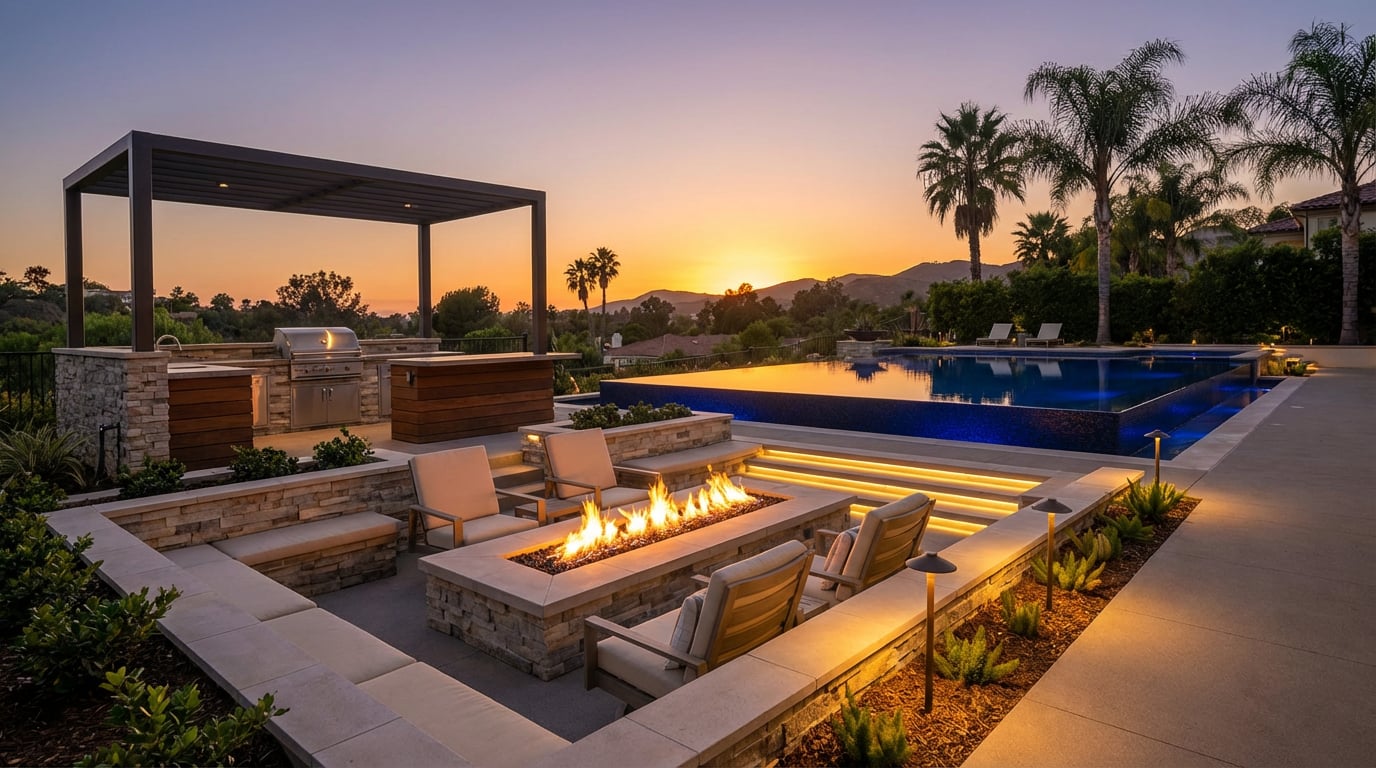
A peninsula that asks the yard to behave
Point Loma is the kind of neighborhood you learn by walking it. The light off Sunset Cliffs at seven in the evening, when the Pacific is flat and the tourists have gone home and the only sound on the bluff is your own footfall. The view from La Playa, where the bay flattens out on a Saturday morning and a sailboat tacks across the Coronado Bridge like it is posing for a painting. The back-roads behind Rosecrans, where a eucalyptus canopy you forgot was there opens onto a front porch and a tile roof and a lawn the neighbor has kept for forty years.
The houses on this peninsula have been lived in. That is the first thing to understand about the yards that belong to them. Your neighbor is not a stranger — they are the family who was there when you moved in, and they will be there when your grandchildren visit. The oaks are older than the addresses. The jacarandas drop onto the same driveways every June. The coastal air carries through every open door between four and six in the afternoon, and the yard that does not work with that air is a yard you do not use.
A Point Loma remodel, done right, is not a staged product shoot. It is a room outside — shaded where the sun insists, open where the view insists, planted in a hand that looks like it has been there for a decade, and built on a slab that will outlast the second refinance. Quiet in photographs. Unmissable in person.
A property profile that changes block by block
Point Loma is not one neighborhood. It is at least six, and the yard that belongs on one of them would be wrong on the others.
Sunset Cliffs runs the outer edge of the peninsula. Bluff parcels, ocean to the horizon, wind that changes the material conversation. Craftsman bungalows from the 1920s sit next to coastal contemporaries built in the last ten years, and both are right.
Loma Portal is the old residential spine — streets laid out in the 1920s and 30s, deep lots, mature canopy, Craftsman and Spanish Colonial revival in their honest, original form. These yards reward restraint and period-correct detail.
La Playa is the estate block. Bay views, some of the largest lots on the peninsula, houses that have been in families for generations. Budgets and expectations here are closer to the La Jolla estate tier than to a standard Point Loma remodel.
Fleetridge sits above the bay with panoramic views and a mid-century custom-home character — low, horizontal, wide eaves, a yard that reads as part of the architecture.
Roseville is the waterfront and harbor-adjacent stretch. Tighter lots, a working waterfront feel, a mix of older cottages and newer infill.
The Wooded Area is exactly what it sounds like — older trees, curving streets, a quiet that feels a half-mile deeper than the main roads nearby.
Lots across the peninsula run from 0.15 to 0.5 of an acre, with La Playa estates pushing well above that. Housing stock spans century-old Craftsmans, 1950s view-lot customs, Spanish Colonial, mid-century modern, and the newer remodels filling in the gaps. The right yard is written in the language the house already speaks.
Soil, air, and what a bluff-side parcel will not forgive
The soil across Point Loma is largely sandy loam near the coast — well-drained by nature, forgiving in ordinary weather, and a pleasure to work with on a flat parcel. Move inland toward the ridgelines and you begin to find clay pockets that tell a different story: slower percolation, movement under loading, a need for engineered drainage that a sandy parcel does not demand.
Bluff-side and hillside parcels carry drainage consequences that cannot be ignored and cannot be deferred. Water that is not routed intentionally off a bluff lot will find the path it wants — and on coastal soils over sandstone, that path is rarely the one you would choose. Retaining walls, subdrains, French drains, and surface grading are not optional features on these properties. They are the foundation everything else sits on.
The salt air is a real variable. Less aggressive than Coronado, which sits in the spray zone, but meaningful — hardware, fasteners, and finish metals are specified accordingly, and wood choices on the outer blocks earn their keep or they do not.
Permits and a coastal jurisdiction that takes its time
Point Loma is City of San Diego. Permits run through San Diego Development Services — the department that reviews residential site improvements, structures, drainage work, retaining walls, and the coordinated permitting that a full outdoor remodel requires. On a standard inland Point Loma parcel the process is familiar and predictable.
Parcels west of the coastal zone boundary are not standard. They sit inside the Coastal Overlay Zone, and that changes the process in ways that matter to your timeline. Projects in the overlay require a Coastal Development Permit or an equivalent determination, undergo additional review for visual, habitat, and public-access considerations, and — on certain projects — remain appealable to the California Coastal Commission. Review windows stretch. Conditions land on the approval. The work of anticipating those conditions is not a surprise on a job like this; it is the job.
We run the Coastal Overlay process as part of scope, not as a caveat on the margin. The right time to engineer drainage, set structure heights, and choose material finishes for a bluff-side parcel is before the application lands on a planner’s desk — not after.
Design character, block by block
The peninsula carries four dominant architectural languages, and the yard borrows from the house.
Craftsman rewards period-correct garden treatment — low stone or masonry walls, clipped hedges, flagstone paths, structures in cedar or Douglas fir with visible joinery, plantings that look like they have been there since the twenties.
Spanish Colonial revival asks for terra cotta or saltillo tile, hand-troweled stucco walls, wrought iron, citrus, and the kind of fountain you can hear before you see.
Mid-century modern — the Fleetridge and view-lot inheritance — prefers horizontal lines, large-format pavers or board-formed concrete, flat-roofed shade structures, architectural plantings, and a planting palette that reads sculptural rather than romantic.
Coastal contemporary, the newer-build language, runs toward restrained materials, honest finishes, ipe or Accoya overheads, and structures detailed to disappear into the view rather than compete with it.
The view lot is its own discipline. Structure height, overhead planes, and material glare are the three variables that will either preserve the view that sold the house or steal it. Restraint is a design choice on these lots, not a compromise.
Where we fit on this peninsula
Point Loma is not a neighborhood for a rolling-truck contractor. It is a neighborhood for a firm that can read a 1923 Craftsman, engineer a bluff-side drainage plan, walk a Coastal Overlay application through review, and deliver the finish work a La Playa estate expects.
San Diego Landscape Remodeling was built for this kind of work. We plan our projects months ahead. We run one crew from first cut to final clean. Gio or Mike is personally on every project — not an account manager, not a coordinator — and you have both cell phones from the first call. Our Field Lead runs the day-to-day on the ground, with twenty-five-plus years of high-end outdoor building behind him.
The Coastal Overlay process is inside our scope, priced and scheduled honestly. The engineering conversation on a bluff-side parcel happens before we sign a contract, not during the build. The period-correct detail work on a Loma Portal Craftsman is the work we came to do.
Ten months after the project is complete — through a wet winter, a hot September, and the first real wear the space will see — we come back for The 10-Month Walk-Through. We inspect every square foot of our work with you. Anything that needs attention gets attention. No invoice. Almost nobody in this industry does this. That is exactly why we do.
By design, not by dispatch. A client who needs a patio this weekend is better served elsewhere, and we will say so honestly.
Services we deliver in Point Loma
Our Point Loma work runs across the full scope we offer countywide, coordinated under one plan and one crew:
- Full backyard remodels — the hero scope, grading through planting, one plan for the whole outdoor footprint.
- Outdoor kitchens and BBQ islands — built-ins and full appliance programs designed for coastal exposure.
- Patios and hardscape — paver, poured concrete, stone, and tile.
- Fire pits and fireplaces — gas and wood, masonry-set.
- Pergolas and shade structures — cedar, Accoya, louvered roofs, engineered overheads.
- Retaining walls and seating walls — bluff-side and hillside engineering.
- Artificial turf installation — where the program calls for it.
- Landscape lighting — path, step, wash, and canopy, zoned and smart-controlled.
- Pool decks and poolside hardscape — finishes detailed for coastal wear.
- Drainage and grading — the foundation the rest of the yard sits on, especially on bluff and hillside parcels.
If your neighborhood sits across the bay or up the coast, see our work in Coronado, Mission Hills, and La Jolla.
Frequently asked
How does the Coastal Overlay process change our timeline?
If your parcel sits inside the Coastal Overlay Zone, the permitting window lengthens meaningfully — additional review for visual, habitat, and public-access considerations, conditions attached to the approval, and on certain projects an appeal window to the California Coastal Commission. We design with the overlay in mind from the first sketch, prepare the application package to anticipate the conditions that land on projects like yours, and build the extended review into the schedule we publish in your proposal. Honest about the window at the start is better than a date we cannot keep.
What does bluff-side drainage actually involve?
More than surface grading. A bluff-side drainage plan typically coordinates engineered retaining, subdrains, French drains, surface flow routing, and — where the site demands — specific discharge points reviewed alongside the coastal process. Water that is not routed intentionally will find its own path, and on coastal soils over sandstone, that path is rarely the one you would want. This work happens before finish work, not after, and it is not a place to value-engineer.
What should we expect to invest for a La Playa estate remodel?
La Playa budgets sit at the upper end of our range. A coordinated remodel of a larger La Playa property — kitchen, structures, pool-deck integration, lighting, planting program, and the finish work the neighborhood expects — typically lands in the $300,000 and up tier, and the right La Playa project runs into the $500,000-plus range. We do not take on small-scope work, we do not price-match, and we do not run “budget” tiers. We give an honest price and deliver the work behind it.
Can you period-match a 1920s Craftsman in Loma Portal?
Yes, and the details are the point. Stone and masonry walls set by hand, cedar or Douglas fir overheads with visible joinery, flagstone paths laid in a period-correct pattern, and a planting palette that reads like it has been there since the house was built. Period-matching is a discipline, not a decoration. It is the kind of work a single crew with twenty-five-plus years on high-end yards can do, and a rolling crew on a Thursday cannot.
How do you handle material selection for salt air?
Point Loma is not the spray zone — Coronado is — but the coastal air is a real variable. Hardware and fasteners are specified in stainless or coated grades appropriate to the exposure. Wood choices favor cedar, ipe, or Accoya on the outer blocks. Stone and masonry specifications account for the moisture cycle. On view-lot and bluff-side projects, every material choice earns its place in a fifteen-year conversation, not a five-year one.
How do you preserve a view without making the yard feel empty?
With restraint, and with the right three moves. Structure height stays below the sight-line that sold the house. Overhead planes are detailed to disappear into the view rather than compete with it. Material palette is chosen for glare — matte finishes, softened edges, plantings that frame rather than block. A view lot is the easiest kind of yard to ruin and the most rewarding kind of yard to get right. The discipline is knowing what to leave out.
What can you do with a smaller Roseville or Wooded Area lot?
A smaller lot rewards a tighter design hand. Outdoor rooms with one clear program — a dining terrace, a morning coffee corner, an evening fire seat — work harder than a larger lot trying to be four things at once. Vertical gardening, layered lighting, and a single well-placed structure can make a 0.15-acre property feel meaningfully larger than it measures. The peninsula has some of the most satisfying small-lot work in the county on it.
Do we need to move out during the build?
Almost never. Our crew works a defined zone, protects the rest of the property, and cleans at the end of every day. We coordinate access weekly. For households with young children, grandchildren visiting, or pets, we walk the containment and safety plan before the first delivery truck arrives.
References available on request
We do not publish testimonials. When a Point Loma project is complete, we invite future clients to speak directly with the homeowners who live in the finished work — a real conversation, not a cropped quote. During discovery we will also walk you past completed projects in the neighborhoods where they sit. On this kind of work, that is still the best way to vet a builder.
When you are ready
If the property is in Point Loma and the timeline is right, we would like to hear about it. A first conversation is thirty minutes — by phone, or walking the yard with you — and there is no cost to begin. We will listen, we will tell you honestly what the peninsula will and will not allow, and we will tell you plainly whether we are the right firm for the work.
Licensed and insured general contractor, operating under Mike’s Class B license — CSLB #1139785. Verify any California contractor’s standing through the CSLB license lookup.