
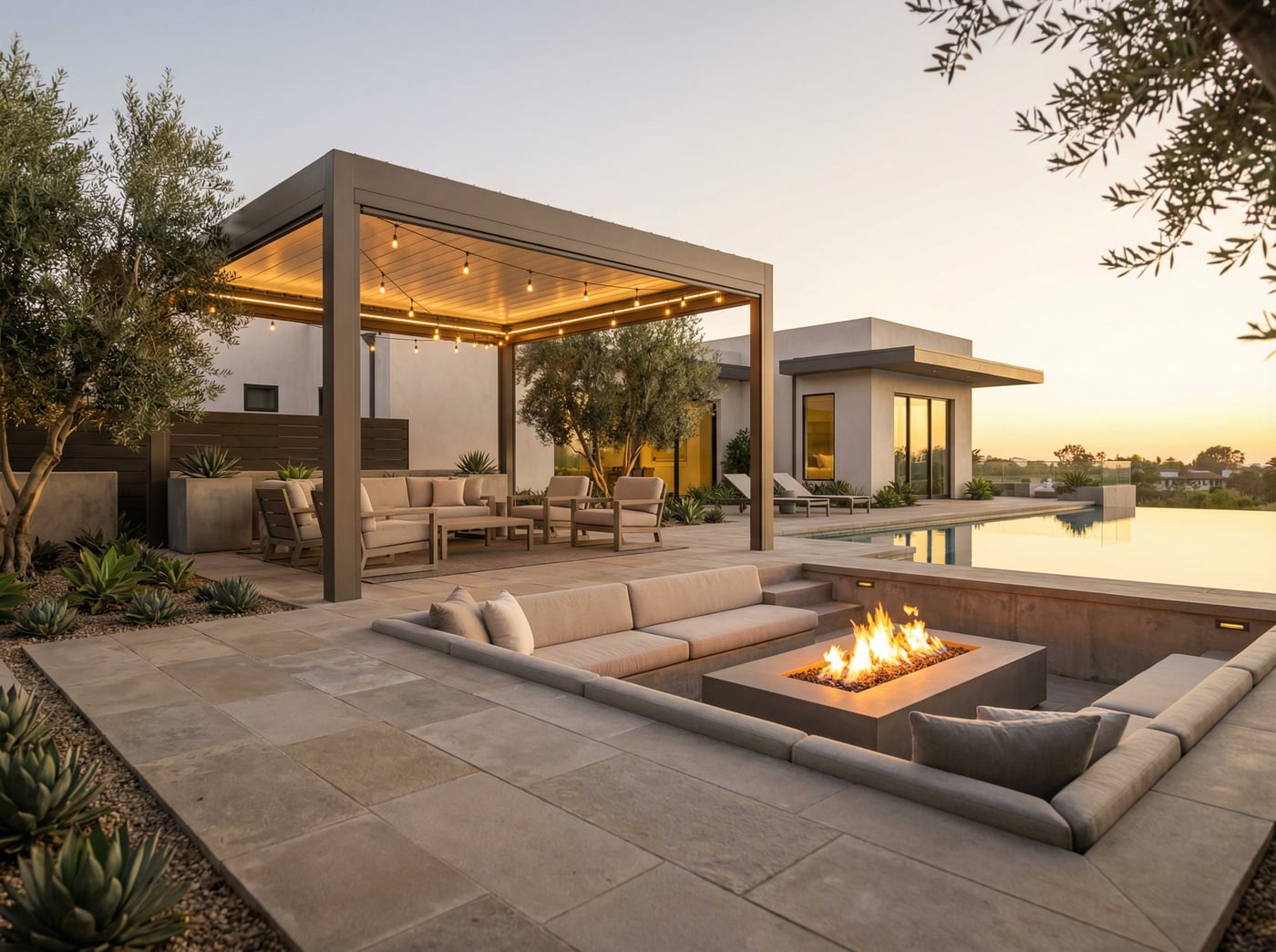
A valley that still feels like a valley
Bonita is the rare San Diego pocket that did not let itself be paved over. Drive in from the freeway on any evening and the thing that strikes you is what is missing — the strip of franchise signage, the tract-house shoulder, the county-subdivision geometry. What is there instead is a valley floor of fruit trees and low stables, a ridge of eucalyptus catching the last of the light, and the Sweetwater River corridor holding its green line through the dry season. At the bottom of Sweetwater Road you still pass horses nosing a split-rail fence at dusk. You still hear them, in fact, before you see them.
Mike lives here. That detail is not branding — it shows up in the work. He drives Central Avenue in the mornings and Corral Canyon in the afternoons, knows which parcels flood in February and which drain themselves by Tuesday, has eaten at the same two restaurants on the same corner for years. When the conversation turns to a property in Bonita Highlands or a horse parcel off Proctor Valley Road, he is not looking at Google Maps. He is thinking about the neighbor two lots over, the oak the county will ask about, the grade change between the patio slab and the arena fence.
A Bonita yard is a lived-in piece of property. The homes tend to stay with families. The lots are bigger than they need to be, which is part of the point. The work we do here is meant to extend that lived-in quality outward — a patio, a structure, a kitchen, a wall — built so the next decade in the house feels more like the last.
The property profile
Parcel sizes in Bonita run wide. The valley-floor homes along Sweetwater Road, Frisbie Street, and the older Central Avenue frontage tend to sit on lots from a third of an acre up to a full acre, with mature orchards and established trees that were planted before the present owners closed escrow. Move up the grade into Bonita Highlands and Bonita Long Canyon and parcels stretch — one, two, occasionally three acres — many with equestrian zoning, corrals, and barn structures that have been part of the property’s program for thirty or forty years.
The housing stock is a deliberate mix. Spanish Colonial and Mission Revival dominate the older valley blocks — clay-tile roofs, courtyard orientations, stucco that has taken on the patina of several San Diego decades. California Ranch is the second register, long and low, often with generous rear elevations that never really decided whether they were indoor or outdoor rooms. On the newer canyon lots you see transitional custom — contemporary Mediterranean, a quieter modern ranch, the occasional Santa Barbara-inflected elevation handled with restraint.
Long-tenured owners are the norm. Many of the families we meet have been in the house twenty years or more. That shapes the brief. The work is rarely about moving in; it is about settling further in.
Soil and climate
Bonita sits across two soil regimes, and getting the build right depends on knowing which one you are on.
The valley floor — the Sweetwater River corridor and the flats that run off it — is clay loam with river-gravel pockets and seasonal alluvial deposits. Clay expands when wet and contracts when dry. That is the quiet reason a patio poured without a proper base separation can telegraph cracks two winters later, and the reason retaining walls below the grade change want real drainage behind them rather than a perforated pipe and a prayer.
The canyon slopes — Bonita Highlands, Corral Canyon, the upper reaches of Long Canyon — shift to decomposed granite with clay pockets. DG drains well on its own. The clay pockets do not, and they sit exactly where you do not expect them. A slope that looks dry in August will hold water against the back of a wall in February if the drainage design assumed uniform DG throughout.
The climate is mild year-round with the real test compressed into a few winter weeks. When Pacific storms stall over the Sweetwater watershed, a slope that never had a drainage conversation becomes the drainage conversation. Building for February is building for ten months of quiet payoff.
Permits and jurisdiction
Most of Bonita is unincorporated. That means the jurisdiction for your permit is San Diego County — specifically the Planning & Development Services department — rather than a city building office. PDS reviews grading, drainage, structural work, and any pool or spa scope, and in canyon-overlay zones and areas with sensitive habitat there can be additional environmental review. The process is not hostile, but it rewards drawings prepared by someone who has submitted into County before.
A subset of Bonita parcels carries HOA overlay. Bonita Highlands in particular maintains CC&Rs with a design review process — setbacks, fence types, wall heights, finish palettes, sometimes even planting lists. Review is typically quicker than County plan-check but not optional. We draft our submissions to satisfy both tracks the first time.
Equestrian parcels introduce their own considerations — setbacks from corrals, manure-management drainage, arena fencing, and access lanes that must be preserved through the build. These do not make the work harder; they make the early design conversation more important.
Anyone we propose to can verify our active licensing through the CSLB license lookup before a proposal is signed. We recommend that step regardless of the firm you ultimately hire.
Design character
The Bonita eye leans traditional, but with a specific, restrained dialect. Spanish Colonial courtyards, ranch-style verandas, and low walls faced in hand-set stone read as native. Contemporary Mediterranean — clean-lined stucco, clay-tile nods, a quieter version of what North County sometimes does loud — reads well on the canyon lots, particularly those where the rear elevation looks out across the valley.
Horse-property parcels and larger equestrian lots call for restrained material palettes. A chunky multi-color paver bay reads wrong against split-rail, oak, and DG. What reads right is a narrower material vocabulary — a single-stone terrace, a CMU-and-stucco wall with a tile cap, a COR-TEN edge at a planter change, timber overhead elements that will weather into the property rather than fight it.
What reads wrong, universally, is suburban tract-vernacular on an acre lot. The acre lot asks for a different scale of gesture — fewer moves, larger ones, and materials that age rather than fade. That is a design discipline more than a cost line; the budget for an acre is not the budget for a tract yard six times over.
One guiding instinct: if a material or a detail would look out of place on a walk past three neighboring properties, it is probably wrong for yours, regardless of what it costs.
Where SDLR fits
This is Mike’s home community. When we take a Bonita project, we are not mobilizing from somewhere else; we are working from a road we drive daily. That has second-order consequences. Our subcontractors already know Bonita addresses and the County permit desk. Our suppliers know where to deliver material so that the truck does not block a neighbor’s horse-trailer access. Our walk-throughs at the end of a long day do not require a second trip home across the county.
For a firm whose governing idea is by design, not by dispatch, Bonita is the closest thing to a home field. Projects here are planned months ahead, scheduled into a short calendar, and executed by a single crew from first cut to final clean. The 10-Month Walk-Through — where we return ten months after completion to inspect every joint, finish, grade break, and drainage detail — is particularly meaningful on a Bonita property, where the real quality test arrives with a wet February that has nothing to do with how the space looked the week after handover.
Clients in Bonita also cross into Eastlake and Rancho San Diego regularly — the neighborhoods blur at the edges — and families with a second address or a guest property on the water in Coronado are familiar to us as well. The operating reality is the same across all four: one plan, one crew, direct founder access on both cell phones.
The outdoor services we bring to Bonita
Most Bonita projects start as a full backyard remodel — one plan across the whole outdoor footprint rather than five trades showing up in sequence. Inside that scope, or as a defined standalone piece on the right property, we handle outdoor kitchens, patios and hardscape, fire pits and fireplaces, pergolas and shade structures, retaining walls, artificial turf, landscape lighting, pool decks, and drainage and grading. On sloped Bonita properties, drainage and retaining are usually the quiet anchor of the scope, even when the visible program is a kitchen and a terrace.
Frequently asked
Is my property in a Bonita HOA or is it unincorporated?
Both arrangements exist in Bonita, sometimes on adjacent streets. Most of the valley-floor homes and many of the canyon parcels are unincorporated San Diego County with no HOA. Bonita Highlands is the notable exception — CC&Rs and an architectural review committee govern finish palettes, wall heights, and setbacks. Part of the first conversation is confirming which regime your address sits under so the design respects the process from day one.
What is the permit path for a patio on an equestrian parcel?
On an unincorporated equestrian lot, permitting runs through County PDS, and the review considers drainage, setbacks from corrals and structures, and access-lane preservation for horse trailers. A patio-only scope is typically a straightforward submittal; once retaining walls, outdoor kitchens, or pool-adjacent work enter the scope, the review broadens. We prepare drawings to anticipate those review layers rather than chase them after a rejection.
What does a full backyard remodel typically cost in the Bonita valley?
The majority of our Bonita work lands between $50,000 and $300,000, with larger acreage and canyon properties often running higher once retaining, drainage, and structure enter the scope. We do not run budget tiers. We give an honest number for the work we will put our name on, and we walk the cost drivers with you in person before a proposal is signed.
How do you handle drainage over the Sweetwater clay floor?
Deliberately, and early. Clay loam is the determining factor on most valley-floor projects, so drainage is designed alongside the hardscape rather than added at the end. That usually means French drains or channel drains tied to a functional outlet, proper base separation under slab work, and — on sloped adjacent property — a plan for where storm flow goes before it reaches your patio. The work is unglamorous and almost invisible. It is also the difference between a yard that behaves for twenty years and one that does not.
Have you worked in Bonita before?
Yes. One of our founders lives in Bonita and works across the valley and the canyon neighborhoods; our subcontractors and suppliers know the addresses. Out of respect for our clients’ privacy, their homes never become our showroom — instead, we share written references and a detailed photographic record of completed work during your discovery conversation.
Should a modern remodel lean ranch or Spanish Colonial on a Bonita lot?
Usually it leans into what is already there. A Mission Revival house with clay tile wants a restrained Spanish-Colonial dialect outside — hand-set stone, a simple stucco wall, restrained overheads — rather than a contemporary-modern imposition. A California Ranch can absorb a quieter modern remodel gracefully, particularly on the canyon lots where a wider horizon invites cleaner lines. The rule we return to is coherence: the yard should read as the same house, built outward.
What about wildfire defensible space on the canyon lots?
It is a real design input, not a footnote. Canyon-adjacent parcels in Bonita Highlands and Long Canyon sit inside the California wildland-urban interface, and Cal Fire’s defensible-space guidelines shape what we specify — Zone 0 material selection near the structure, spacing and pruning in Zone 1, planting choices that do not carry fire toward the house. We design the outdoor program to respect the zones from the outset rather than retrofit compliance later.
Do you work in Bonita Highlands specifically?
Yes, and we treat the HOA design review as part of the design discipline rather than an obstacle. Our drawings are prepared to the HOA’s submission standard on the first pass, which tends to shorten the review and reduce the back-and-forth that slows projects down in covenant communities. Where the HOA and County processes both apply, we run them in parallel rather than sequence.
References available on request
We do not publish client testimonials. Written references and a full photographic record of the work are available on request. It is the old-fashioned way to vet a builder, and on this kind of work it is still the best.
When you are ready
If the property is in Bonita and the scope is serious, we would like to hear about it. A first conversation runs thirty minutes, by phone or on the yard itself, and there is no cost to begin. We will listen, we will tell you what we see on your property, and we will tell you honestly whether we are the right firm for the work.
Licensed & insured general contractor, operating under Mike’s Class B license. CSLB #1139785.