
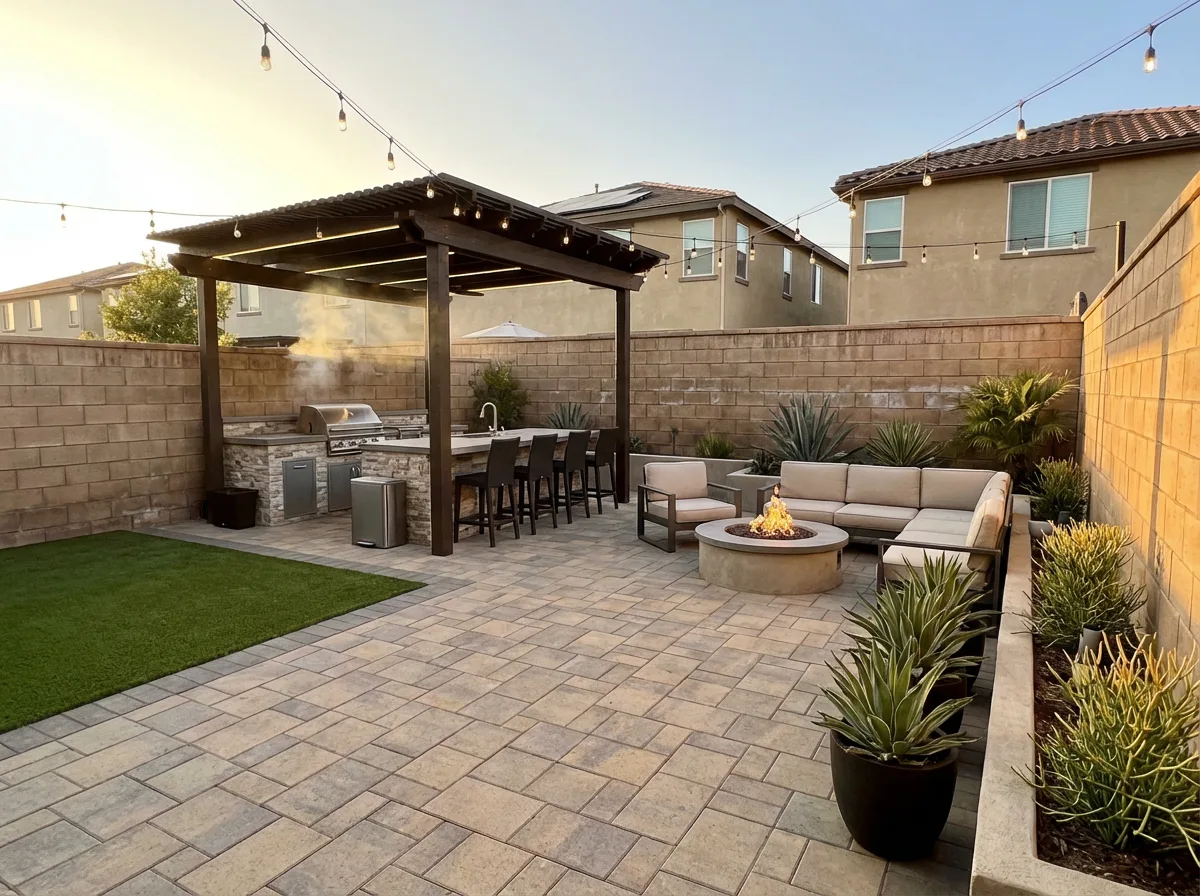
The master-planned yard, finally finished
There is a specific hour in Eastlake — usually forty minutes before sunset, when the light over the lake turns the color of honey and the walkers on the path start coming home — when the shape of your yard reveals itself. The bones of the neighborhood are good. The streets curve the way they were drawn to. The stucco is the color the master-plan architect approved in 1998. The golf-course lots along Eastlake Country Club hold a sightline most of the county would pay for. Everything outside your back slider, though, is where the builder stopped caring and nobody has quite started.
That is the common Eastlake homeowner story. The bones are in place. The house works. The kids are in the pool at the rec center more than they are in the backyard, because the backyard is a thin strip of grass, a concrete slab the size of a ping-pong table, and a single citrus tree the previous owner planted in the wrong place. You have lived with it for seven years. You keep meaning to get to it. Every spring the list grows.
What you actually want is not a landscape. It is an outdoor room — a place where Sunday lunch can sit outside for three hours, where your parents can come down from Murrieta and not have to balance a plate on their knees, where the grandkids can run barefoot on something that is not dichondra-infested weed grass. The house already earns its keep. The yard should too.
Property profile
Eastlake is San Diego’s largest and most coherent master-planned community — one intent, one design language, built out in phases from the late 1980s through the early 2010s. The original Eastlake I neighborhoods sit west, closest to the lake the community takes its name from. Eastlake Greens and Eastlake Woods follow, wrapping the Eastlake Country Club golf course. Eastlake Vistas, Eastlake Trails, and Rolling Hills Ranch were built out later, east and north, with newer architectural vocabularies and larger lots in the Rolling Hills pockets.
Lot sizes run from about 0.10 acre in the denser Eastlake Greens and Trails neighborhoods to roughly 0.25 acre in Rolling Hills Ranch and select Vistas cul-de-sacs. Golf-course lots along Eastlake CC carry their own premium and their own rulebook — the view easement and the course-side setback shape what can be built at the rear property line.
The defining external process on almost every parcel in Eastlake is the community HOA Architectural Review Committee. Eastlake was master-planned down to the shrub palette; the ARC exists to hold that coherence decades after the builder left. Any visible exterior modification — a pergola that reads above the fence line, a material change on a patio visible from the street, a wall color, a lighting plan — almost always triggers review. A yard designed without factoring in the ARC is a yard that will be redesigned after the ARC submits comments.
Soil and climate
Soil across Eastlake is predominantly clay loam, and in several pockets — particularly the older Eastlake I and Greens areas — the clay is meaningfully expansive. Expansive clay swells with winter rain and shrinks as it dries through the summer, and that movement is what cracks a patio slab that was poured fast and thin over poorly prepared base. We have seen the aftermath on more than one Eastlake property: two-year-old hardscape walking apart at the joints because the base was four inches of whatever the original contractor had on the truck.
The climate is mild inland — hotter than the coast in August, cooler than El Cajon in January, with real winter rain events that the master-plan civil design was engineered around. Drainage rules inside the community are strict and specific: water moves from lot to curb or sidewalk along a predetermined path, and a patio or hardscape plan that redirects water into a neighbor’s yard, ponds against the house, or overwhelms a sidewalk scupper is a plan that will fail both the ARC review and a rainy February.
Base preparation and drainage planning are not line items to value-engineer out of an Eastlake project. They are the project.
Permits and jurisdiction
Eastlake sits entirely within the city limits of Chula Vista, which means building permits are pulled through the City of Chula Vista Development Services department. That covers structural permits for pergolas, cabanas, and outdoor kitchens above certain square-footage thresholds; electrical permits for lighting and kitchen circuits; gas permits for built-in appliances; and mechanical where applicable. Plan check turn times and inspection scheduling are set by the city and move at the city’s pace, not the contractor’s.
On top of the municipal process, every Eastlake parcel answers to its community HOA Architectural Review Committee. The ARC reviews proposed exterior modifications before work begins — typically a packet that includes site plan, elevations, material samples, color specifications, and renderings showing the project in context. Review cycles vary by season and by volume, and revisions are normal rather than exceptional. On an Eastlake project the honest expectation is that ARC review is a real part of the calendar, not a postscript.
We prepare ARC submittals as a normal part of every Eastlake scope. That includes the drawing set the committee expects, the physical material samples, the color matches to the approved community palette, and the revision cycles that come back. The ARC is not an obstacle. It is the reason Eastlake still looks like Eastlake.
Design character
The architectural vernacular of Eastlake is Mediterranean, Spanish Colonial, and the softer transitional styles the later phases adopted as tastes shifted. Red tile roofs, stucco walls in the warm neutral range the master-plan approved, arched entries, wrought-iron accents, courtyards in the larger floor plans. The design language is consistent enough that an outdoor room done in the wrong vocabulary reads wrong from the first glance, no matter how well it is built.
Eastlake’s position on the eastern edge of Chula Vista also means some parcels carry wildland-interface adjacency. Where a property sits near open space or canyon edge, Cal Fire defensible-space guidelines shape how we site fire features, what materials we specify for overhead structures, and what clearances we build into the design. We confirm the fire-overlay status at the start of every project.
Taste in Eastlake is not a question of imposing a different style. It is a question of elevating the one already in place. A travertine patio with a tight hand-set joint reads Mediterranean without trying to. A pergola in clear cedar, stained to the warm mid-tone range the ARC will approve, sits with the stucco rather than fighting it. A plaster-finished outdoor fireplace matched to the house color, with a dry-stacked stone hearth, looks like it was always meant to be there because in a sense it was.
Color palettes are almost always ARC-constrained. The approved community palette is narrow on purpose, and the outdoor materials — stone, stucco, concrete color, wood stain, even metal finish on rail work — read better when they sit inside that palette rather than shouting over it. Restraint is the Eastlake move. The yard that photographs best twenty years from now is the one that does not date itself.
Where SDLR fits
We work the HOA process as a normal part of the job. That is the honest difference in Eastlake. A remodeler who treats the ARC as an afterthought will either run your project past schedule fighting comments or deliver a yard that reads out of place. We prepare the drawings the committee expects, submit material samples in the format they want them, handle the revision cycles, and track the review on the same calendar we track permit plan-check and material lead times. When the committee signs off, the crew breaks ground.
Our in-house team and trusted trade partners — the same people, project after project — run every job from demolition to final clean. Our Field Lead — a twenty-five-year specialist in high-end outdoor work — runs the day-to-day, and either Gio or Mike is personally on every project. You have both cell phones from the first call. No account managers, no rotating cast of workers who don’t know your project, no calling a different number each week to ask a question about your own home.
The 10-Month Walk-Through is built into every Eastlake project. Ten months after completion — after a wet winter has moved the clay, a hot September has dried it back, and the first real wear has shown itself — we come back. We walk every square foot of our work with you. Anything that needs attention gets attention. No invoice. Almost nobody else in this industry does this, which is exactly the point.
Services we build in Eastlake
- Full backyard remodels — one plan, one crew, the whole outdoor footprint.
- Outdoor kitchens and BBQ islands
- Patios and hardscape design — paver, concrete, stone.
- Fire pits and fireplaces
- Pergolas and shade structures
- Retaining walls and seating walls
- Artificial turf installation
- Landscape lighting
- Pool decks and poolside hardscape
- Drainage and grading
If your project is across the freeway in Bonita, over the bridge in Coronado, or further west in Point Loma, start with those neighbors’ pages — we write each one from what we see on the ground.
Frequently asked
How long does the Eastlake HOA ARC review take?
It varies by season and by committee volume. Straightforward submittals with a complete drawing set, material samples, and a clean color palette tend to move faster than mixed-material projects that require more discussion. Revisions are normal. We budget the review as a real line on the calendar — not a rubber stamp — and we submit in the format the committee expects, which is the single biggest factor in how smoothly the cycle runs.
What triggers ARC review on my Eastlake property?
Almost any visible exterior modification. That includes pergolas and shade structures above the fence line, outdoor kitchens and fireplaces with any vertical mass, wall and patio materials visible from the street or a neighbor, color changes, lighting plans, and fencing or wall work at the property line. Soft-scape swaps that stay below sightlines are typically lighter-touch. When in doubt, we submit — a ten-minute confirmation from the ARC is cheaper than a stop-work conversation mid-build.
How constrained is the color palette in Eastlake?
Meaningfully. The approved community palette is narrow by design, and the strongest Eastlake yards lean into that rather than against it. We select stone, stucco finishes, paver blends, wood stains, and metal finishes inside the palette and submit samples as part of the ARC packet. Bold colors are not the Eastlake move; depth and texture inside a restrained palette are.
My lot is 0.12 acre. Can you still build an outdoor room?
Yes, and smaller lots often end up better-resolved than larger ones because every decision has to earn its place. Tight Eastlake lots do well with a single, generous hardscape surface rather than three fragmented zones; a shade structure sized to the house, not the magazine photo; built-in seating that gives you capacity without eating floor area; and a planting plan that buffers the fence lines without closing the room in. The trick is restraint, not square footage.
How do you prepare base on expansive clay?
Properly. That means excavation to a meaningful depth, moisture conditioning and compaction of the subgrade, a correctly specified geotextile where the design calls for it, a clean aggregate base in lifts compacted to the right density, and a setting bed detailed to the material above it. Drainage is designed alongside — weepers, swales, and surface slope coordinated so water does not pool where the clay can move. Every one of those steps is a line item on the proposal. None of them are where we cut cost.
We are on a golf-course lot along Eastlake CC. What changes?
The view easement and the course-side setback. Anything built along the course-facing property line — a structure, a fire feature, a taller wall, a planting that will reach height — is subject to the view rules written into the CC&Rs for those parcels and to the ARC’s interpretation of them. Golf-course lots also carry an informal etiquette: balls land, maintenance crews pass, and the fence line is not the same as a neighbor-facing fence line. We design the rear of the yard with those realities in mind.
What does a full remodel in Eastlake typically cost?
Most of our full Eastlake projects fall between $50,000 and $300,000, with the majority landing in the $75,000 to $200,000 range on the typical 0.12 to 0.25 acre lot. A scoped remodel of a modest footprint — new hardscape, a pergola, lighting, finish planting — can land near the floor. A coordinated remodel with an outdoor kitchen, a structure, fire feature, pool-deck integration, and a full planting program runs toward the upper end. We do not take on small-scope work, we do not price-match, and we give an honest price the first time we quote it.
Do you handle the Chula Vista permit and the ARC in parallel?
Yes. The two processes run on different calendars and we manage both under the same project. Drawings are prepared to satisfy both the city plan-check requirements and the ARC submittal format. When the committee signs off and the city issues the permit, we break ground.
References available on request
We do not publish testimonials. When a project is complete, we invite future clients to speak directly with the homeowners who live in the finished work — a real conversation, not a cropped quote. Out of respect for our clients’ privacy, their homes never become our showroom — instead, we share written references and a detailed photographic record of completed work during your discovery conversation.
When you are ready
If your Eastlake property is ready for an outdoor room that finally matches the house, we would like to hear about it. A first conversation is thirty minutes — by phone, or on your yard — and there is no cost to begin. We will listen, we will tell you what we see on your specific lot, and we will tell you honestly whether we are the right firm for the work.
Licensed and insured general contractor, operating under Mike’s Class B license — CSLB #1139785. Verify any California contractor’s active standing through the CSLB license lookup.