
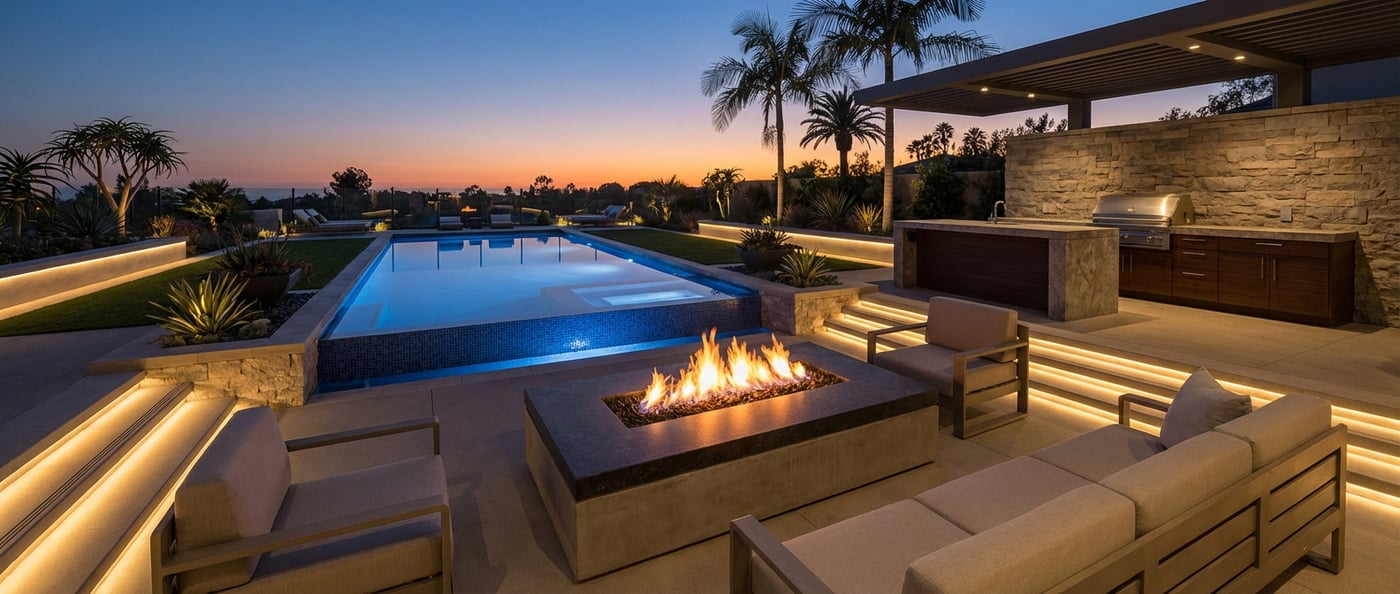
A village that still feels like one
Del Mar is small on purpose. You can walk from a house on Stratford Court down Fifteenth, past the hedge-lined lots and the jacarandas, and be on the sand before the coffee goes cold. The village is 1.8 square miles and it behaves like it — two stoplights, a post office everyone actually uses, a farmers’ market on Saturday that is mostly people who live within a ten-minute walk of it.
A Del Mar yard sits inside that rhythm. The morning is marine layer and the soft grey light off the bluff. By ten the fog has burned back and the ocean reads as a long horizontal line through whatever you have framed it with — a hedge, a window of the house, a gap in the Monterey cypresses. Mid-afternoon the light gets flat and warm, the kind of light Southern California photographers drive two hours for. In July the horse track a mile north runs and the village quietly fills with a wave of people who will never find your street.
A homeowner in Del Mar is usually not trying to make the yard look bigger than it is. A village lot is what it is. The work is to make it feel composed — a morning coffee seat that catches the east light, a dining table sized for six not twelve, a small lawn or planted court that reads as deliberate rather than left over. The neighbors will notice. Del Mar notices quietly.
The property profile — three Del Mars
Del Mar is three distinct markets stacked inside one zip code, and the yard strategy is not the same across them.
Del Mar Village sits west of Camino del Mar, bounded by the bluff on one side and Crest Canyon on the other. Lots are small — 0.1 to 0.2 acres is typical — and many of the houses are historic or historically adjacent, with the village’s specific mid-century and cottage vernaculars intact. The design challenge is restraint. On a 5,000-square-foot lot, one well-scaled outdoor room is the program; two is a crowd.
Del Mar Heights runs east of Interstate 5 along the mesa. Lots are larger, 0.2 to 0.5 acres, and many are view parcels — the ocean to the west over the valley, or the lagoon and the hills to the east. Retaining, terracing, and the geometry of the sight line to the view are the core conversation.
Del Mar Beach Colony is the ultra-premium coastal strip — small lots, some on the sand, most within a block of it, and a price per square foot that is among the highest in the county. The build quality the neighborhood expects is uncompromising; the permit path is the most involved in the village. Scope here is rarely about size. It is about finish, material, and the quiet authority of the detail.
Soil, salt, and the slope of the ground
The ground under Del Mar is not one thing. On the bluff-side parcels — the west side of the village and the ocean edge of the Beach Colony — the soil reads as sandy and coastal, which drains fast but carries the structural conversation of bluff stability. Any work near a bluff edge or on a slope feeding the bluff has to be designed with setbacks and drainage that respect what the bluff is already doing. Move a few blocks inland, particularly on the Heights side of I-5, and the soil shifts to a clay-heavy profile that expands when wet and shrinks when dry. A patio detailed for sand will not hold on clay, and a patio detailed for clay is over-built on sand.
Salt air is present everywhere in the village and pronounced in the Colony. Unprotected steel corrodes, soft stone etches, and standard low-voltage fixtures that last a decade inland can fail in three years a block off the sand. We specify for the micro-climate the property actually sits in — marine-grade fasteners, sealed concrete and stone, stainless or bronze where the detail demands metal. Drainage is engineered for the winter rain event, not the Tuesday afternoon.
Permits and jurisdiction — what Del Mar actually requires
Del Mar is its own city. The City of Del Mar Planning Department handles zoning, design review, and the permit path for most exterior work in the village. Plan for a review process that is more involved than the neighboring jurisdictions — Del Mar has a strong local design tradition and the regulations read that way.
The Design Review Board (DRB) reviews exterior changes visible from the public right-of-way. Setbacks, height, material, massing, and sometimes the specific finish of a retaining wall or a fence are inside the board’s scope. For most Del Mar yards, DRB review is part of the schedule, not an exception to it, and the review is iterative — drawings go in, comments come back, drawings revise, a hearing is scheduled.
On any parcel in the Coastal Zone — which covers most of the village west of I-5 and effectively all of the Beach Colony — the California Coastal Commission becomes a second jurisdiction on top of the city. A Coastal Development Permit may be required for hardscape, grading, retaining, or any structure within the coastal setback. The process adds months and requires drawings and narrative prepared to the Commission’s standard.
None of this is a reason to avoid the work. It is a reason to plan the calendar honestly and to work with a builder who runs the process as scope, not as an afterthought.
Design character — coastal, contemporary, Mediterranean
Del Mar has a vernacular. The village reads as coastal cottage at one end of the spectrum and contemporary coastal at the other, with a strong Mediterranean thread running through both — clay tile, hand-trowelled stucco, low-pitched roofs, courtyards that face away from the street. The Heights carries more mid-century and contemporary work; the Beach Colony has produced some of the region’s most photographed contemporary houses.
The through-line is restraint. Scale matters in Del Mar more than in any other North County market. A massive outdoor kitchen on a 6,000-square-foot village lot fights the architecture and the neighborhood both. The yards that read as belonging tend to do a few things very well — a single composed patio, a hedge or wall that frames it, a tree that was chosen for what it will do in fifteen years rather than what it looks like at the nursery, lighting that disappears by day and is unmissable at night.
New work in Del Mar either honors the village vocabulary or fights it. The honoring path is quiet — proportion first, material second, species selection and finish third. The fighting path shows immediately and keeps showing every time someone turns off Coast Boulevard into a driveway. We have a strong bias toward the first path, and we write the design brief around it.
Where San Diego Landscape Remodeling fits in Del Mar
We run full outdoor remodels across all three Del Mars — the village, the Heights, and the Beach Colony. Design Review Board submittals and, where the parcel requires it, California Coastal Commission permitting are inside our scope, not a subcontracted unknown. We prepare the drawings, write the narrative, respond to comments, and sit through the hearings. You sign. We do the walking.
Both founders are on every Del Mar project personally. Gio or Mike walks your property on the first visit, and one of them is on the job from design through final clean — not an account manager, not a rotating coordinator. Our Field Lead runs the day-to-day on the ground; he has been building at the high end for twenty-five years. Del Mar is a village where craft is noticed, and the crew that shows up needs to be the crew that can earn the notice.
Every project we build in Del Mar is enrolled in The 10-Month Walk-Through. Ten months after completion — through a wet winter, a hot September, and the first real salt load the space will carry — we come back and inspect every square foot of our work with you. Anything that needs attention gets attention. No invoice. On coastal parcels especially, ten months is when the climate has told us everything it is going to tell us about the build.
We are not the firm to call if you need someone on your property by Thursday. We are planned months ahead and executed by a single crew. That is the product.
Services we offer in Del Mar
Every service below is available as a standalone scope on the right project, and as a coordinated line inside a full remodel.
- Full backyard remodels — the hero of what we do. One plan, one crew, the entire outdoor footprint.
- Outdoor kitchens and BBQ islands — scaled honestly to Del Mar lots, detailed for salt-air exposure.
- Patios and hardscape design — paver, concrete, and stone, detailed to the ground profile of your parcel.
- Fire pits and fireplaces — gas, wood, or hybrid, sited for the village wind pattern.
- Pergolas and shade structures — engineered, permitted, and specified for coastal durability.
- Retaining walls and seating walls — the core structural conversation on Heights view lots.
- Artificial turf installation — where the program calls for year-round green without irrigation.
- Landscape lighting — marine-grade, zoned, wired as part of the build.
- Pool decks and poolside hardscape — coordinated with the deck structure and the coping detail.
- Drainage and grading — the conversation that decides whether the rest of the work holds.
Frequently asked
How long does Design Review Board review take in Del Mar?
Plan for several months from drawing submission to a discretionary-review hearing, and longer if the project is substantial or visible enough to draw comment. Simple projects that meet the ministerial-review criteria can move faster. We scope DRB review into the calendar at the proposal stage so the date we give you for construction start is the date we are actually building against. The City of Del Mar Planning Department publishes the current submittal requirements and hearing schedule.
My village lot is small. What does restraint actually look like?
One well-scaled outdoor room is the program. On a 5,000-square-foot lot, that usually means a composed patio with a dining table for six, a planted edge that functions as privacy, a single structure if the architecture supports one, and lighting. What it does not mean is a full kitchen, a separate lounge zone, a fire feature, and a lawn crammed into the same footprint. Del Mar village lots reward editing. The design decisions we make on the front end are largely about what to take out.
We are on a bluff lot. How do you handle drainage and stability?
Carefully, and with a civil or geotechnical engineer when the property asks for one. Bluff-adjacent work is as much about where water goes as about what the patio looks like. We design surface and subsurface drainage to move the winter rain event away from the bluff edge, we detail any retaining to the soil profile we are actually building into, and we coordinate with the city and, where the setback requires it, the California Coastal Commission. Bluff stability is not a value we negotiate against finish.
Our parcel is in the Coastal Zone. How does that change the project?
It adds a second permitting jurisdiction on top of the city. A Coastal Development Permit from the California Coastal Commission may be required for hardscape, grading, or any structure within the coastal setback. The process typically adds several months and requires drawings, a project narrative, and sometimes biological or geological review. We run it as scope. The calendar is honest about it from the first proposal.
What does a full remodel in the Beach Colony typically cost?
Beach Colony remodels land in the upper tier of our range — most projects fall between $150,000 and $500,000, and a fully-scoped remodel on a premium parcel can exceed that. The drivers are finish level, structural complexity, permitting through both the city and the Coastal Commission, and material specification for the salt-air environment. We do not publish an all-in “start-to-finish” estimate for Del Mar work because the permit path alone varies by parcel; what we publish is an honest proposal once we have walked the property. For a full breakdown across the Village, Heights, and Colony, see our Del Mar remodel cost guide.
We are on a Heights view lot with a grade. How do you approach retaining?
Geometry first. On a view lot, the retaining wall is often the single most important design decision in the yard — it defines the sight line to the view, the usable area at the top of the grade, and the character of the lower terrace. We look at material (concrete, stone, COR-TEN, masonry), height (and whether a single tall wall or a tiered system is structurally and visually right), and drainage behind the wall before we talk about the finish. A retaining system designed for the view reads as architecture. A retaining system designed as an afterthought reads as a wall.
Our house is historic or period-specific. How do you match the character?
We start with the architecture and work outward. On a period village house, material, proportion, and the species of plants we specify are chosen to belong — tile that matches the roof, stucco finish that reads as hand-trowelled, hedges of a species the village was originally planted with. The yard should read as if it had always been there. New work that belongs is almost always quieter than new work that announces itself, and in Del Mar the quiet version is what the market respects.
Do you work with our architect?
Often, yes. If you already have an architect or an interior designer on the project, we collaborate directly with them — they carry the design direction, we carry the build discipline and the material knowledge, and we run one set of drawings through DRB rather than two. If you do not have a designer, our in-house design process handles the program from sketch to photorealistic rendering.
References available on request
We do not publish client testimonials. Out of respect for our clients’ privacy, their homes never become our showroom — instead, we share written references and a detailed photographic record of completed work during your discovery conversation. It is the old-fashioned way to vet a builder, and in a village this small, it is still the best.
When you are ready
If your property is in Del Mar — the village, the Heights, or the Beach Colony — and the scope is serious, we would like to hear about it. A first conversation is thirty minutes, by phone or on your yard, and there is no cost to begin. We will listen, we will tell you what we see on the property and in the permit path, and we will tell you honestly whether we are the right firm for the work. Neighboring markets we also serve include Solana Beach, La Jolla, and Rancho Santa Fe.
Licensed and insured general contractor, operating under Mike’s Class B license — CSLB #1139785. Verify active standing through the CSLB license lookup.