A pool deck in La Jolla carries material requirements that simply do not apply in most other San Diego markets. The salt air is the reason. It travels further inland than most people expect, it loads onto surfaces over years rather than days, and it finds every specification shortcut — the standard hardware, the unsealed stone, the galvanized fastener — and begins to work on it immediately. A pool deck that is not specified for the coastal environment it actually sits in will show the decision within a few years. One that is correctly specified will still look intended a decade in.
The material conversation is the first one. But on bluff lots and in properties near the CCC boundary, it is not the only one.
What Salt Air Does to Standard Specifications
Unprotected carbon steel corrodes in coastal environments faster than anyone who has not built at the coast expects. Standard galvanized hardware — the kind specced appropriately for an Inland Empire project — degrades under sustained salt exposure. Soft natural stone absorbs the salt load and over time begins to spall, stain, and lose the surface integrity that made it look right when it was installed.
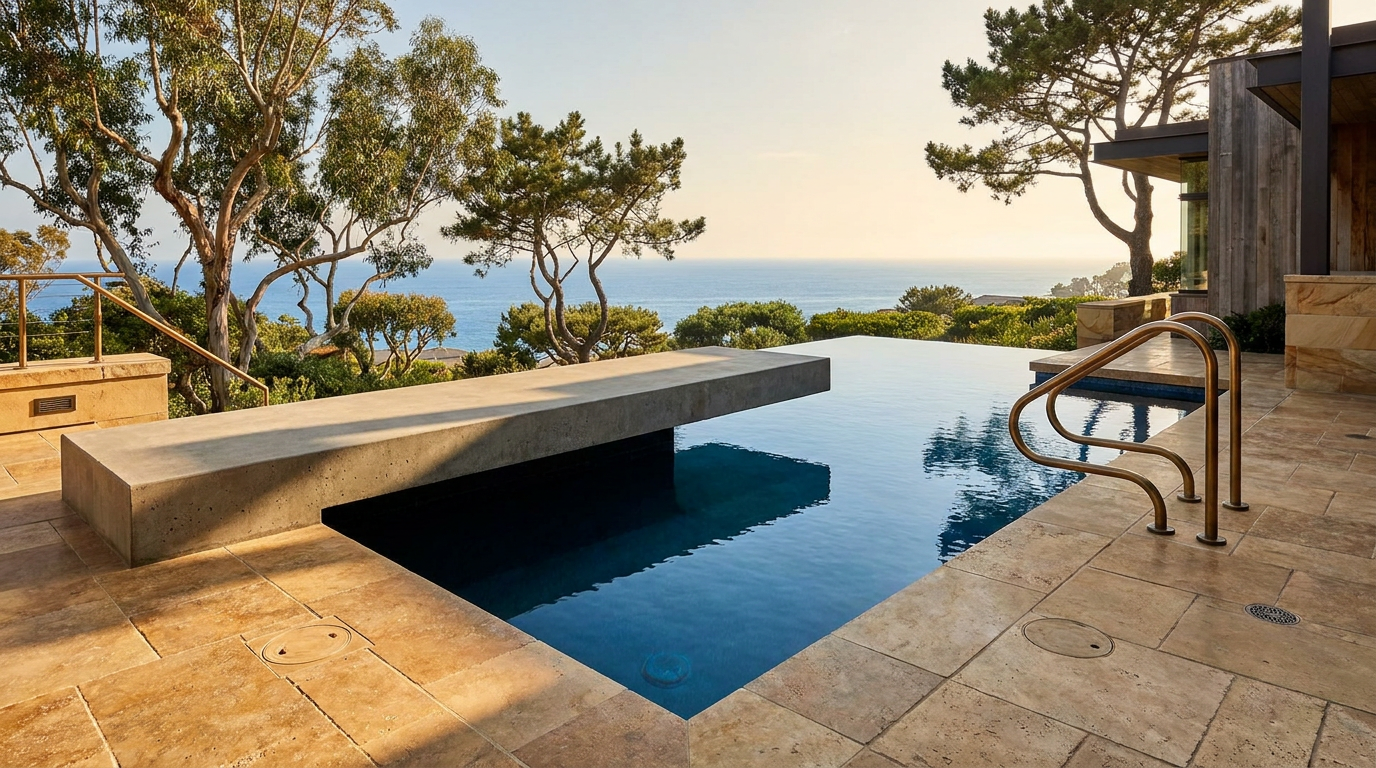
At a pool-deck level, where you have the compound exposure of moisture from the pool and salt from the air, the specification has to account for both. The fasteners in a pool-deck handrail, the clips holding a lighting fixture, the hardware on a built-in privacy screen — these need to be stainless at a grade appropriate for marine exposure. The difference between 304 stainless and 316 stainless is the nickel content that resists chloride corrosion. On a pool deck a block from the Bird Rock waterfront or on the bluff at La Jolla Farms, 316 is not a premium upgrade. It is the correct specification.
Stone and Porcelain: What Actually Holds
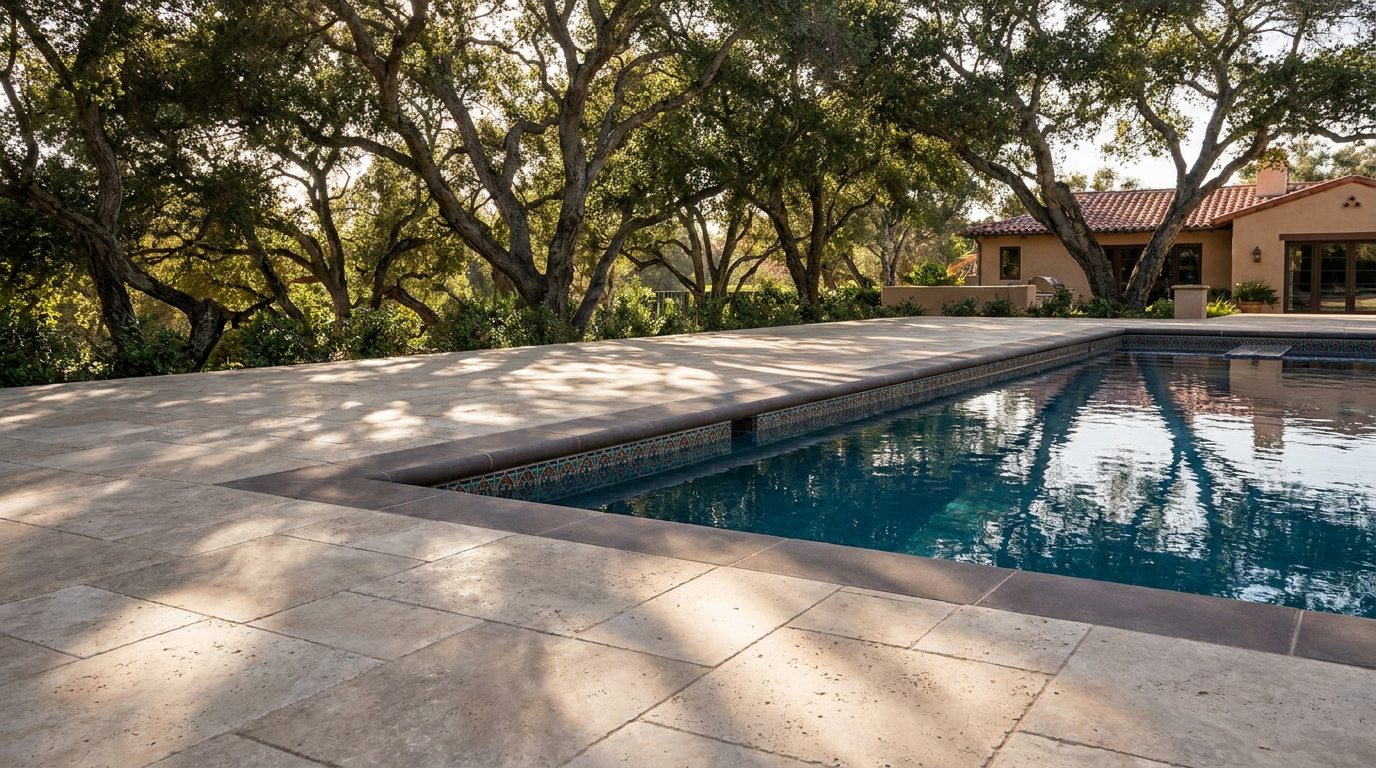
Travertine remains the most common pool-deck material in La Jolla’s premium residential market, and it holds its position for good reasons — it is thermal-appropriate for a pool deck (does not retain heat the way darker stones do), it reads as architecturally correct against most of the Mediterranean and Spanish Revival homes in the Muirlands and Country Club areas, and in a honed or tumbled finish it provides adequate slip resistance for the pool edge.
The specification that separates a La Jolla travertine deck from an average installation is in the sealer and the fill. Open-pore travertine at pool edge in a salt-air environment will absorb the pool chemistry into the pores and begin to stain within two to three seasons. Filled travertine, properly sealed with a penetrating sealer appropriate for exterior coastal use, holds significantly longer. The sealer choice is not cosmetic — it is the specification decision that determines whether the stone looks the same in year eight.
Porcelain pavers are increasingly common on La Jolla Farms and Muirlands pool decks, particularly where the architecture supports a more contemporary reading. The relevant specification is the COF (coefficient of friction) rating, which governs slip resistance at the pool edge when wet. A porcelain with an appropriate wet COF rating for pool-adjacent installation is a correct product. A porcelain selected for its visual quality without confirming the wet COF is a liability waiting to express itself.
Drainage on Bluff Lots: An Engineered Question
The most consequential design decision on a bluff-lot pool deck is not the material. It is where the deck drains.
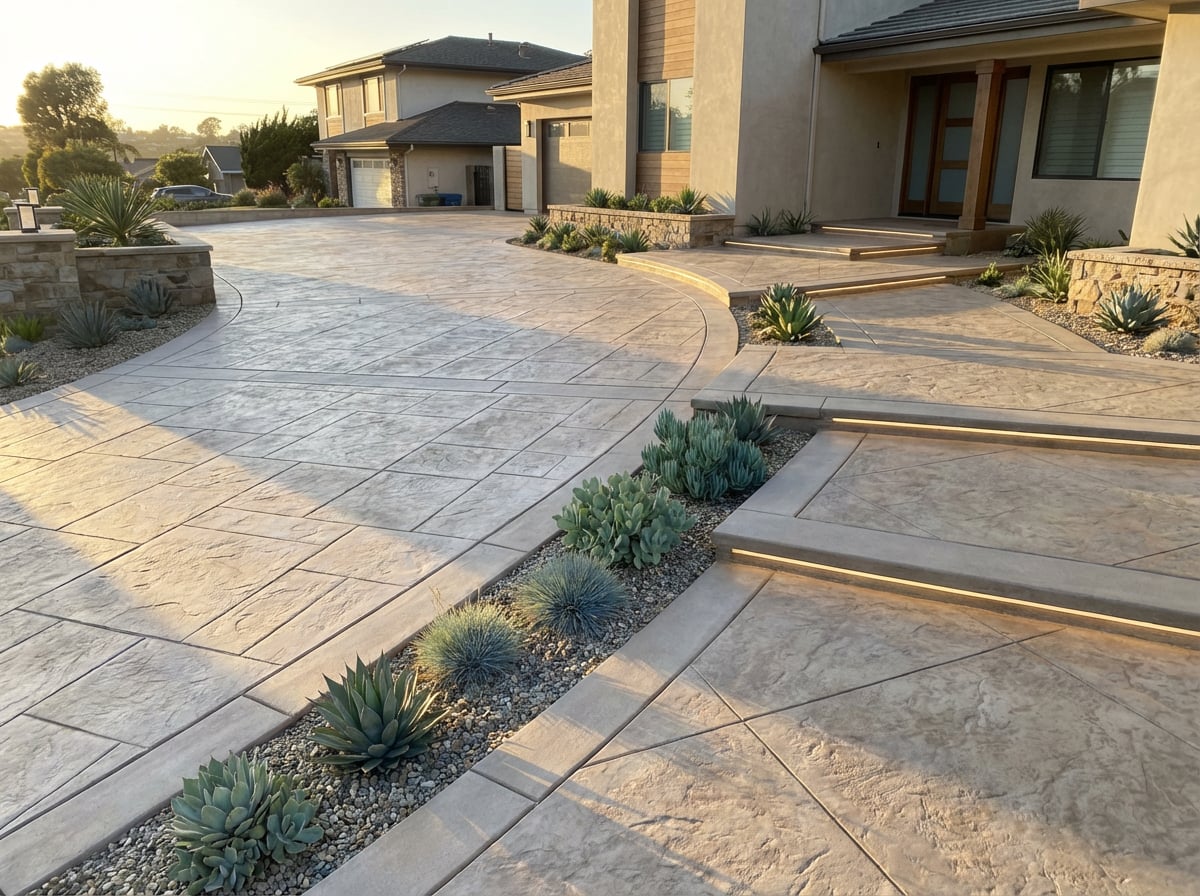
Pool decks shed water — from rain, from pool splash, from hosing down. On an inland lot, that water typically routes to a perimeter drain and into the city storm system. On a bluff-adjacent lot, the drainage routing question carries additional weight: water routed toward the bluff edge accelerates bluff erosion. Over years, the cumulative effect of surface runoff concentrated at the bluff margin changes the stability of the ground that the deck, the pool, and the house sit on.
The correct approach treats deck drainage as engineered scope from the beginning of the design process, not as a field call made during construction. Where does the water go in a three-inch February rain event? Where does it not go? What is the relationship between the surface drainage and the bluff setback? These questions are answered on paper with a civil engineer’s input, not improvised with a slope and a channel drain on the day of the pour.
California Coastal Commission jurisdiction complicates pool-deck drainage on La Jolla Farms parcels specifically. Any grading or drainage work within the coastal setback may require a Coastal Development Permit, and the CCC’s standard for what constitutes an adverse drainage impact on coastal resources is more specific than the Development Services standard for inland parcels. We plan the drainage routing with the CCC overlay in mind from the first site visit, which determines what can be built at what location before any drawings are produced.
La Jolla Farms and the Muirlands as the Primary Markets
The two sub-neighborhoods where pool-deck work reaches the level this post describes are La Jolla Farms and the upper Muirlands. The reasons are complementary: La Jolla Farms has the lot scale, the bluff exposure, and the CCC complexity that makes pool-deck specification a serious design conversation; the Muirlands has the architect-coordinated homes and the architectural vocabulary that makes material selection a design problem with only a few correct answers.
Bird Rock pool decks exist and are done well, but the lot sizes constrain the pool-deck scale and the architectural vocabulary is simpler. The considerations above — particularly the CCC drainage implications and the full-perimeter material board — are most relevant on the larger La Jolla Farms and Muirlands properties.
Cost Range
Pool-deck work in La Jolla ranges from roughly $50,000 for a focused deck replacement on an existing shell in a straightforward location, up to $200,000 when the shell perimeter is large, the drainage is engineered, the CCC review adds design iteration to the schedule, and the material specification runs to high-end natural stone with full-perimeter coping replacement.
The coastal material premium — the upgraded sealer, the 316 stainless hardware, the marine-grade lighting system, the porcelain specification that meets wet COF requirements — is a real cost differential versus a comparable inland project. It is not optional on a correctly built La Jolla pool deck.
Related: Pool Decks & Poolside Hardscape · Drainage & Grading · Projects in La Jolla · Pool Deck Materials in San Diego · Pool Coping Options