The most artistic trade on the property is also the most mathematical
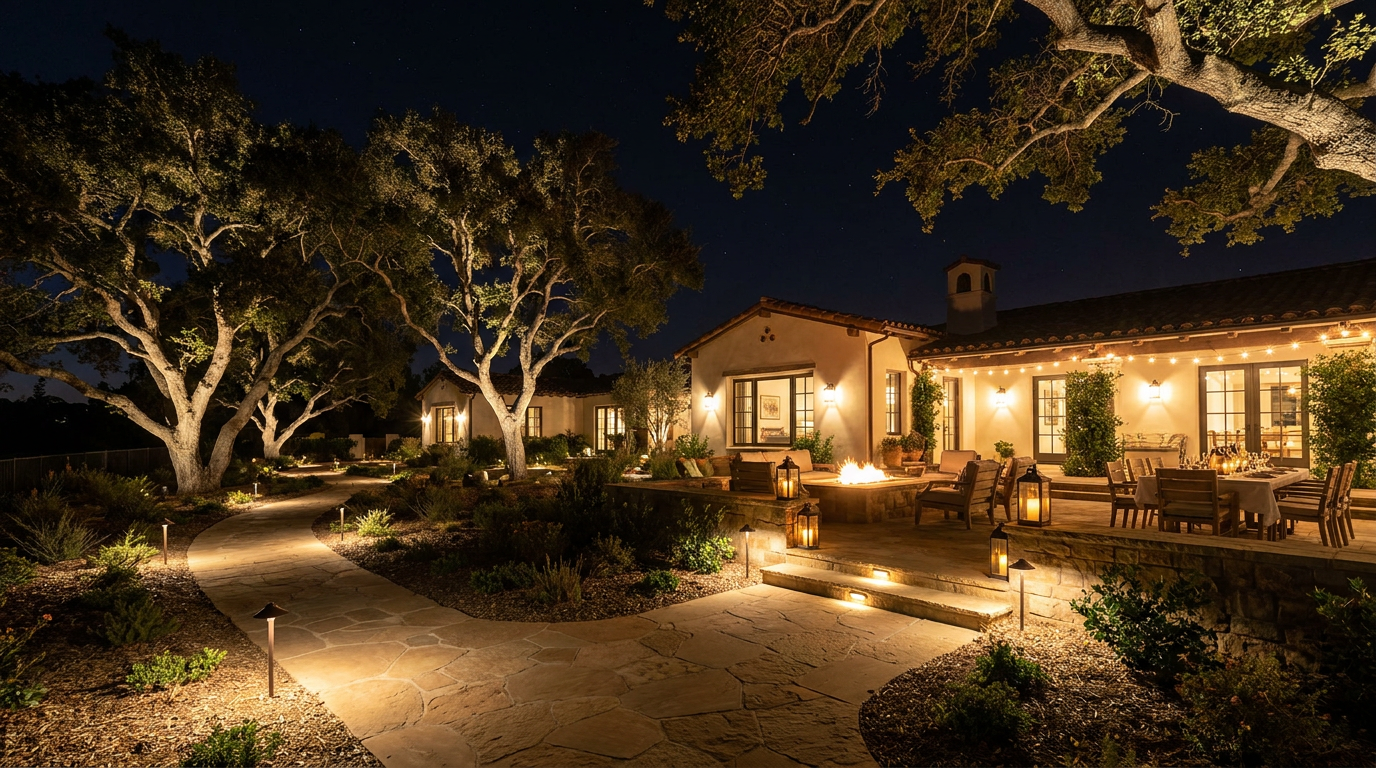
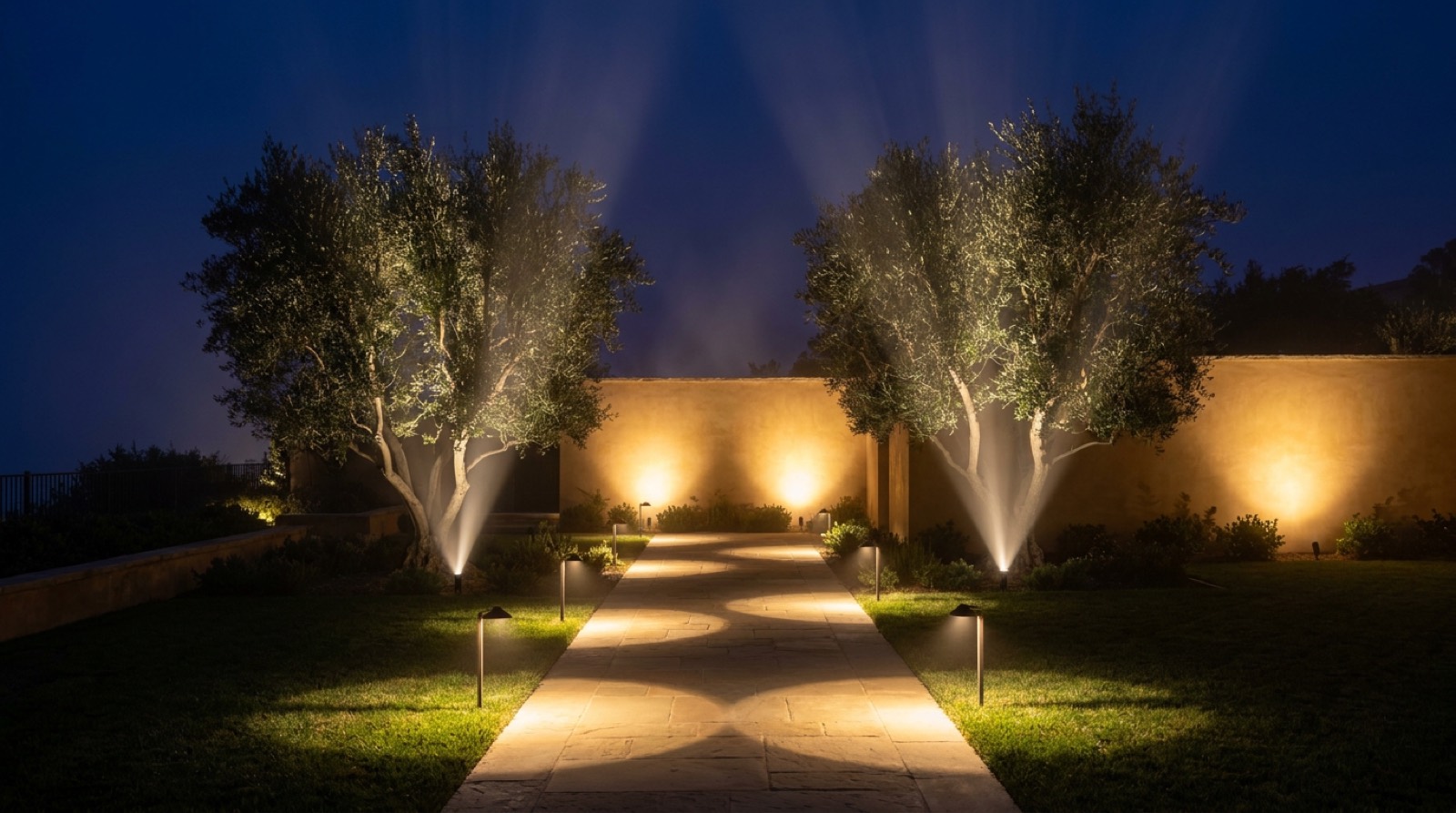
Stand in a beautifully lit garden at night and nothing about it feels like arithmetic. The olive tree glows as if it decided to. The path reads as a rhythm of soft pools. The wall texture comes alive. It feels like taste.
It is taste — sitting on top of math. Every one of those effects is a calculation that either worked or didn’t: a color temperature chosen in kelvin, a beam angle matched to a trunk width, a lumen output matched to a viewing distance, a voltage drop computed down a two-hundred-foot wire run. The romance is real, but it is engineered. This post is about the engineering; its companion piece is about the art.
Kelvin: the one number that sets the mood
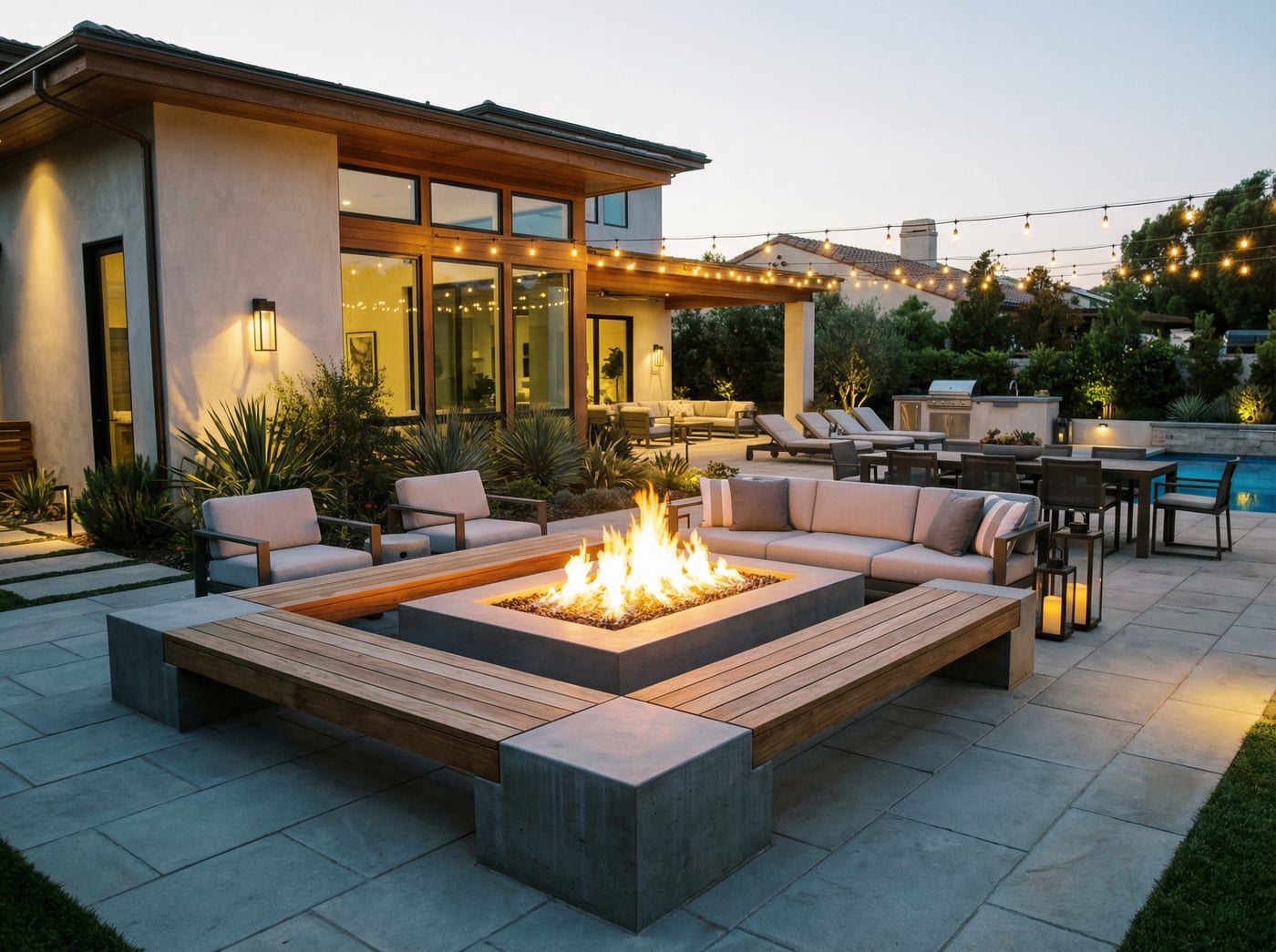
Color temperature is measured in kelvin, and outdoors the argument ends quickly: 2700K, warm white, everywhere. It is the color of firelight and incandescent memory — the temperature at which stone looks expensive, planting looks alive, and skin looks healthy. At 3000K a landscape starts drifting toward showroom; at 4000K it becomes a parking lot.
The discipline is consistency. A single 3000K lamp in a field of 2700K reads as a mistake from fifty feet away — the eye is brutal about color temperature even when the owner can’t name what’s wrong. We spec one temperature across the entire property and never mix. (The exception that proves the rule: moonlighting from high in a tree can run slightly cooler, because real moonlight is cool — and that’s the effect being imitated.)
Beam angle: matching the light to the thing it lights
Every uplight throws a cone, and the cone’s spread is a spec you choose: 15°, 35°, 60°. The math is simple trigonometry — a 15° spot at the base of a palm reaches thirty feet up a slender trunk without spilling; a 35° flood at the same distance wraps a mature olive’s full canopy; a 60° wash covers a garden wall.
Get it wrong and no fixture quality saves you: a narrow spot on a broad oak reads as a hot stripe up the bark, a wide flood on a thin palm wastes most of its light on the neighbor’s fence. We walk the property with a spec sheet and measure — trunk diameter, canopy height, wall length — because the fixture list is derived from the geometry, not from a package.
Lumens and the distance problem
Brightness obeys the inverse square law: double the distance and you need four times the output for the same effect. That’s why a catalog’s “540-lumen uplight” means nothing until you know what it’s aimed at and from how far. A boxwood at four feet wants a fraction of what a canopy at twenty-five feet demands.
The practical craft: light the far thing harder than the near thing feels like it needs, because the eye judges the composition from the terrace, not from the fixture. Distant focal points that match the foreground’s apparent brightness are what make a deep property read as one composed scene instead of a bright rim with a black middle.
Voltage drop: the invisible failure
Low-voltage systems run on 12 volts, and copper wire steals some of it on every foot of the run. Run 150 feet of undersized cable to a group of fixtures and they might receive 9 volts — LEDs dim, shift color, or flicker, and the last fixture on the run performs worse than the first. This is the classic failure of installed-by-the-yard-guy systems, and it is pure arithmetic: load in watts × distance ÷ cable constant. We size wire gauge and split runs so every fixture on the property sees proper voltage — which is also why professional systems are wired in balanced loops and hubs rather than daisy chains.
The transformer: sizing the heart
Add up every fixture’s wattage, then size the transformer so the total load sits at 40–80% of its capacity — big enough for headroom and expansion, small enough to run efficiently. A smart transformer (we spec Luxor and Kichler’s smart units) adds zoning and dimming, which turns the math into scenes: dinner at 40%, party at 70%, midnight at 10%.
None of this appears in the photograph. All of it is why the photograph looks the way it does. On properties in Rancho Santa Fe where runs are long and oaks are protected, the calculation layer is most of the job — the design layer gets the compliments, and that’s exactly how it should be.
Licensed and insured general contractor, operating under Mike’s Class B license — CSLB #1139785.