When a paver driveway starts to heave, sink, spread, or grow weeds through every joint within three years of installation, homeowners almost always blame the pavers. In most cases, the pavers are fine. What failed is everything underneath them — the base, the compaction, the edge restraint, and the drainage — installed by a crew that moved too fast, cut material costs, or simply did not know better.
A correctly installed paver driveway should hold its alignment, its drainage, and its surface quality for twenty to thirty years with basic maintenance. Here is how it gets built when it is done right.
Step 1: Excavation — how deep you actually need to go
The first decision is how much material to remove. This is where most budget installs go wrong, because shallow excavation means less material hauled away and less base rock brought in — both of which save the contractor money at the homeowner’s expense.
For a residential passenger vehicle driveway in stable soil, the minimum excavation depth is typically 10 to 12 inches below finished grade. That accounts for:
- 6–8 inches of compacted aggregate base
- 1 inch of bedding sand
- ~3.5 inches of paver thickness (standard 80mm paver)
For driveways that take heavier loads — RVs, trucks, trailers, equipment — excavation goes deeper: 12 to 14 inches, with 8 to 10 inches of base.
In San Diego’s clay-heavy inland soils — Bonita, La Mesa, El Cajon, Rancho San Diego, parts of East County — the native soil expands when wet and contracts when dry. This seasonal movement is the primary reason driveways built on shallow bases fail. On clay sites, we excavate to a minimum of 12 inches and add a geotextile separation layer between the native soil and the base rock. Without that separation, clay fines migrate upward into the base over time, reducing its structural capacity.
On canyon-adjacent lots and properties with significant slope, excavation also addresses drainage routing — where water will go during the pour and after the driveway is complete.
Step 2: Sub-base material — what goes in the ground
The aggregate base is the structural layer of the entire system. It is also the one homeowners never see after installation, which makes it easy to cut.
The correct material for San Diego driveway base is Class II aggregate base (also called Class 2 base rock or crushed aggregate base). It is a graded mix of crushed rock and fines that compacts into a rigid, interlocking layer. Do not accept recycled concrete as a base substitute for a driveway — it can be appropriate for some applications, but its variability in gradation makes compaction behavior unpredictable.
Depth by application:
| Application | Base depth |
|---|---|
| Residential passenger driveway, stable coastal soil | 6 inches compacted |
| Residential driveway, clay or expansive soil | 7–8 inches compacted |
| Driveway with occasional RV or trailer traffic | 8–10 inches compacted |
| Commercial vehicle loading | 10–12 inches compacted, engineer-specified |
Lift thickness: Base rock cannot be dumped in all at once and compacted as a single mass. It must be placed and compacted in lifts — layers of no more than 4 inches of loose material at a time. Each lift is compacted to 95% modified Proctor density (the standard for driveway construction) before the next lift goes on. A crew that dumps six inches of base and runs a plate compactor over it once is not achieving adequate compaction, regardless of how much equipment noise they make.
Step 3: Geotextile fabric — the layer most installers skip
Between the native soil and the aggregate base, a non-woven geotextile fabric should be placed. Its function is separation — it prevents the fine particles in the native soil from migrating upward into the aggregate base over time.
In stable sandy soils near the coast, skipping this layer is a smaller risk. In San Diego’s inland clay soils, skipping it is a setup for base contamination and long-term settlement. The fabric costs a fraction of a percent of the total project. There is no legitimate reason to leave it out.
Step 4: Compaction — what it actually means and how to verify it
Compaction is the step that separates a base that performs from one that settles. The goal is to remove air voids from the aggregate until the particles are interlocked and the layer behaves as a rigid mass.
The right equipment:
- A plate compactor (vibratory plate) is the minimum for driveways. A small jumping jack (rammer) is appropriate for trenches and confined spaces but cannot cover a driveway field effectively.
- A ride-on roller or double-drum vibratory roller is appropriate for larger areas or high-load applications and achieves more consistent compaction than a walk-behind plate.
How to evaluate a base that has been compacted correctly:
- The surface should not deflect noticeably under foot traffic
- A steel rod driven by hand should not penetrate more than an inch or two
- The surface should be relatively smooth and stable, not loose or rutted by foot traffic
A contractor who cannot tell you what equipment they use for compaction, or who does it in a single pass, is not achieving the specification.
Step 5: Bedding sand — the setting layer
Over the compacted base, a 1-inch layer of coarse bedding sand is screeded to a uniform depth. This is the layer the pavers sit in — it allows for fine adjustment of level and provides a seat for each paver to key into during final compaction.
Bedding sand is not structural. A common mistake is using too much bedding sand — 2 or 3 inches — to compensate for an uneven base. Thick bedding sand is unstable and allows pavers to shift under load. The base must be graded correctly. The bedding sand does the fine-tuning.
Correct material: Coarse concrete sand (ASTM C33) or manufactured angular sand. Do not use fine play sand or beach sand — the round particles do not interlock and the layer remains unstable.
Step 6: Edge restraint — why pavers spread and how to stop it
Edge restraint is the framing that holds the entire paver field in place. Without it, pavers at the perimeter of the driveway gradually migrate outward under vehicle load, which opens joints throughout the field, allows the bedding sand to shift, and accelerates the failure of the entire installation.
Types of edge restraint:
Plastic snap-edge restraint — the most common product in the industry. Interlocking sections of rigid plastic spiked into the base with 10-inch steel spikes on 12-inch centers. Appropriate for pedestrian applications and light residential driveways on stable soil. On driveways with regular vehicle loading, particularly at the curb cut where vehicles turn and push laterally, plastic edge restraint can flex and fail.
Aluminum edge restraint — stronger than plastic, appropriate for driveways. Products like Snap Edge by Ames Research and Permaloc Edge Restraint provide rigid containment spiked at close intervals. Correct installation requires spikes no more than 12 inches apart in straight sections and 6 inches apart at curves.
Concrete border or soldier course set in concrete — the highest-performing edge condition for driveways. A row of pavers (or a poured concrete border) set in a concrete bed along the perimeter creates a rigid structural edge that will not flex or migrate regardless of load. This is what we specify on high-load driveways, on properties with heavy vehicles, and wherever the edge of the driveway is exposed to lateral tire forces from turning maneuvers.
What correct spiking looks like: Every 10–12 inches in straight runs, every 6 inches at curves, always into compacted base rock (not into loose material). Spikes that go into uncompacted material or that are placed too far apart will pull out under load. The edge restraint should be fully embedded — not sitting proud of the base, not bent or angled.
Step 7: Paver quality — what the number on the spec sheet means
Not all concrete pavers perform the same. The difference between a commodity paver and a premium product is visible within five to ten years on a driveway, particularly in San Diego’s coastal UV exposure and the thermal cycling of inland valley climates.
Key specifications to ask about:
Compressive strength (PSI)
The minimum compressive strength for a concrete paver used in vehicular applications under ASTM C936 is 8,000 PSI. Most premium paver products exceed this — Belgard’s vehicular-rated products run 8,500–10,000 PSI, and some performance lines exceed 12,000 PSI.
Budget pavers sometimes come in at 6,000–7,000 PSI. They are not rated for vehicular load. Under a decade of driveway use, the difference shows as surface spalling, chipping at edges, and cracking at paver corners under vehicle tires.
Water absorption rate
ASTM C936 limits water absorption to a maximum of 5% for vehicular-use pavers. Lower is better. Pavers with high absorption rates in coastal San Diego will absorb moisture, which weakens the concrete matrix and increases efflorescence (the white mineral bloom that appears on paver surfaces). Near the coast, specify pavers with absorption rates under 3%.
Dimensional consistency
Premium pavers are manufactured to tighter tolerances — more consistent thickness, squarer edges, more uniform face texture. Inconsistent thickness makes achieving a flat, level surface significantly harder. The bedding sand compensates to a degree, but a paver that varies 3/16 inch in thickness within a batch produces visible lippage (edge height differences between adjacent pavers) that no amount of screeding corrects.
Brands and what they mean in practice
Belgard — the most widely specified premium brand in Southern California. Strong dimensional consistency, broad design range, reliable compressive strength across their product lines. Their Mega-Bergerac and Mega-Arbel products are well-suited to San Diego coastal and inland conditions.
Pavestone — a strong performer at the mid-to-premium tier. Their Rumble Stone and Slate Step products have a long installation record in San Diego County.
EP Henry — well-regarded for vehicular applications, good surface texture, appropriate for high-load driveways.
Big box store pavers — the products sold at Home Depot and Lowe’s under house brands or low-cost labels are not the same specification as commercial-grade pavers. Their compressive strength and absorption rates are often not published by the manufacturer, and dimensional consistency is notably lower. They are appropriate for light garden paths and borders. They are not appropriate for driveways.
Step 8: Laying pattern — which one to specify for a driveway
The laying pattern is not just aesthetic. On a driveway, the herringbone pattern at 45 or 90 degrees provides interlocking resistance to the directional forces of vehicle braking and turning. Running bond (straight rows) is easier to lay but provides less rotational resistance under load.
For driveways, specify:
- Herringbone (45° or 90°) — the strongest pattern for vehicular applications. Required by many engineers for commercial paving; strongly preferred for residential driveways.
- Flemish or basket weave — acceptable for residential driveways with normal vehicle loads.
- Running bond — adequate for pedestrian areas and patios. Not the preferred choice for driveways.
At the curb cut — where vehicles drive over the paved edge and the forces are highest — a soldier course or border of pavers perpendicular to the field provides additional structural resistance.
Step 9: Polymeric sand — the final lock
After pavers are set and before the field is final-compacted, the joints are filled with polymeric sand: a blend of fine aggregate and a polymer binder that activates with water and cures to a semi-rigid joint. It inhibits weed germination, resists ant excavation, and prevents joint sand from washing out in rain events.
What correct polymeric sand installation looks like:
- Sweep dry polymeric sand into joints until filled flush with paver surface
- Compact the paver field with a plate compactor (with a protective pad on the plate to avoid scarring the paver face)
- Blow off excess sand from paver surfaces with a leaf blower
- Apply water with a fine mist — saturate the joints without flooding or displacing the sand
- Allow to cure per manufacturer specification before vehicle traffic
What goes wrong: Applying polymeric sand when rain is imminent causes premature activation before the joints are properly filled. Allowing water to pond during activation washes sand out of joints. Skipping the final plate compaction means the pavers are not fully keyed into the bedding sand and the joints are not at final density.
Polymeric sand has a service life of approximately five to eight years in San Diego conditions before it breaks down and needs refreshing. This is normal maintenance, not a defect.
What a correctly installed paver driveway looks like after ten years
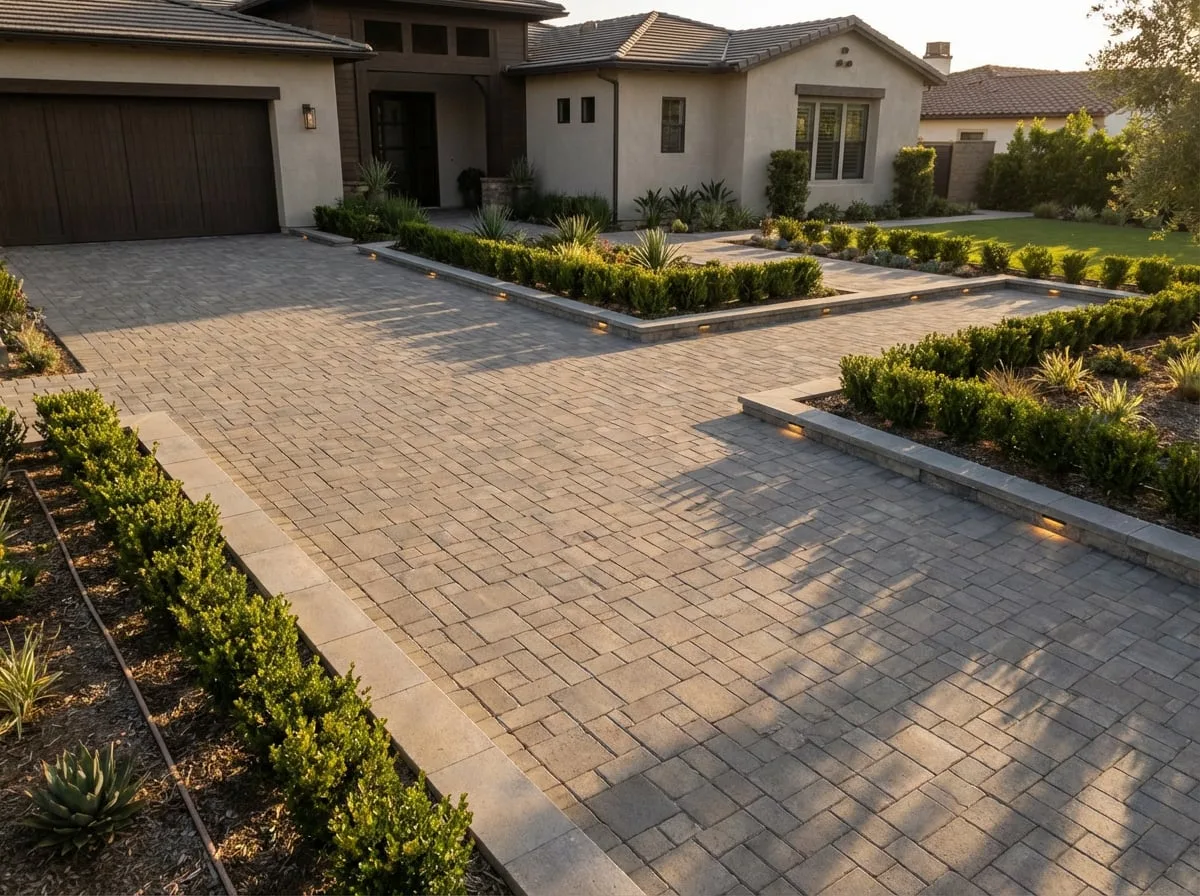
A driveway built to the specification above — proper excavation, Class II base in compacted lifts, geotextile separation, coarse bedding sand, rigid edge restraint, premium pavers, herringbone pattern, polymeric sand — should look nearly identical at ten years as it did at one year. Individual pavers may need occasional resetting if root intrusion or unusual point loads cause settlement in isolated areas. The polymeric sand will need refreshing. The field itself should be tight, level, and draining correctly.
A driveway built on four inches of base with plastic edge restraint, builder-grade pavers in running bond, and polymeric sand swept in by hand without plate compaction will show you the difference within three to five wet seasons.
How to evaluate a contractor’s installation spec
When you receive a proposal for a paver driveway, the line items that reveal the quality of the installation are:
- Excavation depth — ask for the number, not a generalization
- Base material and depth — Class II aggregate, compacted in lifts, specific depth
- Geotextile — is it included?
- Edge restraint type — plastic, aluminum, or concrete border
- Paver brand and product name — look it up; verify the PSI spec
- Laying pattern — herringbone for a driveway
- Joint sand type — polymeric or standard
- Compaction equipment — what plate compactor or roller
A contractor who cannot answer these questions specifically is building the driveway the way they were taught, not the way the specification requires. The questions are not adversarial — they are the standard of care for a project that costs tens of thousands of dollars and is going to live on your property for decades.
Related: Patios & Hardscape · Drainage & Grading · Concrete vs. Paver Driveways in San Diego · Best Driveway Installer in San Diego · Pavers vs. Concrete in San Diego