Both concrete and pavers make durable, attractive driveways in San Diego. The question is not which material is better in the abstract — it is which one fits your property, your architecture, your maintenance tolerance, and the way your soil behaves. Get that answer right and either material will serve you for decades. Get it wrong and you will be looking at repairs far sooner than you should.
Here is the honest breakdown.
Concrete driveways in San Diego
Poured concrete is the baseline comparison point because most homeowners have one — or have replaced one. It is a single monolithic surface, finished smooth or with a broom texture, and when it is done correctly it is genuinely low maintenance for the first fifteen to twenty years.
What concrete does well
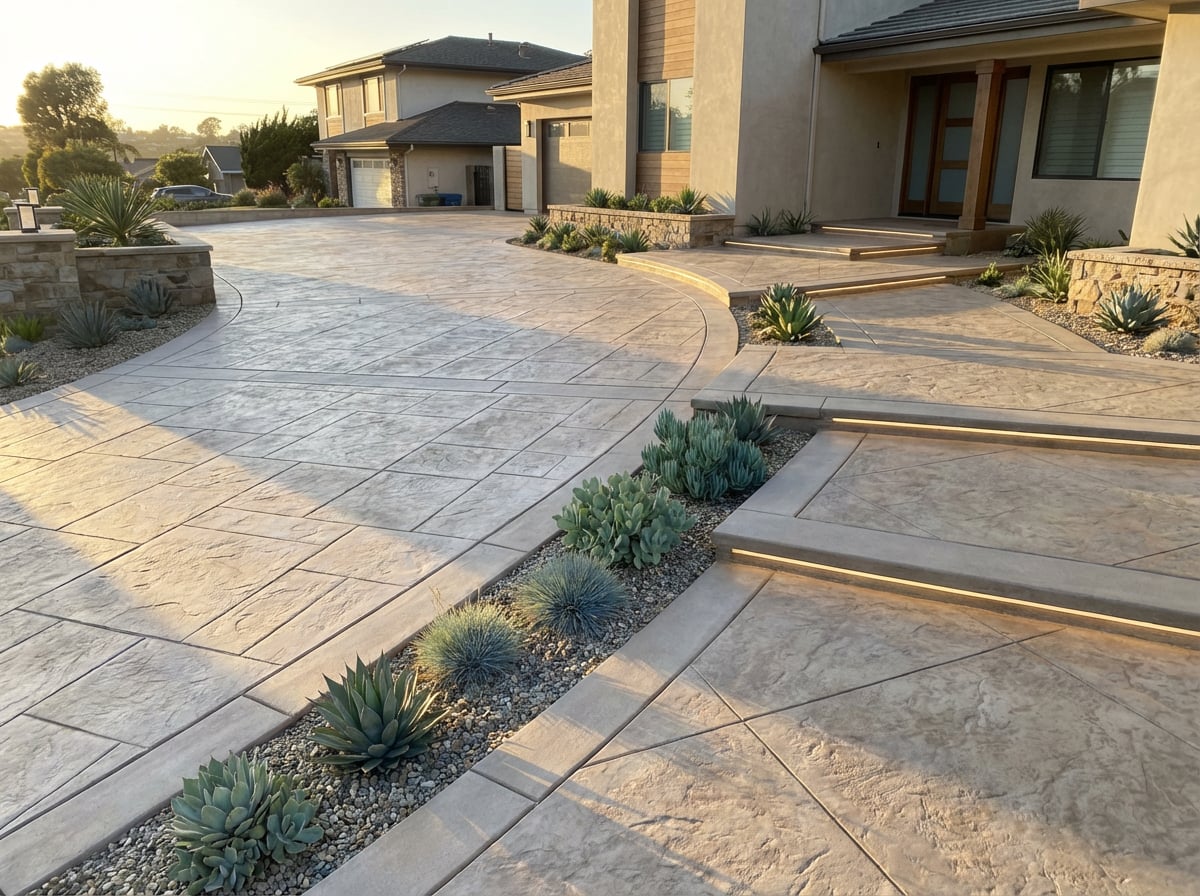
Cost: Poured concrete is typically less expensive per square foot than pavers for a comparable installation. On a standard two-car driveway in San Diego County, expect concrete to run $12–$22 per square foot installed, depending on thickness, finish, and the complexity of the pour. Stamped concrete — which adds color, texture, and pattern — runs $18–$35 per square foot and substantially closes the visual gap with pavers.
Cleanability: A flat concrete surface is easy to pressure wash. Oil stains are more problematic on unsealed concrete than on properly sealed pavers, but the maintenance rhythm is simpler.
Structural uniformity: For driveways with heavy vehicle loads — RVs, trucks, equipment — a well-engineered concrete slab distributes load effectively.
Where concrete falls short
Cracking: Concrete cracks. It is not a defect — it is physics. Concrete expands and contracts with temperature, and without properly placed control joints, that movement expresses itself as cracks across the field. In San Diego’s clay-heavy inland soils, seasonal ground movement accelerates this. Concrete driveways near La Mesa, El Cajon, Bonita, and the East County valleys often show stress cracking within five to ten years when the base is under-built.
Repair difficulty: When a section cracks or settles, patching poured concrete is obvious. The patch never matches the surrounding surface. For a clean repair, you typically need to break out and repour the affected section — which is not a small job.
Limited repairability: You cannot lift and reset a concrete slab the way you can an individual paver. Once a section is compromised, the options are patch (visible), overlay (temporary), or full removal and repour (expensive).
Paver driveways in San Diego
Concrete pavers — individual units set over a compacted aggregate base — perform differently from poured concrete in almost every category. The installation is more labor-intensive and the upfront cost is higher, but the long-term story is different.
What pavers do well
Movement tolerance: Because pavers are individual units set with sand-filled joints, ground movement and thermal expansion do not accumulate into a single crack across the field. Each paver shifts slightly and independently. The result is that well-installed paver driveways in San Diego’s clay soils outperform concrete over a fifteen-to-twenty-year horizon.
Repairability: A settled or damaged section of a paver driveway can be lifted, the base re-compacted, and the pavers reset to look exactly as they did on installation day. No patching, no color mismatch, no visible repair. This is a significant long-term advantage on properties where tree roots, soil movement, or utility access might require intervention.
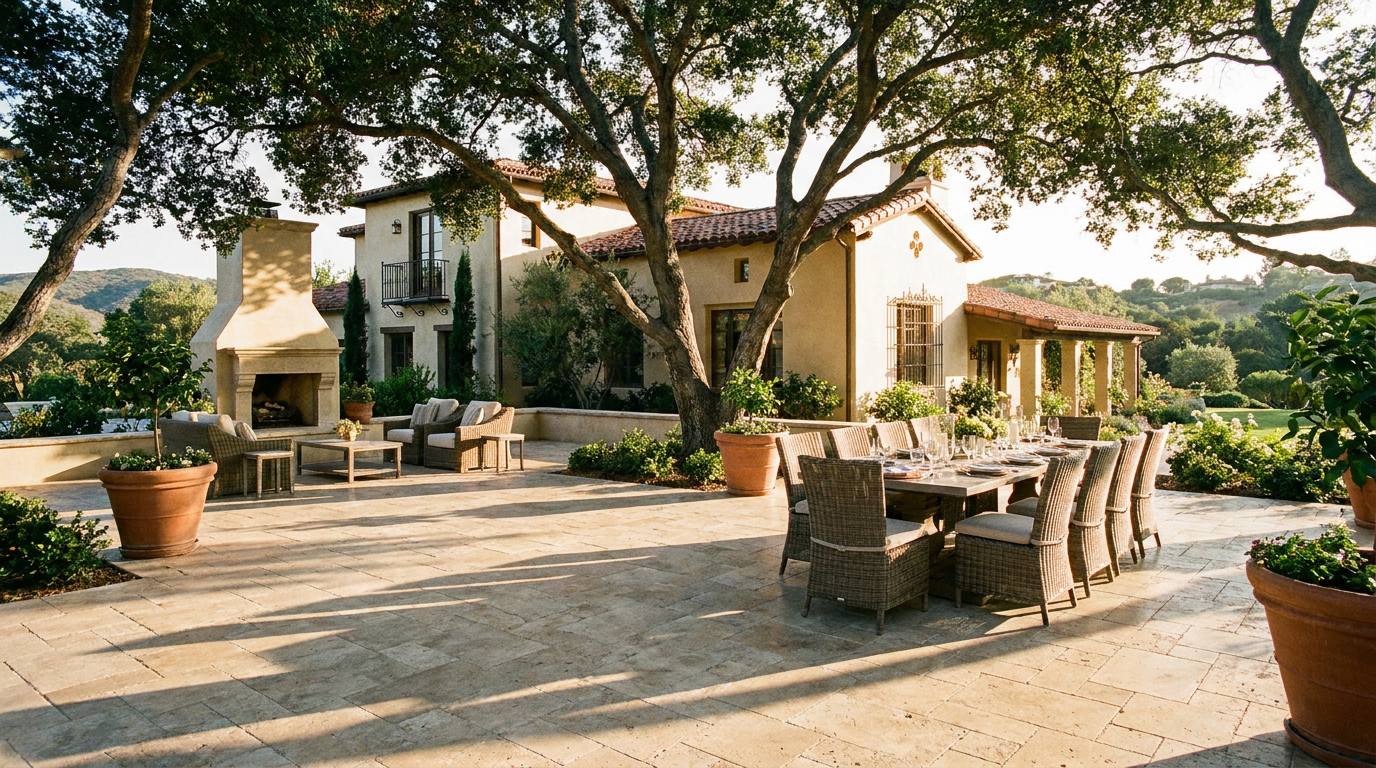
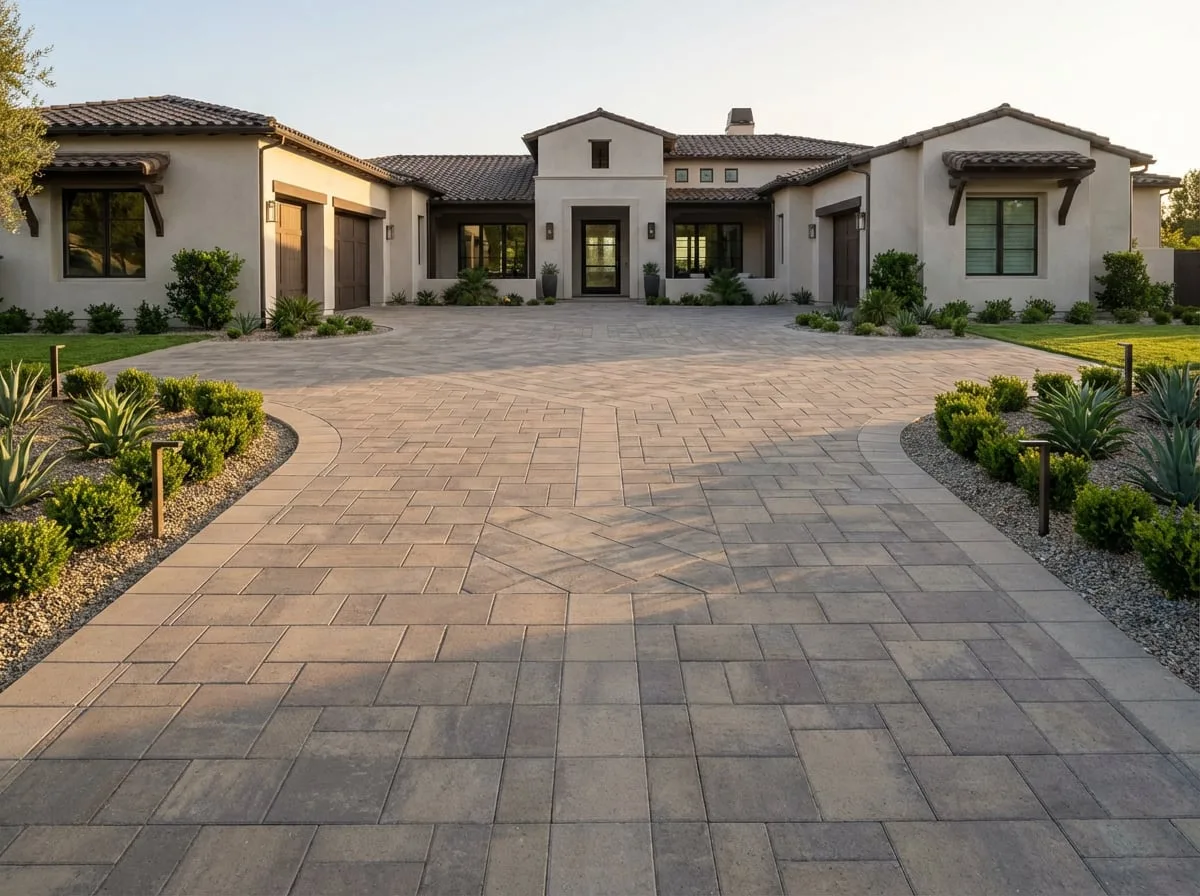
Curb appeal and design flexibility: Pavers come in a range of sizes, colors, profiles, and laying patterns — running bond, herringbone, basket weave, Flemish, and custom combinations. A herringbone paver driveway in a charcoal or sandstone tone reads as architecture. It adds to the property in a way that stamped concrete approximates but does not quite match.
Drainage: Permeable paver systems — pavers set with wider joints filled with aggregate rather than polymeric sand — allow water to percolate through the surface. In San Diego County stormwater compliance zones, permeable pavers can satisfy low-impact development requirements that poured concrete cannot.
Where pavers cost more
Upfront installation: A well-installed paver driveway in San Diego runs $22–$45 per square foot, depending on paver selection, pattern complexity, and base depth requirements. Premium natural stone pavers — travertine, bluestone, quartzite — run higher. The installation is more labor-intensive than concrete because of the base prep, the setting bed, and the hand-placement of each unit.
Joint maintenance: Polymeric sand joints — the material that locks paver joints and resists weed germination — eventually break down and need to be refreshed. On a typical San Diego driveway, this is a once-every-five-to-eight-year maintenance item. It is not expensive, but it is a real maintenance task that concrete does not require.
The base work that determines both
Here is the decision that matters more than the surface material: the base.
A concrete driveway over four inches of well-compacted Class II base rock on stable soil will last. A concrete driveway over a shallow, inadequately compacted base will crack within five years regardless of who poured it. The same logic applies to pavers — the sand-set surface only performs as well as what is underneath it.
In San Diego County, the variance in soil behavior between the coast and the inland valleys is significant. Coastal soils — La Jolla, Del Mar, Solana Beach — tend to be stable and sandy. East County and the inland valleys — Bonita, La Mesa, El Cajon, Rancho San Diego — often have expansive clay soils that move seasonally. Canyon-adjacent properties add drainage and bedrock variables. A contractor who specifies the same base depth for every driveway regardless of soil type is not doing the engineering.
We do a visual assessment of soil conditions on every proposal and design the base accordingly. On clay-heavy sites, six to eight inches of compacted base is a minimum — not four, which is what many budget bids will quote you.
Climate and coastal considerations
San Diego’s mild, semi-arid climate is generally favorable for outdoor hardscape. A few specifics worth knowing:
- Coastal salt air: Properties within a mile of the coast should specify pavers with low water absorption rates. Belgard’s Mega-Bergerac and EP Henry’s concrete pavers both perform well in coastal exposure.
- UV stability: Lighter-colored concrete can yellow or bleach with direct sun exposure over years. Sealed pavers hold color better, though resealing is a maintenance task.
- Freeze-thaw: Not a concern in San Diego. This eliminates one of the main reasons pavers outperform concrete in northern climates, though it does not change the movement-tolerance advantage pavers carry in clay soils.
What to expect at different budgets
$15,000–$30,000
A two-car concrete driveway with a quality pour, proper control joints, and broom finish. Or a smaller paver driveway (single-car width, approximately 400–500 square feet) in a mid-grade concrete paver. Done correctly, either will hold up.
$30,000–$55,000
A two-car paver driveway in quality concrete pavers, with proper base depth, edge restraint, polymeric sand joints, and a coordinated apron or walkway to match. This is the range where the driveway starts to become a design feature rather than just a functional surface.
$55,000–$90,000+
Premium materials — large-format porcelain, natural travertine, or custom-blend concrete pavers — with detailed patterns, integrated drainage, and full coordination with the front yard hardscape and landscaping. These projects typically involve multiple trades and a cohesive design plan.
The honest answer
If your priority is lowest upfront cost and you have stable soil: concrete is a reasonable choice, done well.
If your priority is long-term performance, repairability, and curb appeal: pavers are worth the premium.
If you are on a canyon lot, a clay-heavy inland site, or a property where tree roots or utility access are a realistic future concern: pavers are strongly preferred, because the ability to lift and reset individual units rather than patch or demolish is a practical advantage you will eventually use.
Either way, the material decision is secondary to the base work, the drainage design, and who is doing the installation. A well-built concrete driveway outlasts a poorly built paver one every time.
Related: Patios & Hardscape · Drainage & Grading · Full Backyard Remodels · Pavers vs. Concrete in San Diego · Serving La Mesa · Serving Bonita · Serving Rancho Santa Fe