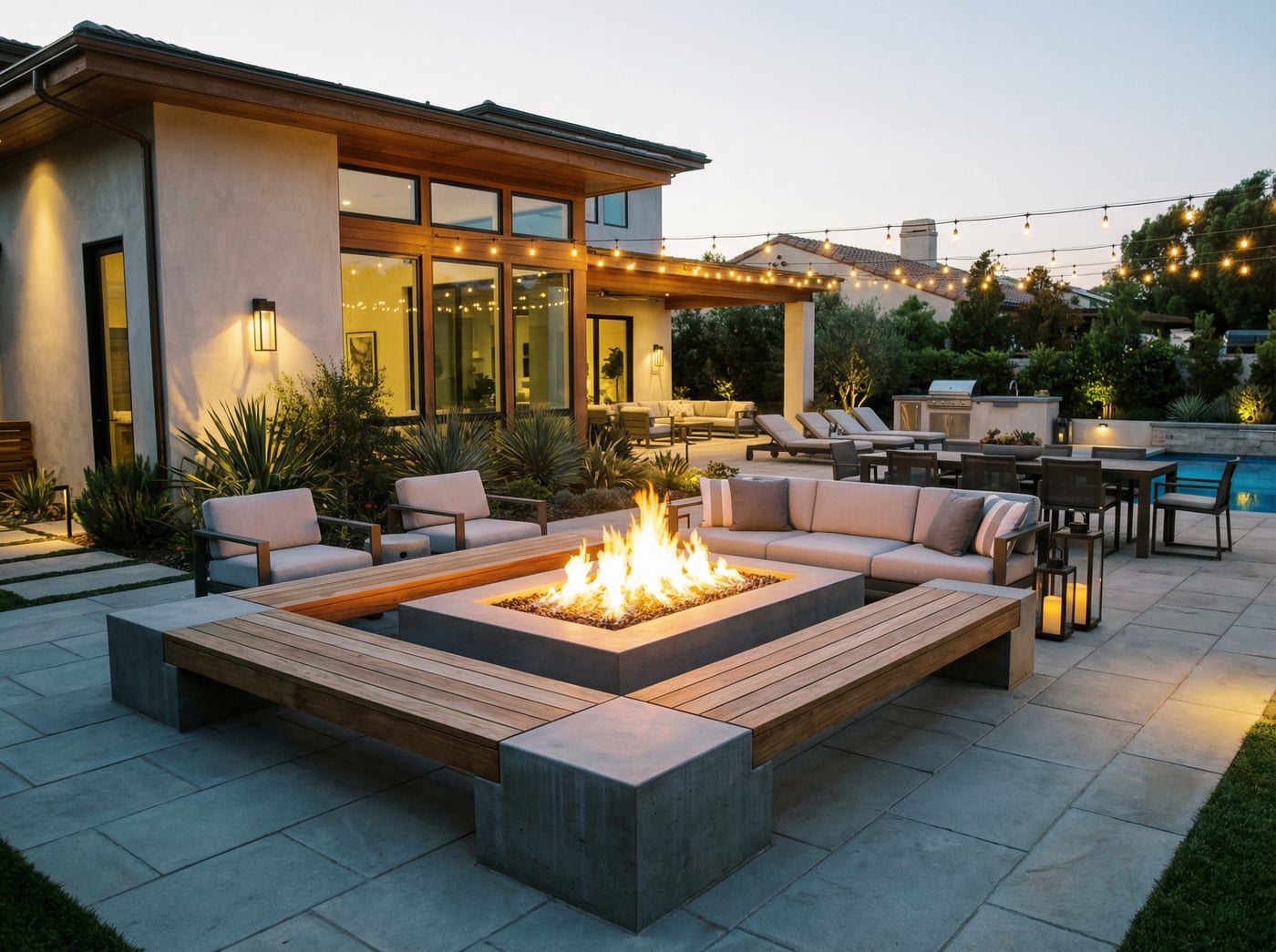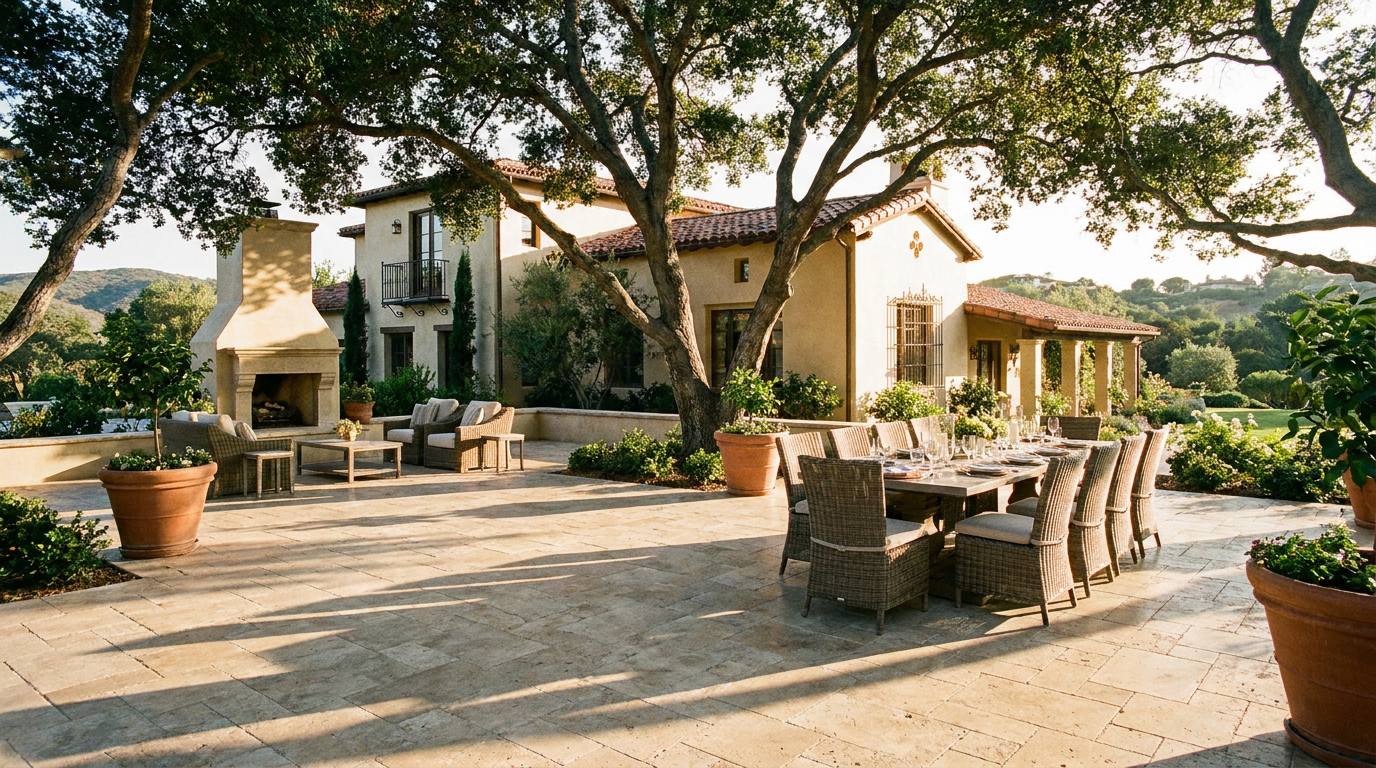
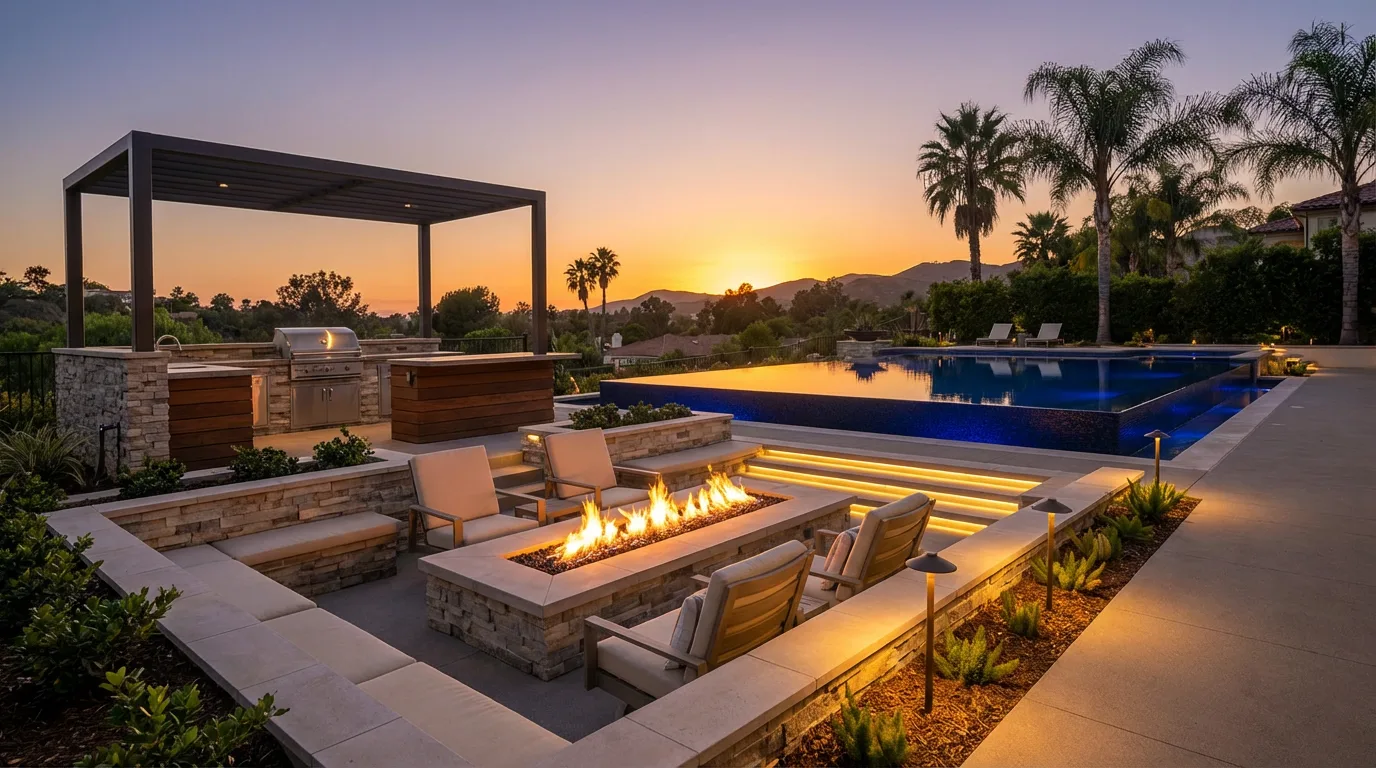
Bonita is one of the few San Diego communities where the word “yard” still means something close to what it meant forty years ago — not a staging area for a barbecue, but a piece of property with its own character, one that the next generation of the family is also going to live in. The valley is wider here, the lots are bigger, and the houses have been built to stay. What that means for outdoor design is that the work needs to fit the property — not just the current season’s taste, but the architecture, the grade, the mature trees, and the way the light moves across the yard at the hours the family actually uses it.
The ideas below are organized by property type, because in Bonita a flat valley ranch and a Bonita Highlands canyon lot with a fifteen-foot grade change are not the same design conversation.
Valley-floor properties: the ranch, the Mission Revival, the California bungalow
The valley floor — the Sweetwater River corridor, Central Avenue, Frisbie Street, the older blocks below the ridge — runs flat, clay-loam soil, mature canopy, and housing stock that mostly arrived between 1940 and 1975. The lot is generous. The architectural character is already established. The design problem is almost always: how do we make the outdoor program feel like it belongs to this house, rather than something that was carried in and set down?
Work with what is already there
The mature coral tree at the back of the lot is worth more than any specimen you could plant today. The low clinker-brick wall that came with the 1957 ranch is an asset, not an obstacle. The avocado grove at the fence line is part of the property’s identity. A good remodel on a valley-floor Bonita lot starts by mapping what exists and asking what needs to be edited rather than replaced.
Where the existing hardscape is failing — a buckled concrete slab, a brick patio that has heaved with the clay — the replacement takes the existing character as its brief. Belgard pavers in a running bond or herringbone that echoes the original brickwork read as restoration rather than renovation. A board-formed concrete pour that extends the roofline geometry of a ranch house reads as the patio the architect always intended. What reads wrong is a new patio that could have come from any catalog — contemporary-modern on a 1955 ranch, a Spanish tile inlay on a California bungalow that never had tile in its vocabulary.
The covered outdoor room
The ranch house and the Mission Revival are built around the idea of indoor-outdoor continuity — deep eaves, sliding doors to the yard, rooms that extend their width through the back of the house. A pergola or covered patio structure that picks up that geometry is one of the highest-value moves on a valley ranch. Cedar or Accoya reads warm and ages into the property. Alumawood works well where low maintenance is a priority and the architecture is contemporary enough to support it. Timber and steel work on the more ambitious programs.
A note on sizing: one well-scaled structure is the move. Two structures on a valley lot compete with each other and chop the space. Size the overhead to cover the dining table and six chairs with room to stand at the edges, and stop there.
Fire features for the valley
The Bonita valley is sheltered enough to make a fire feature genuinely pleasant for nine months of the year. For valley-floor properties, a gas fire pit or linear fire table integrated into the seating area is usually the right answer — no firewood logistics, clean ignition, and BTU sizing that does not overheat a covered outdoor room. Napoleon’s Patioflame and Warming Trends crossfire burner systems are both well-matched to the outdoor kitchen and patio programs we build in Bonita. For a wood-burning fireplace that belongs to a Mission Revival or Spanish Colonial, a masonry box with a cast-iron damper and a proper flue reads as architecture rather than appliance.
Planting and irrigation
Bonita’s clay-loam valley floor and mild, fire-sheltered climate support a wide planting palette. Mediterranean species — Agapanthus, Lavender, Salvia, Rosemary, Cistus — thrive without high irrigation inputs and look right against stucco and clay tile. Bougainvillea on a low wall or along a pergola is a Bonita signature that has been earning its place in the valley for sixty years. For canopy, the coast live oak or a multi-trunk olive planted where the property can grow it over fifteen years is the right move. For the Sweetwater water district properties on irrigation budgets, California Friendly plant lists from BeWaterWise.com are the practical starting reference.
Bonita Highlands and canyon lots: the terrace, the retaining wall, the view
Bonita Highlands and Long Canyon carry a different program entirely. The grade is the site. The design is about making the slope work in your favor rather than managing it as a liability.
The retaining wall as the primary design decision
On a canyon lot with a ten-to-twenty-foot grade change, the retaining wall is not a utilitarian structure you dress up with veneer at the end. It is the decision that determines how much usable area you have at each level, what the upper terrace looks like, and whether the lower garden feels like a destination or a leftover. Get the wall wrong and no amount of finish work makes the yard feel right.
Material choice here is deliberate. Poured concrete with board-form texture reads contemporary and holds scale at height — the right call on the post-2000 canyon customs. Natural stone or CMU with a Cultured Stone or Eldorado Stone ranch-appropriate veneer reads warmer and more settled — right for the Spanish Colonial and Mission Revival properties on the older Highlands lots. Redi-Rock retaining systems work well where structural mass is needed at the base of a steep slope and a natural stone profile fits the architecture. What reads wrong consistently is decorative stacked-stone veneer on a block wall that is trying to look like something it is not.
Terracing the usable area
Most Bonita Highlands lots reward a two-level program: an upper terrace at house grade for the primary outdoor room — patio, kitchen, dining, shade structure — and a lower terrace accessed by steps for a secondary lawn or garden zone. The sight line from the upper terrace across the valley is often the best feature of the property; the design work is to build a frame for it rather than compete with it.
Steps between terraces deserve the same material care as the patio. DG steps or timber landscape ties read as temporary. Stone or concrete steps that match the wall material and the patio surface read as permanent and designed.
Defensible space on canyon-adjacent lots
Canyon lots in Bonita Highlands and Long Canyon sit inside Cal Fire’s wildland-urban interface. The hundred-foot defensible space requirement — Zone 0 (zero combustibles next to the structure), Zone 1 (reduced fuel within thirty feet), Zone 2 (reduced fuel from thirty to one hundred feet) — is a design input, not a code footnote. Planting palette, mulch choice, structure setback from property edges, overhead material selection (non-combustible vs. ignitable), and irrigation programming all respond to the zone guidelines.
Ready for Wildfire publishes the current guidance. The practical implication for outdoor design is that species selection skews toward low-water, low-fuel plants — native bunch grasses, Salvia, Ceanothus, Manzanita — and away from high-resin, dense shrubs planted under or adjacent to the structure. A defensible-space-compliant garden looks intentional and belongs to the landscape. It is not a sacrifice.
Equestrian properties: the large lot, the honest material
Equestrian parcels — the Corral Canyon lots, the Proctor Valley Road properties, the Long Canyon parcels with arena zoning — are a different design register again. The scale is larger, the material vocabulary is narrower, and the best work looks like it belongs to the land rather than having been carried in.
A narrower palette, executed well
A complex mix of materials that works on a 0.2-acre lot looks scattered and restless on an acre. The equestrian property wants a single-stone terrace, or a CMU-and-stucco wall with a tile cap, or a concrete slab with a board-form edge and a stabilized-DG secondary zone — done well and consistently throughout. Pavestone’s natural concrete pavers in a large format work well on these properties: scale-appropriate, durable under trailer and equipment traffic, and visually honest next to split-rail fence and corrugated metal.
Artificial turf where irrigation fights gravity
On equestrian lots with defined lawn areas near the house, SYNLawn’s Pet Series or a comparable pet-durable turf performs well in zones that get heavy use from dogs and foot traffic. On slopes and secondary zones, native groundcovers are almost always the better answer — they belong to the hillside, they do not require irrigation once established, and they support the defensible-space program rather than complicating it.
Drainage as infrastructure
An equestrian property with horses, an arena, and seasonal storm flow from the Sweetwater watershed needs drainage designed as infrastructure — not as an afterthought. Concentrated flow from the arena, runoff from the barn and corral, and storm flow from upper slopes all need managed outlets. NDS drainage systems — channel drains, area drains, and basin components — are workhorses in these programs, used where the flow volumes are predictable and the outlet is an established drainage course. Coordination with County PDS grading requirements on any drainage alteration is standard on equestrian parcels.
Ideas that work across all Bonita lots
Landscape lighting built into the construction
The best lighting decisions in Bonita are made before the first paver is laid. Conduit is cheap before the patio is poured and expensive after. Path lighting, step lighting at terrace transitions, uplighting in canopy trees, and task lighting at a cooking zone are all roughed in during construction and trimmed out at the end. CAST Lighting and FX Luminaire both produce fixtures specified for outdoor durability in Southern California conditions. The quality difference between a proper low-voltage system and a hardware-store kit shows within three seasons.
The outdoor kitchen question
Bonita lots generally have the space for an outdoor kitchen, and the family-focused, long-tenured ownership profile here means the investment earns its use. A well-specified outdoor kitchen — a Lynx Professional grill or Fire Magic Aurora as the anchor appliance, a masonry or steel-stud-frame counter run with poured concrete or natural stone tops, a refrigerator drawer, and a prep sink — is a meaningful upgrade to how the outdoor room functions. The gas line, the electrical, and the drainage from the sink all route during rough-in, before the structure is closed.
What makes an outdoor kitchen wrong in Bonita is scale mismatch. On an equestrian lot, a 10-foot counter run with a single grill and a prep space reads right. A 20-foot commercial-grade kitchen with a beer tap, a pizza oven, and four burners reads like it belongs in a restaurant, not in the Sweetwater Valley.
Where to begin
The ideas above are organized by property type because that is how design starts in Bonita: with the land, the slope, the architecture, and the trees that were already there when the last family bought it. The right starting point is thirty minutes on the property — not in a showroom.
Related: Full Backyard Remodels · Pergolas & Shade Structures · Fire Pits & Fireplaces · Retaining Walls · Outdoor Kitchens · Landscape Lighting · Outdoor Remodeling in Bonita · Outdoor Remodeling in Eastlake