La Mesa and Mount Helix are not one backyard. The 1922 craftsman bungalow a block from the trolley wants a garden that reads like it came with the house in 1922. The mid-century ranch on Alta La Mesa wants low horizontal beds, board-formed concrete, and a patio that extends the roofline into the yard. The hillside custom on the Mount Helix saddle wants a terrace, a retaining wall that doubles as architecture, and a view corridor left uncluttered enough to earn the elevation.
These are three different design conversations. The ideas below are organized by lot type, because a great idea on the wrong lot is just a mistake that cost a lot of money.
For village-flat lots: the ranch and the bungalow
Village La Mesa — the craftsman corridor near the trolley, the mid-century ranches between 70th and Grossmont, the Spanish bungalows off Date Avenue — runs on lots of roughly 0.15 to 0.25 acres. Tight is not the problem. Scattered is.
Define the rooms first
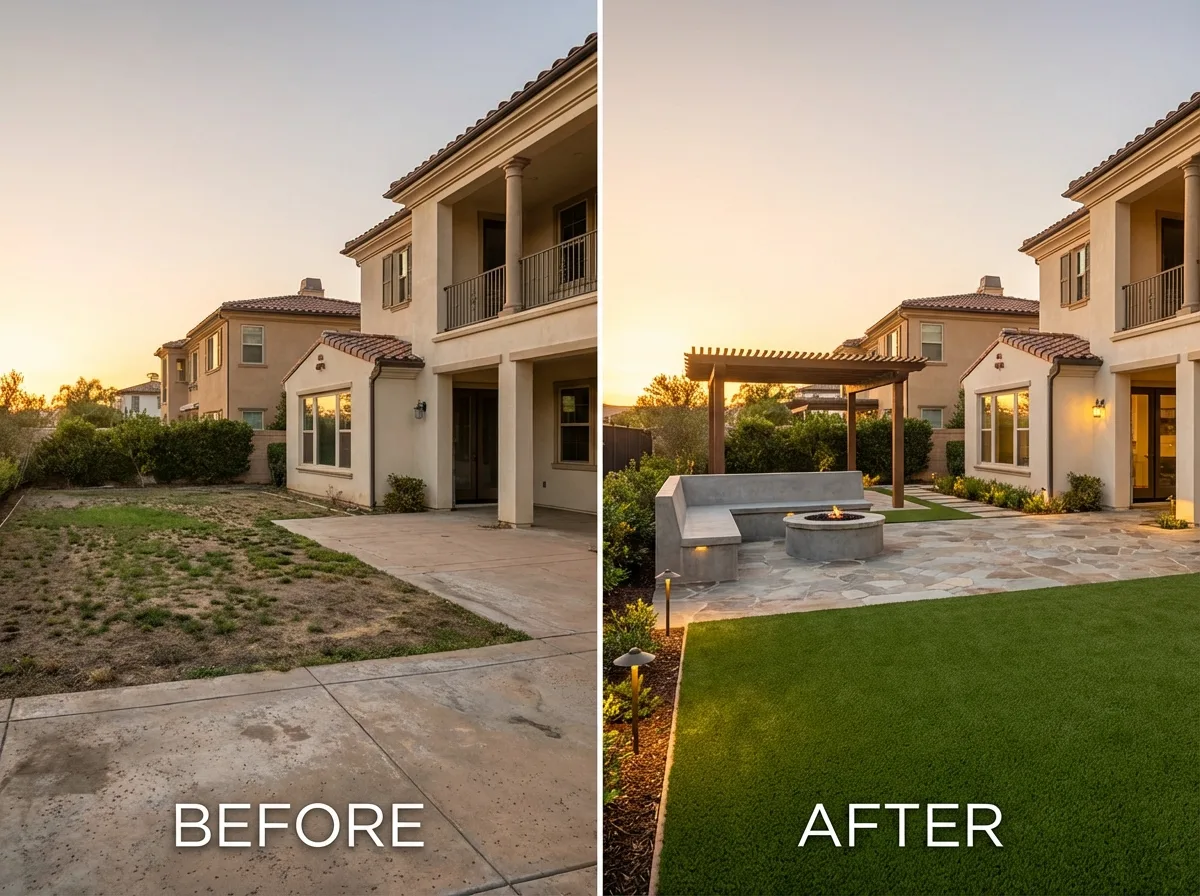
On a compact lot, the most impactful move is not adding more — it is editing what is already there into defined zones. A patio for dining, a secondary seating area around a fire feature, a small planted buffer between them. Each zone is sized to its real use. The result reads larger than a single paved plane because the transitions between zones give the eye somewhere to go.
Match the material to the house
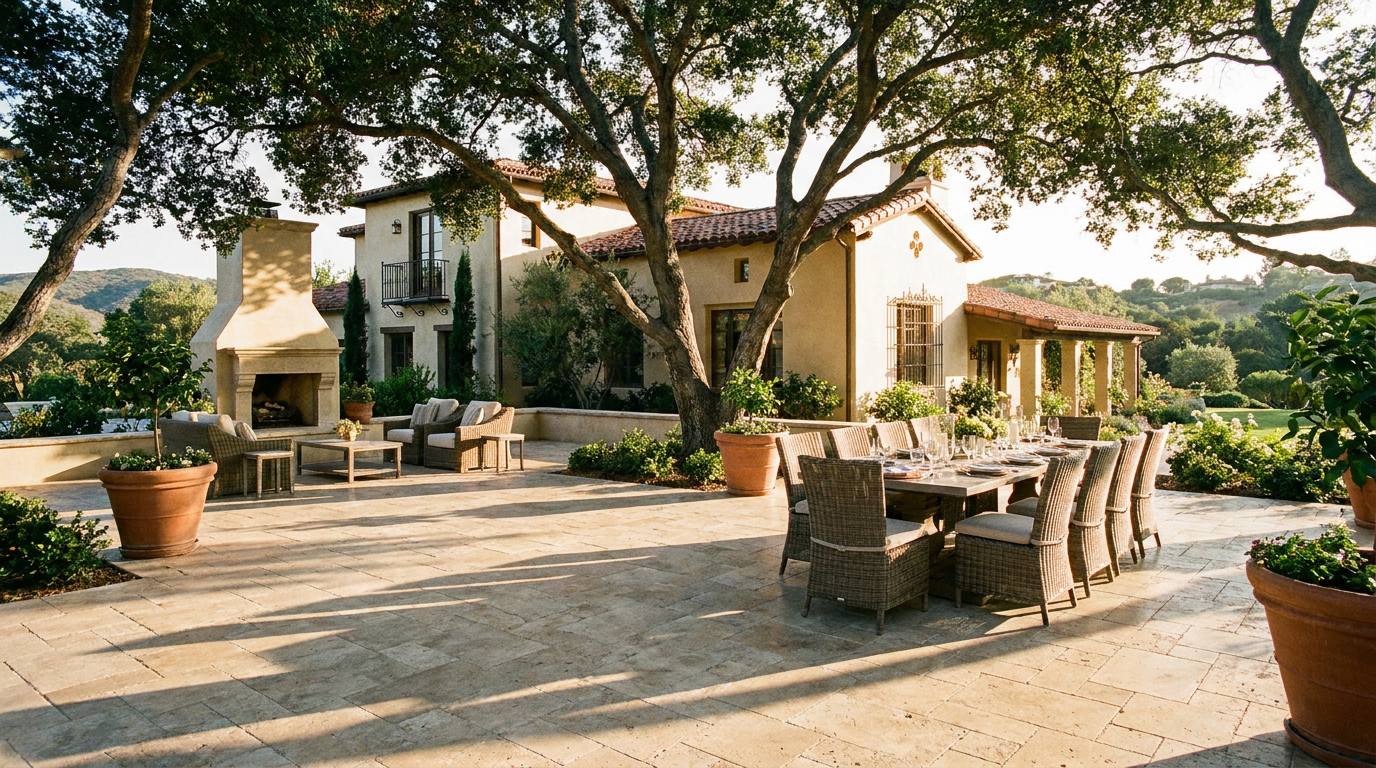
The mid-century ranch does not want Spanish tile or a Tuscany-inspired stone. It wants honest material — concrete pavers in a neutral tone, a board-formed poured edge, clean joint lines. The craftsman bungalow wants clinker brick echoes, or a simple exposed-aggregate that belonged to 1940. The Spanish bungalow wants warm stucco, clay-tile accents, a water feature that earns its place without overcrowding the courtyard. Getting the material right is the move that makes new work look like it was always there.
A single overhead structure
A pergola or shade sail on a village lot is almost always the right move — shade, definition, an anchor point for string lights or a ceiling fan. On a tight lot, one well-scaled structure does more than two fighting for position. Cedar or Accoya reads honest against a craftsman. Clean aluminum or steel reads right on a contemporary ranch. Oversized kits read wrong on any of them.
The fire feature question
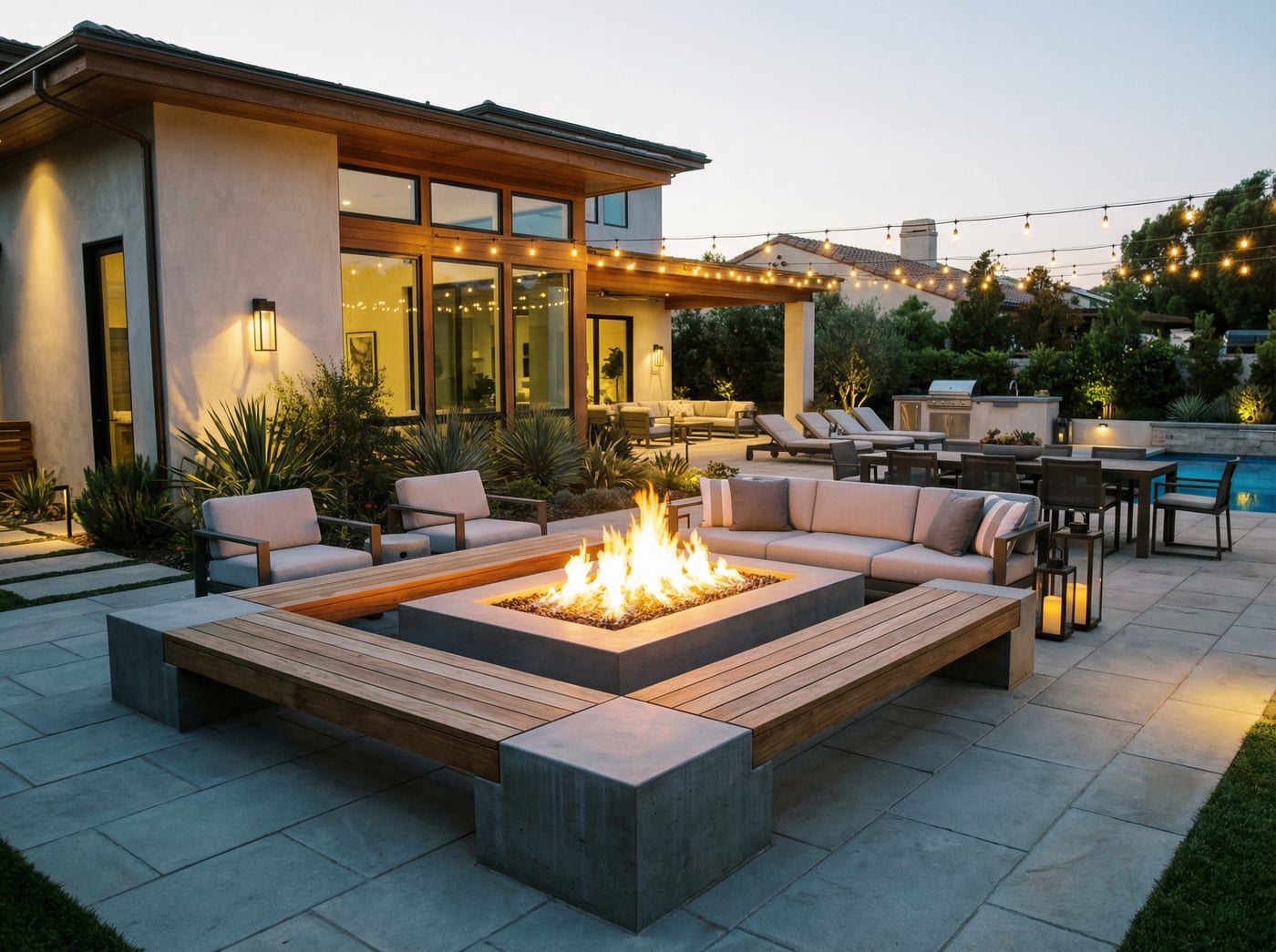
On a village lot, the fire pit competes with the patio for space if you let it. The move here is a gas fire table integrated into the seating area — no additional footprint, no firewood logistics, and it satisfies the ambiance brief without eating the dining table’s square footage. A low-BTU linear burner in a concrete or steel surround works well. Save the masonry fireplace for the properties that have room to stand twelve feet back from it.
Low-maintenance planting that belongs
La Mesa clay soil in the flats means you need plants that handle wet winters and dry summers without high-input irrigation. Decomposed-granite pathways with native or Mediterranean-climate plants — Salvia, Agapanthus, Lomandra, Lavender, Cistus — earn their place with seasonal color and almost no intervention. Mature canopy you already have — the avocado at the back fence, the coral tree — stays. You design around it.
For Mount Helix hillside lots: the terrace, the wall, the view
Hillside La Mesa — the Mount Helix saddle, the upper Fuerte parcels, the contemporary customs built after 2000 on what was raw slope — plays a completely different game. The grade is not a problem to solve. It is the site. The design is about making the slope work for you.
The retaining wall as architecture
On a hillside lot, the retaining wall is usually the single most important design decision in the yard. It defines how much usable area you have at each level, how the view reads from the upper terrace, and what the lower space feels like when you look back toward the house. A retaining wall designed as an afterthought is just a wall. A retaining wall designed as the organizing gesture of the site reads as architecture.
Materials matter here: poured concrete with board-form texture reads contemporary and holds scale at height. Natural stone reads warmer and more settled into the hillside. COR-TEN steel cap and edging at grade transitions earn their place on the hillside customs without fighting the architecture. What reads wrong is decorative block veneer that is trying to look like stone from a distance.
The upper terrace as the room
On most hillside lots, the upper terrace — the flat zone nearest the house — is where the real outdoor living happens. This is where the patio, the kitchen or grill station, and the shade structure belong. Keep it defined and don’t over-program it. One well-scaled dining area, a shade structure that follows the roof geometry, a built-in grill if the program warrants it. The view is the amenity. Don’t compete with it.
The lower terrace as borrowed space
If a second flat zone is possible at the base of the slope, the move is usually informal: a lawn panel, a planted slope between terraces, a seating vignette with a fire feature that reads as a destination rather than the main event. Hillside lots that try to squeeze a full outdoor program onto both levels end up feeling cramped and overbuilt. The lower terrace should breathe.
Drainage before everything
On decomposed-granite-over-bedrock hillside soil, drainage is not a detail — it is the engineering. DG drains well on its own until it hits the clay lenses and bedrock pockets that sit below it. Water that cannot drain fast enough moves laterally, and lateral movement on a hillside puts pressure on retaining structures, saturates patio bases, and erodes planted slopes. Surface drainage, subsurface drainage, and downspout management all have to be designed together before the hardscape is drawn. We design drainage first on every hillside La Mesa project.
Defensible space as a design input
Mount Helix hillside parcels carry real fire exposure. Cal Fire’s defensible-space requirements — Zone 0, Zone 1, Zone 2 — are not optional overlays on this type of property. They are design inputs. Planting palette, mulch choice, overhead geometry, and structure setbacks all respond to the zone guidelines. A hillside garden that ignores fire is not a garden we will design. The good news is that defensible-space planting — low water, sparse, California-native or Mediterranean-climate — also happens to look right on a hillside that is trying to belong to its geography.
Ideas that work across both lot types
Landscape lighting as infrastructure
Good landscape lighting is designed into the build, not added afterward. On a village lot, path lighting, step lighting, and uplighting on a canopy tree or a specimen plant change the yard from a daytime asset into one you actually use after 6pm. On a hillside lot, lighting the retaining wall and the terrace transitions makes the elevation legible after dark and extends the time the space is usable. The fixture spec matters: quality low-voltage fixtures with marine-grade connectors, sized transformers, and wiring buried in conduit. The ones that come in a box at the hardware store last three years. Proper spec lasts fifteen.
Artificial turf where irrigation is the enemy
On a flat La Mesa lot with a small lawn panel surrounded by hardscape, artificial turf performs well. It stays green through the dry season without irrigation, handles pet traffic, and closes the gap between what a lawn looks like and what it costs to maintain. On a hillside lot, turf is useful on small flat panels where irrigation would otherwise fight gravity. It is not appropriate on slopes — it doesn’t drain correctly and it doesn’t look right.
One good tree, planted correctly
The mature canopy tree already on a La Mesa or Mount Helix property is usually the most valuable thing in the yard. When we design around an existing coral tree, pepper tree, or oak, we start with its drip line and work outward. When a new tree belongs in the program, we specify for what it will do in fifteen years — shade, screening, or structure — not for what it looks like at the nursery. The wrong tree in the wrong place is a fifteen-year problem. The right one is a permanent asset.
Where to start
The ideas above are organized by lot type because that is how design starts in La Mesa and Mount Helix: with the property, not with a catalog. A village flat and a hillside custom are not solved the same way, and a contractor who approaches them with the same palette and the same layout is designing for a different yard than yours.
The right starting point is a thirty-minute conversation on the property, where we look at the soil, the grade, the existing trees, the architecture of the house, and how you plan to use the space. That conversation is free. It shapes everything that comes after it.
Related: Full Backyard Remodels · Patios & Hardscape · Pergolas & Shade Structures · Fire Pits & Fireplaces · Outdoor Remodeling in La Mesa · Outdoor Remodeling in Mount Helix