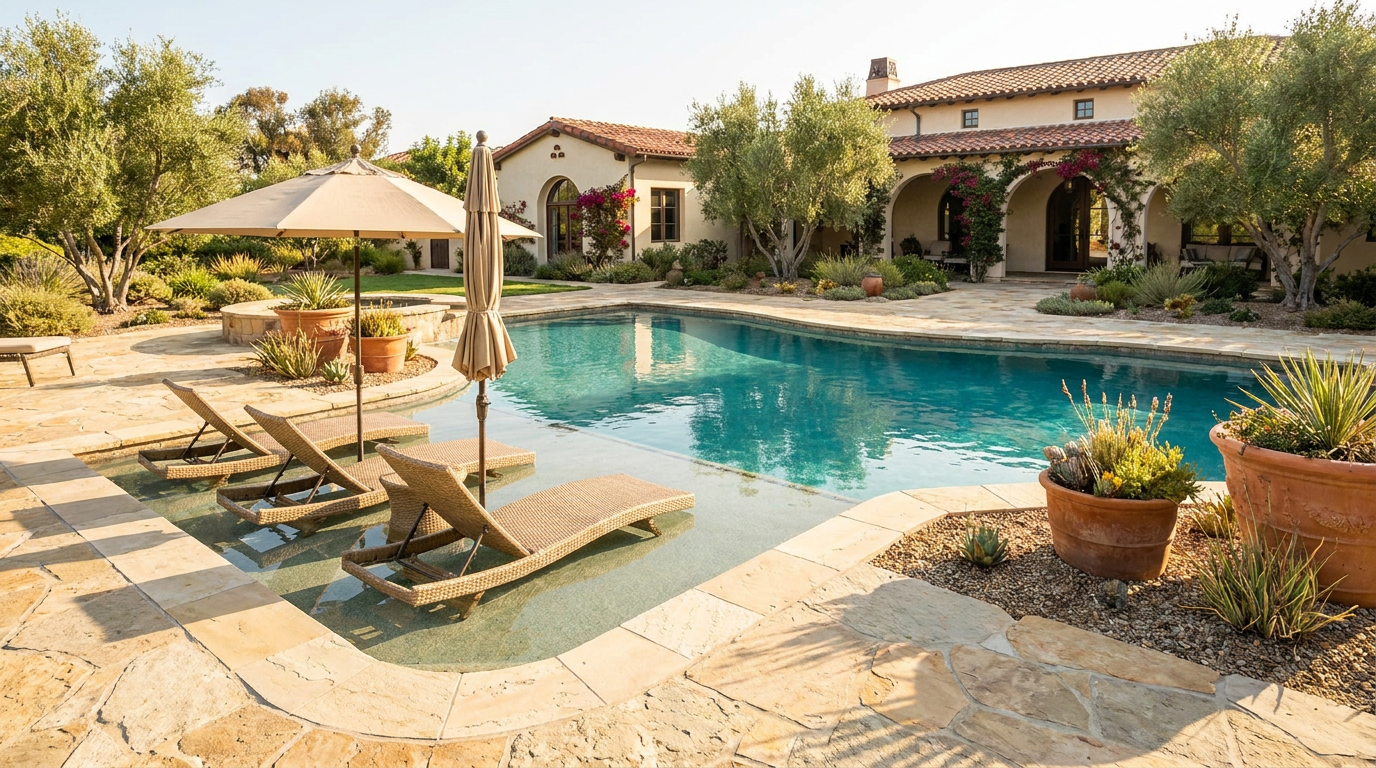
Tanning ledges and Baja shelves have gone from a specialty request to a near-standard feature on new pool builds and pool remodels in San Diego over the past decade. The appeal is obvious — a shallow, flat surface at the water’s edge where you can set a lounge chair in the water, let young children play in inches of water, or sit in a pool umbrella stand with your feet submerged on a hot afternoon.
But the range of execution quality is wide. A well-designed tanning ledge is one of the most used and best-integrated features in a pool. A poorly designed one is an awkward shallow step that collects leaves and does not quite work for any purpose.
Here is what separates the two.
Tanning Ledge vs. Baja Shelf — What’s the Difference?
The terms are used interchangeably in most conversations, but there is a meaningful distinction:
Tanning ledge: A shallow, flat shelf — typically 6 to 12 inches of water depth — positioned at the entry end of the pool, wide enough for a lounge chair. Usually 8 to 14 feet wide, 5 to 8 feet deep (into the pool footprint). The water depth is shallow enough that an umbrella base sits on the shelf and the occupant sits with water at hip level while reclined.
Baja shelf: A slightly deeper, more relaxed version — often 12 to 18 inches of water depth — sized for bench seating or wading rather than lounging flat. Less oriented to the chair-in-the-water use and more to casual sitting and young children.
The two terms are often used to mean the same thing. When a client says “Baja shelf,” they usually mean a tanning ledge. When specifying, ask how the feature will actually be used — that determines the ideal depth and configuration.
What a Well-Designed Tanning Ledge Involves
Depth
The most critical dimension. Too shallow (under 6 inches) and it reads as a wide step. Too deep (over 14 inches) and the water covers the chair seat uncomfortably. The sweet spot for a lounge chair tanning ledge is 9 to 11 inches of water depth at the finished water level.
That water depth must account for the pool’s evaporation and seasonal water level variation. A ledge designed at 10 inches that runs at 8 inches for three months of the year due to evaporation is functionally a step, not a tanning ledge.
Width and Depth (Into the Pool)
A tanning ledge that fits a single pool lounge chair is typically 8 feet wide and 6 feet deep. Two chairs side by side need 14 to 16 feet of width. The depth (the dimension going into the pool) determines how far out from the pool wall the occupant sits — less than 5 feet reads as tight.
Transition to the Pool Depth
The drop from the tanning ledge to the main pool depth should be clear and safe. A vertical face from ledge to pool floor is standard. The edge needs a visual indicator — a tile band, a coping profile change, or a color contrast — so bathers stepping off the ledge know they are leaving the shallow zone. This is a safety consideration, not just an aesthetic one.
Material
The tanning ledge surface is in constant wet contact and sees the most direct sun exposure of any horizontal surface in the pool. Material choices:
Interior plaster or aggregate: The most common and lowest-cost approach on gunite pools. The ledge surface is finished with the same plaster, quartz, or pebble aggregate as the pool interior. Consistent, seamless. The aggregate surface is more comfortable underfoot than standard plaster.
Tile: A tile surface on the tanning ledge creates a higher-end, more intentional look — particularly large-format porcelain or natural stone tile set on the shelf surface. This requires careful specification for wet-surface slip resistance and a pool-compatible setting system.
Raised tile insets: Some designs inset a decorative tile element (glass mosaic, pattern tile) in the center of the tanning ledge floor — a detail that photographs well and gives the pool a custom, designed quality.
Umbrella Sleeve
For a tanning ledge to function as intended with a pool umbrella, a sleeve (typically 2-inch diameter stainless steel) needs to be cast into the ledge during construction. This is impossible to retrofit cleanly after the fact — if you want the option, specify it during the build.
Sunken Bench and In-Pool Seating
Related to the tanning ledge concept: built-in bench seating inside the pool, at sitting depth (typically 18 to 22 inches of water depth). A sunken bench along one wall of the pool allows occupants to sit in the water at chest or shoulder depth — comfortable for conversation, watching the space, or soaking on a warm day.
In-pool bench seating is most common in larger pools with a social orientation — entertainment-focused backyards where the pool is used as a gathering space rather than primarily for lap swimming. It is less common in pools where the primary use is athletic swimming.
Construction: The bench is formed as part of the pool shell structure — a raised ledge at the pool interior at the appropriate seat height. In gunite pools, this is formed and shot in the same process as the rest of the shell. Bench surfaces are typically finished in the same aggregate or tile as the rest of the pool interior, or given a distinct tile treatment.
Adding a Tanning Ledge to an Existing Pool
This is one of the more common questions in pool remodel consultations: can a tanning ledge be added to an existing pool?
The answer is yes, but it requires structural work. A tanning ledge cannot be added by resurfacing or modification of an existing shell. It requires excavating at the pool entry, cutting into the existing shell, installing rebar and forming for the new ledge structure, shotcreting the new section, waterproofing the tie-in between old and new concrete, and refinishing the pool interior to match.
This is meaningful work — not a minor add-on. The realistic cost for adding a tanning ledge to an existing gunite pool, including the interior refinishing required to blend the new section, is typically in the $15,000 to $30,000 range depending on size and existing conditions.
It is also the reason homeowners who are planning any pool renovation and want a tanning ledge should include it in the initial scope rather than adding it later. The cost and disruption are significantly lower when it is part of an already-scheduled remodel.
If you are remodeling a pool and want to understand what a tanning ledge would realistically add to the scope — or if you are planning a new pool and want to talk through how the ledge fits with the broader pool and deck design — we are glad to walk through it.
Related: Pool Decks & Poolside Hardscape · Full Backyard Remodels · Patios & Hardscape · Projects in La Jolla · Projects in Bonita