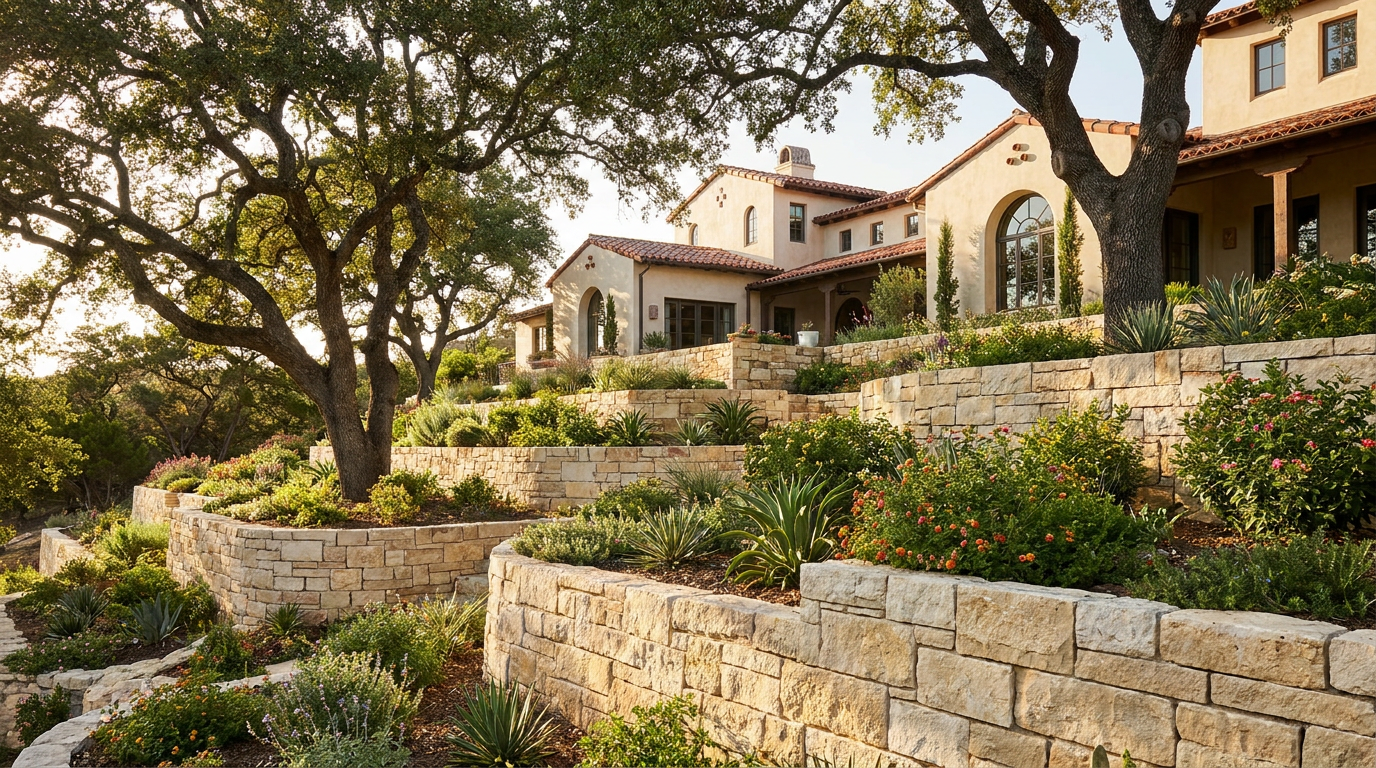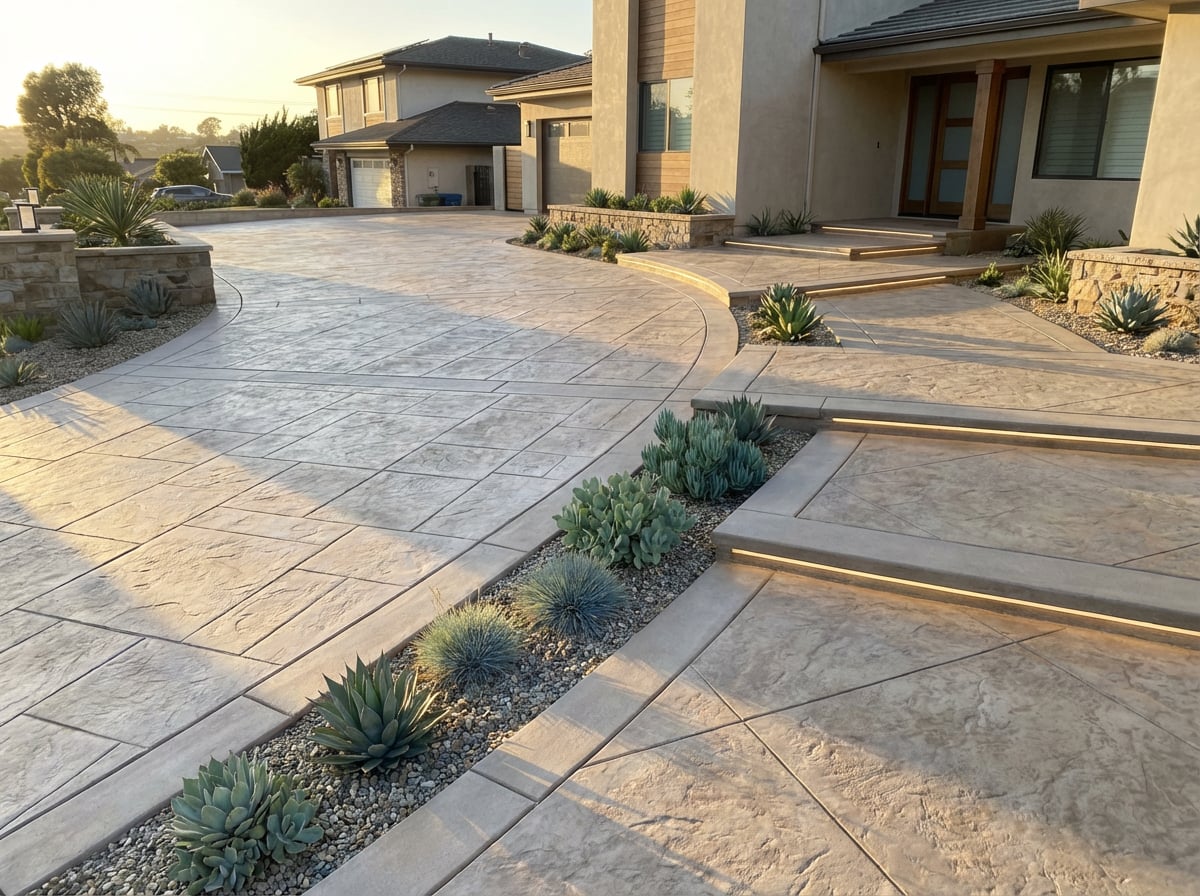

Del Mar Heights view lots exist because of the grade. The mesa drops toward the coast, the ocean or the lagoon appears at the bottom of the slope, and the value of the property is directly tied to how much of that view is captured and from how many positions inside the yard. A property with a fifteen-foot grade change between the house pad and the back fence is not a property with a retaining-wall problem. It is a property with a design opportunity that happens to require a retaining wall to realize.
The retaining wall — or more typically, the terraced system of retaining walls — is the single most important structural and spatial decision in a Heights backyard.
The Design Problem: Sight Lines and Usable Area
A Heights view lot with a significant slope gives you two things that are in tension: the view, which is at the bottom of the slope, and the usable flat area, which is at the top. A yard that simply holds the slope with a wall and leaves the lower terrace unaddressed gives you a view you can see from the house but not comfortably sit in.
The design that earns the property is a stepped program — a primary terrace at the top of the grade for the dining and cooking function, a lower terrace for a fire feature or planted area that frames the view, and retaining walls between them that are also seat walls, that read as architecture, and that become the visual transition between the two levels rather than an invisible engineering solution. The wall that separates a beautifully composed terrace from a well-planted lower terrace is not infrastructure. It is the most visible built element in the yard, and it is designed accordingly.
The sight line from the upper terrace to the view is a specific design calculation. The height of the lower terrace retaining wall, the species and mature height of any planting on the lower terrace, and the position of a fire feature or garden element relative to the primary view axis from the kitchen slider — all of these are designed together, not solved independently. A wall that is four inches too high blocks the horizon from the chair everyone will actually sit in.
Two Soils, One Zip Code
The soil split in Del Mar Heights is real and has genuine engineering implications for retaining wall design.
The western edges of the Heights, where the mesa meets the bluff-side terrain, carry sandy-over-bluff-rock substrate that drains quickly, behaves predictably under structural load, and has a different geotechnical character than the mesa interior. Retaining walls in these locations are typically designed for a drier soil profile — less hydrostatic pressure behind the wall, lighter drainage specification, different foundation behavior.
Move east toward the interior mesa parcels, and the soil shifts to clay-heavy profiles — sometimes described as Olivenhain clay in this part of the county — that hold water, expand when wet, and shrink during dry months. A clay-heavy soil behind a retaining wall exerts lateral pressure that changes with the season. A wall designed without accounting for that seasonal pressure variation is a wall that moves, cracks, and eventually fails. The drainage behind the wall is not a detail — it is a fundamental design question that determines how the wall behaves over ten or twenty years.
Clay-site retaining walls need properly engineered drainage: a gravel drainage layer directly behind the wall, weep holes or a perforated drain pipe to move the water out of the backfill zone, and surface drainage that prevents the water from pooling at the base of the wall where it continues to load the soil. All of this is inside the wall design, not an afterthought bolted on after the wall is set.
Materials the DRB Reads as Correct
Del Mar’s Design Review Board reviews materials for exterior work visible from the right-of-way, and the village has a design tradition strong enough that the DRB has opinions. Retaining wall material in Del Mar Heights is part of the review conversation when the wall is visible from the street, from a neighbor’s property, or from the downslope side of a view lot.
The materials Del Mar reads as correct: natural stone (dry-stacked or mortared, in warm regional tones), board-formed concrete that carries an honest finish rather than a decorative veneer, and COR-TEN steel where the architecture of the house has already established a contemporary material vocabulary. COR-TEN develops a controlled rust patina over the first several seasons and then stabilizes — it reads as architectural rather than industrial when it belongs to the design, and it is increasingly present in the contemporary coastal homes that have been built on the Heights over the last decade.
What does not read as correct in Del Mar: split-face CMU, the modular concrete block product that dominates retaining wall construction in utilitarian applications throughout the county. Split-face block is not a design product in this market. It reads as retaining structure rather than as architecture, and it will draw comment at DRB in any location where it is visible. On a view lot where the retaining wall is visible from the downslope neighbor or from the street below, split-face block is not an acceptable material for the outer face, regardless of its structural performance.
Engineered vs. Non-Engineered Walls
In San Diego County, retaining walls that exceed approximately four feet in height — measured from the top of the footing — typically require an engineering stamp on the drawings. The specific threshold varies by jurisdiction and by site conditions, but the practical rule on Del Mar Heights view lots is: assume engineering is required.
The height requirement is one trigger. Surcharge conditions are another — if a wall is supporting additional load above the retained soil (a driveway, a building pad, a pool), engineering is required regardless of height. Proximity to a slope or bluff edge triggers geotechnical review in most permit situations. Del Mar’s DRB, which reviews the structural condition of retaining walls as well as their aesthetic appropriateness, expects to see engineering on walls of any significant height.
Engineered walls require drawings signed and stamped by a licensed structural or civil engineer, and the permit must be issued before construction begins. On a Heights view lot, the typical retaining scope involves walls that are well past the ministerial-approval threshold. The engineering fee is a line item in the project budget — it is not a contingency, and a contractor who tells you the wall can be permitted as a simple home improvement project without engineering review has not looked at the site or the relevant code.
Cost Range
Retaining wall work in Del Mar Heights typically runs from $20,000 for a modest single-tier wall in natural stone or board-formed concrete on a straightforward slope, up to $100,000 or more when the scope includes multiple terrace levels, significant linear footage, engineered drainage throughout, and premium material finishing on visible faces.
The most important cost variable — beyond material and linear footage — is soil access and site conditions. A Heights lot with vehicle access to the slope and compactable decomposed granite at the base of the work is a different project from one with difficult access, clay soil with a seasonal drainage problem, and a geotechnical condition that requires a tieback or deadman system rather than a gravity wall. Those conditions are discovered during the site visit, not after the proposal is signed.
The design phase matters here as much as the construction phase. A correctly designed Heights retaining system — one that captures the view from the right positions, uses materials the DRB will approve, and drains correctly through both wet and dry seasons — requires genuine design work before a single cubic foot of concrete is poured.
Related: Retaining Walls & Seating Walls · Drainage & Grading · Projects in Del Mar · Retaining Wall Cost in San Diego