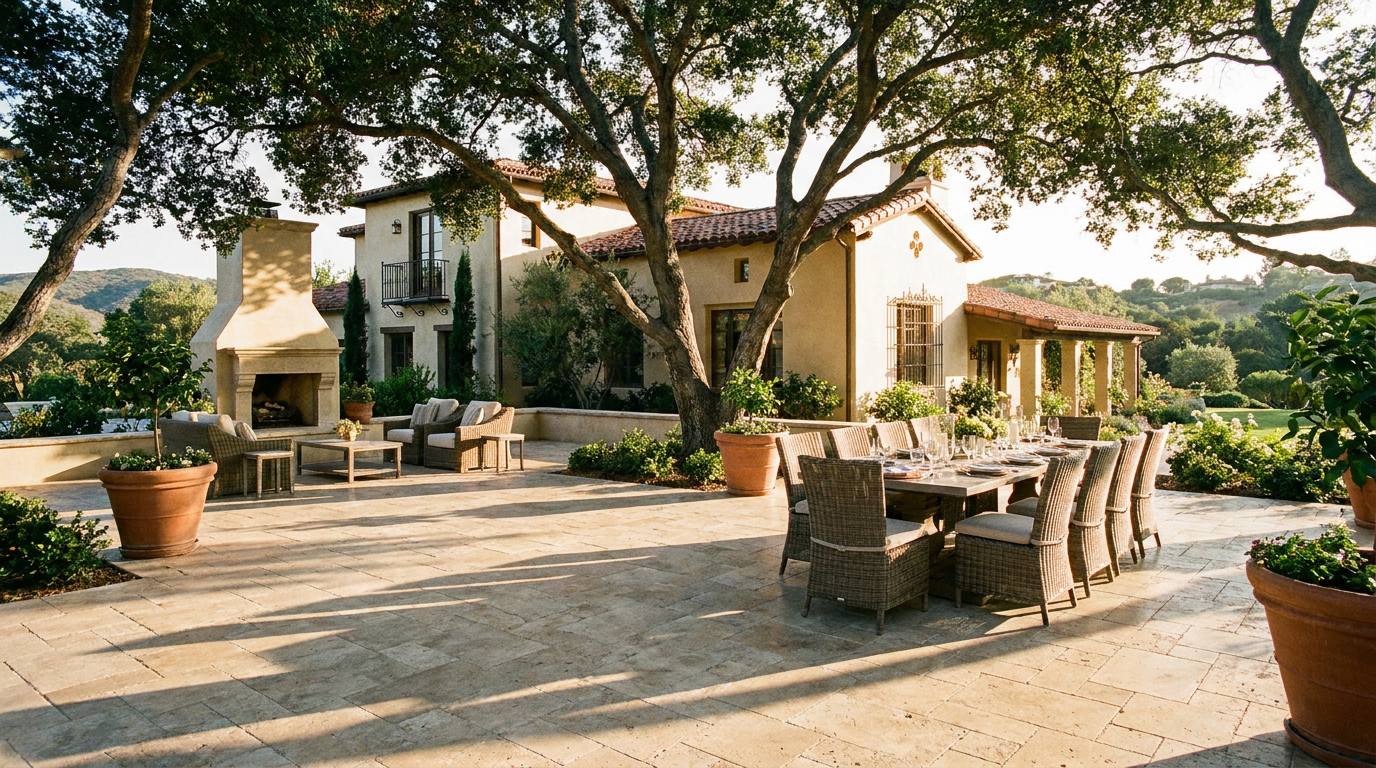
The structure that makes a Covenant terrace work in August
Rancho Santa Fe sits inland enough to mean it. Mid-90s in August is not a coastal exaggeration — it is a fact about the air on the terrace at 2 PM, and the difference between a shade structure that actually shades and one that provides architectural interest is the difference between a terrace you use in summer and one you cross quickly on the way to the interior. A properly designed pergola on a Covenant property turns the August terrace into a functional room.
It also has to pass CDRC review. The Covenant Design Review Committee reviews shade structure height, footprint, material, and finish before construction. A pergola that reads as a correct extension of the Spanish Colonial or Mediterranean vocabulary the Covenant was drawn in will move through CDRC in the normal review cycle. One that introduces a material or form foreign to the vernacular will move more slowly.
What the Covenant vernacular asks of a pergola
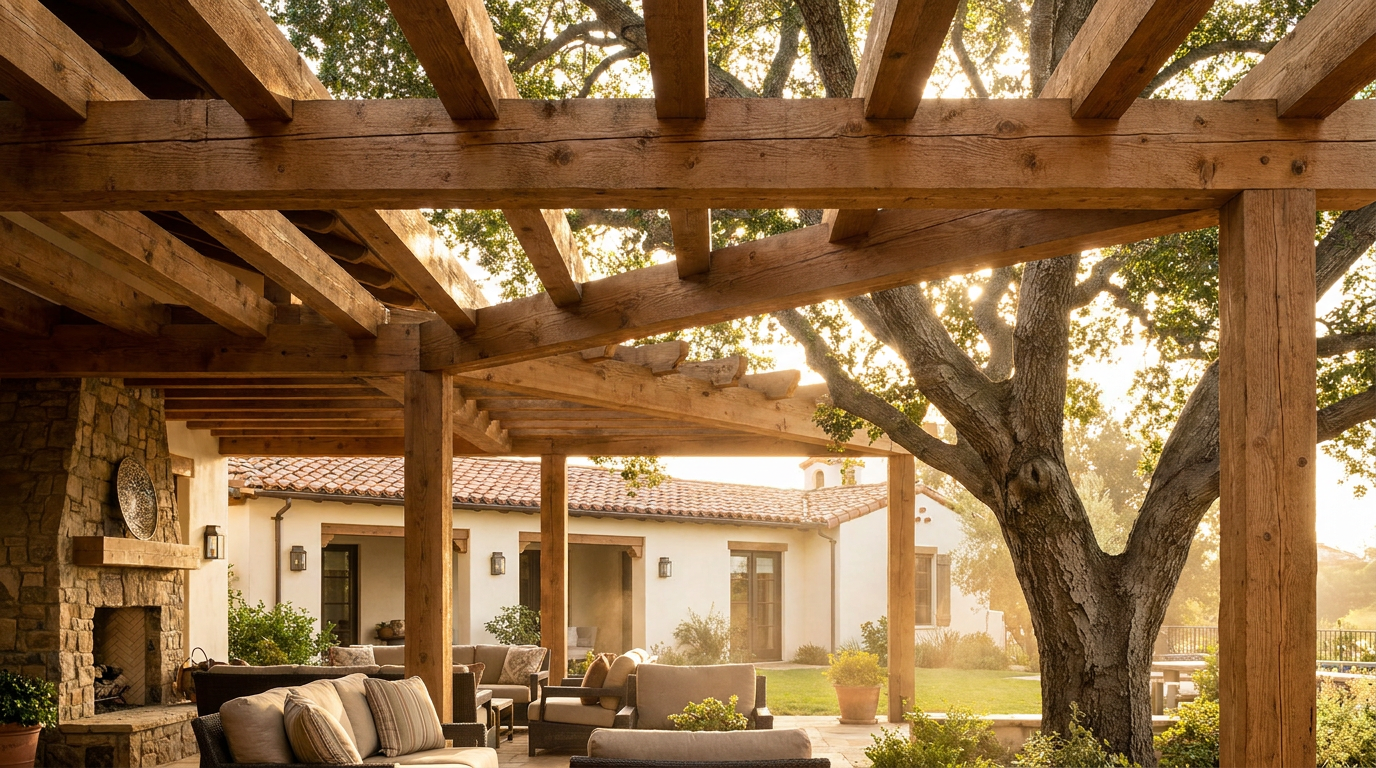
The Rancho Santa Fe architectural vocabulary is anchored in Lilian Rice’s Spanish Colonial of the 1920s: white and cream stuccos, clay tile roofs, cedar and pine structural elements, wrought iron accents, and the shaded arcade or covered breezeway as the primary outdoor circulation. A pergola that extends that vocabulary uses rough-sawn cedar at the beam and rafter, a post profile that reads as timber rather than lumber, and a finish — left natural, oiled, or in a warm stain — that ages correctly alongside the oaks.
Contemporary and transitional homes in the Covenant — and there are excellent examples of both — open the material palette somewhat. Powder-coated steel columns and a steel beam structure, with cedar or redwood rafters to soften the contemporary line, reads correctly on a property where the architecture has already earned the move. COR-TEN steel as a structural element reads correctly on a very small number of Covenant homes and incorrectly on most. We read the architecture before we propose the structure.
Alumawood and aluminum pergola systems, while durable and low-maintenance, do not typically pass CDRC review on Covenant properties. The material does not belong to any architectural vocabulary the Covenant recognizes. We do not propose it inside the Covenant boundary.
Oak clearance and root zones
The oaks define a Covenant property more than any built element — they are why the land was worth what it was worth before the house was drawn, and they are the visual context that makes the terrace what it is. A shade structure placed under or near the oak canopy has to be engineered around the root zones and the crown clearance, not against them.
No grade change, no compaction, and no concrete poured inside the critical root zone without arborist review in writing. Post footings near root zones use a helical pile or an engineered alternative to minimize excavation impact. The structure height is determined partly by the existing canopy clearance — a pergola that crowds the canopy overhead creates a fire risk and an aesthetic problem simultaneously.
Where the program places the shade structure away from the oaks — in the more open areas of the terrace — the design has more latitude, but the visual relationship to the canopy still matters. The structure should belong to the site, not compete with it.
Engineering and permits
Pergolas in Rancho Santa Fe are permitted through San Diego County Planning & Development Services and reviewed by the CDRC. We prepare structural drawings, pull the permits, and run the CDRC submittal package. We do not build structures without permits. On a Covenant property, that would be a shortcut that stops the project when the neighbor files a complaint.
What a Rancho Santa Fe pergola costs
A freestanding or attached cedar pergola on a Covenant estate with engineered footings, rough-sawn timber construction, and proper clearances runs between $25,000 and $80,000 depending on size, structural complexity, and whether the scope includes integrated lighting, fans, or a roofing element. A full covered patio structure with composite or tile roofing is a different project at a higher investment. We quote after walking the site and understanding the program.
Licensed and insured general contractor, operating under Mike’s Class B license — CSLB #1139785.