What the patio has to do first
On a Rancho Santa Fe estate, the patio is not an amenity. It is the primary outdoor room — the terrace that catches the late afternoon light through the oaks, the surface your guests walk from the kitchen doors onto without thinking about it, the stage where the entertaining actually happens. It has to be correct before it can be comfortable, and correctness in the Covenant has a specific meaning.
The Covenant Design Review Committee reviews exterior materials, colors, and surface finishes on every property inside the Rancho Santa Fe Association boundary. A patio proposal arrives as a concept submission with a material board — not a catalog printout, but physical samples of the actual stone or paver you intend to set. The board reads wrong, the review adds months. The board reads right, work proceeds. We build the material board and run the submittal. That is inside the scope, not an additional service.
What the climate asks of paving materials
Rancho Santa Fe sits inland enough to run into the mid-90s in August and to frost the low pockets in January. That thermal swing is the first filter on any paving material: it has to expand and contract without cracking, hold its finish through summer heat, and stay dimensionally stable when the soil below it wets up and dries down through a February and then a hot March.
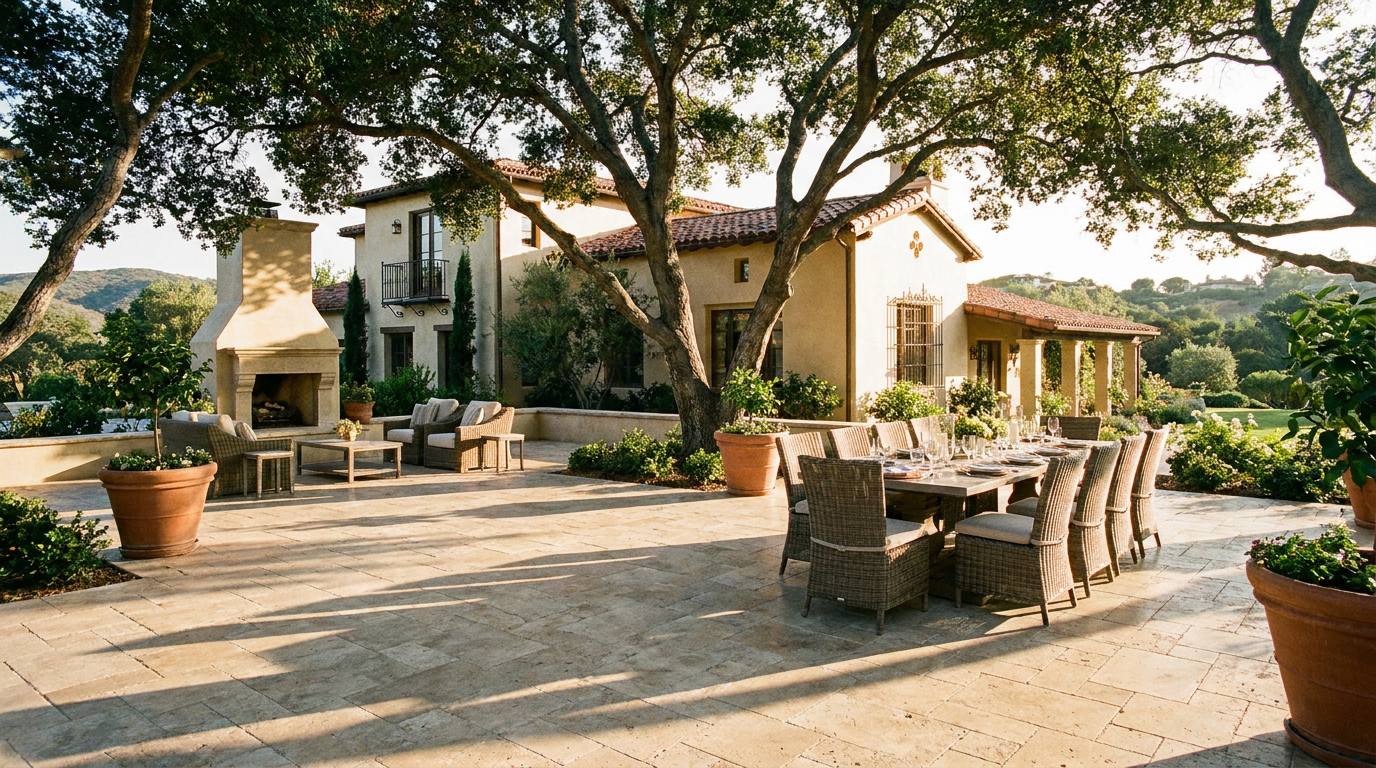
Honed, filled travertine is the material that answers all of those requirements in the Covenant vernacular. The Spanish Colonial language the Covenant was drawn in — Lilian Rice’s stuccos and clay tiles and wrought iron — reads travertine as native. The honed-and-filled finish is warm underfoot, cool on a hot afternoon relative to dark concrete, and provides enough texture to hold safely when wet. It sets beautifully against the orange and gold tones of a late RSF afternoon.
Cut limestone is the other material that carries weight at Covenant scale. On a large entertaining terrace — 2,000 to 3,500 square feet on a two-acre lot — it has the mass and the visual density that travertine lacks at the same quantity. Dry-stack limestone at the seating wall or the step risers is the natural companion. The cost is higher and the installation is more demanding, which is precisely why it reads as it does.
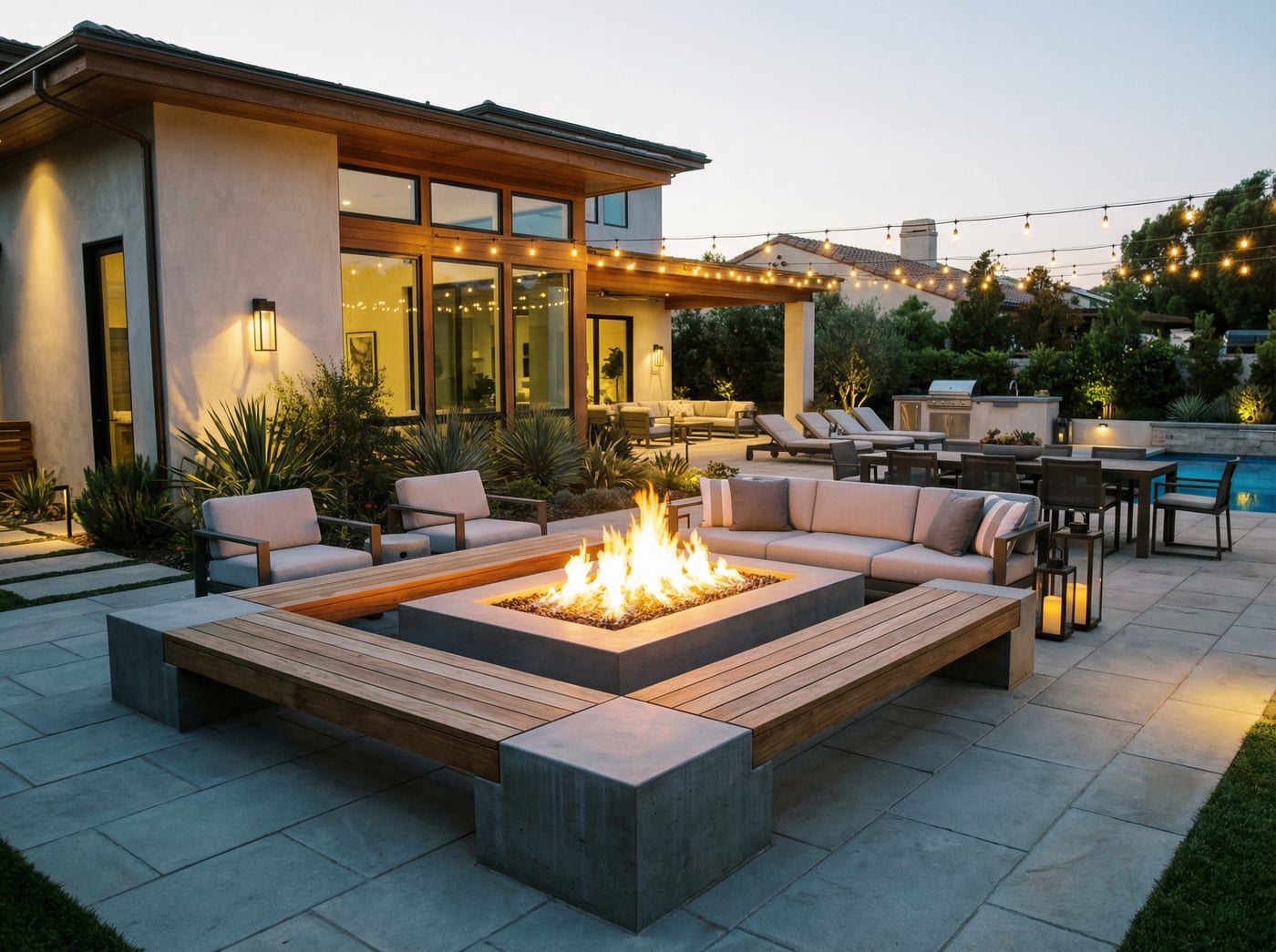
Large-format concrete pavers at the premium end of the specification — 24x24 or 24x48, warm sand tone, rectified edge — can work on the properties that sit on the contemporary or transitional side of the Covenant vernacular. The version that reads wrong is the standard tumbled paver in a cobble format. The eye catches it immediately, and at Covenant scale the result is a yard that looks borrowed from somewhere with smaller budgets and lower expectations.
The oak constraint is the real constraint
Every paving plan on a Covenant property begins with the oak canopy mapped and the critical root zones fenced. Root zones extend well past the drip line — often 1.5 to 2 times the crown spread — and they cannot receive grade change, compaction, or impermeable coverage without consequences the tree will express over the next five to ten years. The consequence is usually invisible for the first two or three years and then suddenly obvious.
Where the patio program needs to run close to a protected root zone, we use a structural soil system or a permeable paver installation over a structural aggregate base. We consult the arborist in writing when proximity is a design decision, not a field call. The tree outlives the patio. The patio is designed around the tree.
Drainage on a two-acre lot typically crosses multiple soil types — decomposed granite on the ridges drains fast, clay loam in the low pockets holds water and expands under it. The patio grade plan is engineered to the full-lot topography, not just the footprint of the terrace. A patio that drains correctly in October will drain correctly in February.
How a Covenant patio project runs
Design first. We do not quote materials until we have walked the property, photographed the canopy, and understood the architectural character of the house and the way the outdoor program is meant to work. Material selection follows from the architecture, not from a default preference.
CDRC submission comes before procurement. The concept submittal goes in with the material board, the preliminary plan, and the canopy map. Conditions of approval are normal. Revisions between concept and final are the rule rather than the exception on a detailed patio scope. We build that review window into the calendar rather than attaching it to the end.
Build follows approval. One senior crew, from first cut to final clean. Our field lead has twenty-five years of high-end outdoor build experience and has run Covenant properties before. Gio or Mike is personally on every project — no account manager, no handoff.
The 10-Month Walk-Through closes every project. Ten months after completion, we come back and walk every linear foot of coping, every expansion joint, every drain and edge transition with you. Anything the seasons have exposed gets corrected. On a patio that cost what this one costs, that is the minimum the investment deserves.
For cost context on the broader outdoor program, see our Rancho Santa Fe remodel cost guide.
Licensed and insured general contractor, operating under Mike’s Class B license — CSLB #1139785.