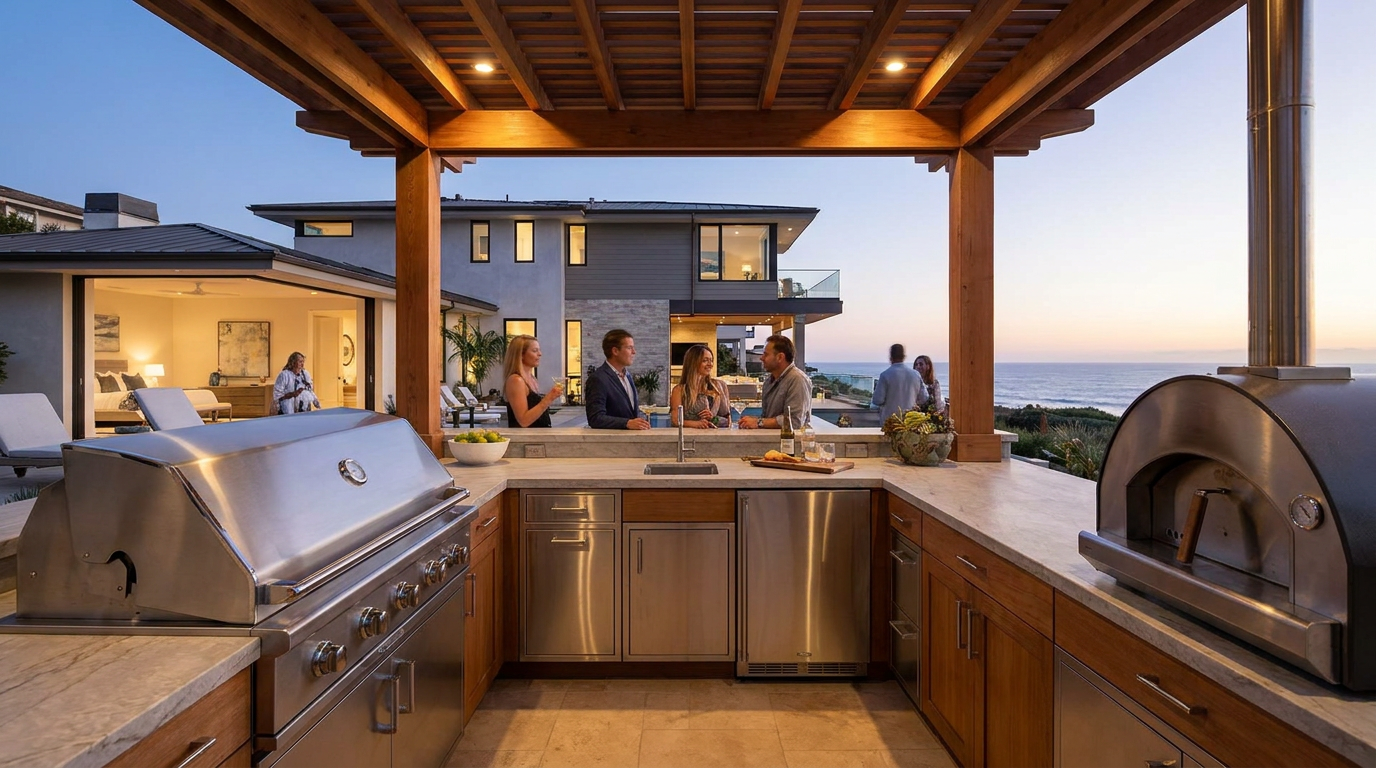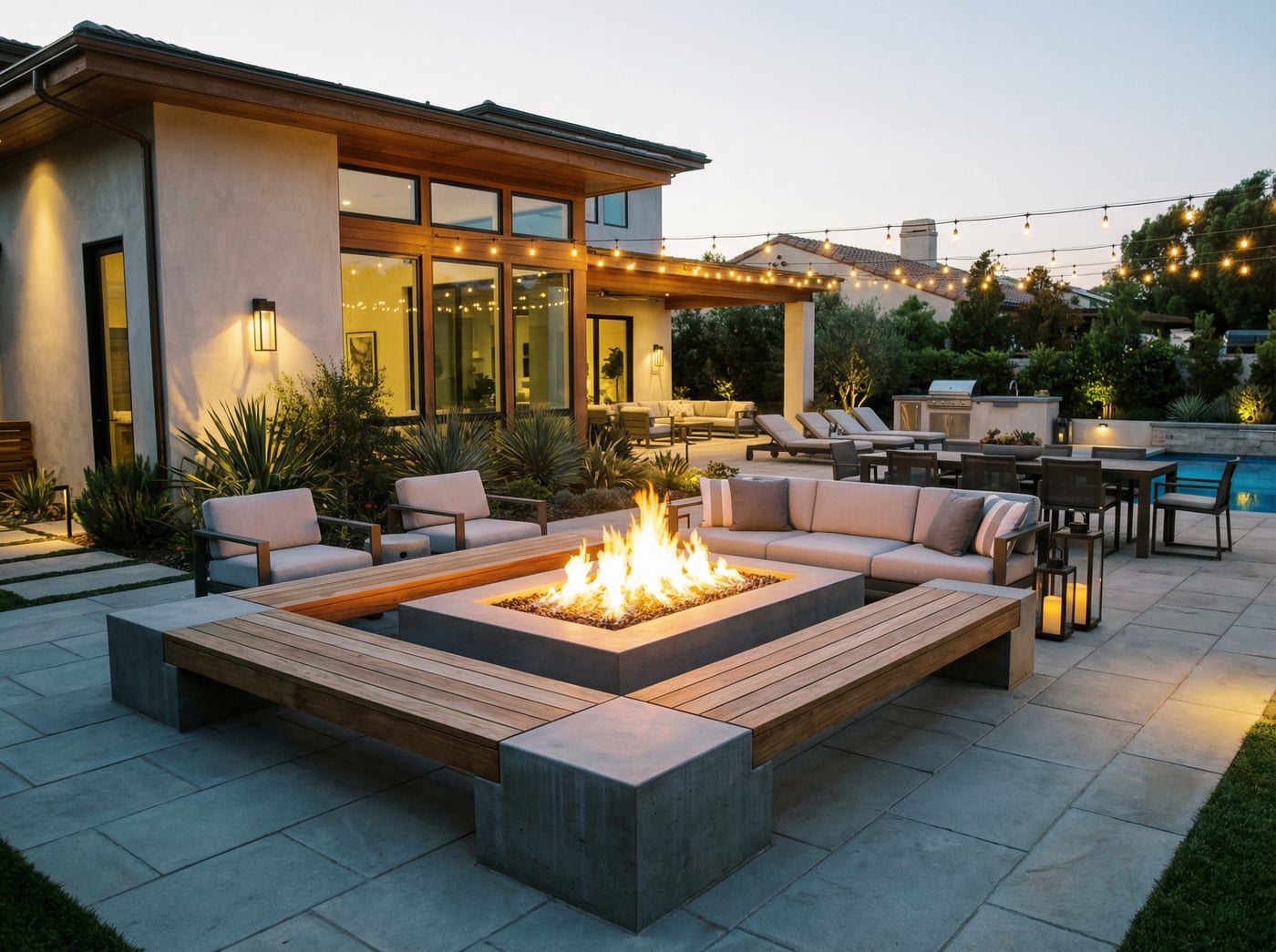
The outdoor kitchens that get built inside the Rancho Santa Fe Covenant have almost nothing in common with the category as it typically gets discussed in outdoor living circles. The lots are two acres at minimum, the entertaining expectation is different, the material language is prescribed by a design review process that has held the same aesthetic standard since Lilian Rice laid out the village in the 1920s, and the kitchen is invariably a permanent structure — which means a CDRC submittal before a single block is set.
Understanding what a Covenant outdoor kitchen actually requires starts with understanding what the Covenant actually is.
The CDRC Review for Permanent Outdoor Structures
Any permanent outdoor structure on a Covenant property — a kitchen with a gas line, a covered structure over it, a masonry fireplace attached to it — goes through the Rancho Santa Fe Association’s Covenant Design Review Committee. Permanent means permanent. A built-in kitchen on a concrete slab, with utility connections and a structure above it, is not a homeowner’s prerogative to install without review.
The submittal package for a kitchen structure typically includes architectural drawings showing plan, elevation, and the relationship to the adjacent patio and house; a material board with physical samples of every surface and hardware finish; and sometimes a photorealistic rendering of the finished structure in context. The CDRC will review the scale, the massing, the material palette, and the degree to which the structure belongs to the Spanish Colonial vocabulary the Covenant governs.
Conditions of approval are normal. A first-pass concept may come back with revisions — a material substitution, a height reduction, a change to the roofline of a covering structure. That is the process, not an exception to it. We design Covenant kitchens with that iterative reality built into the schedule.
What Covenant-Appropriate Materials Look Like on an Outdoor Kitchen
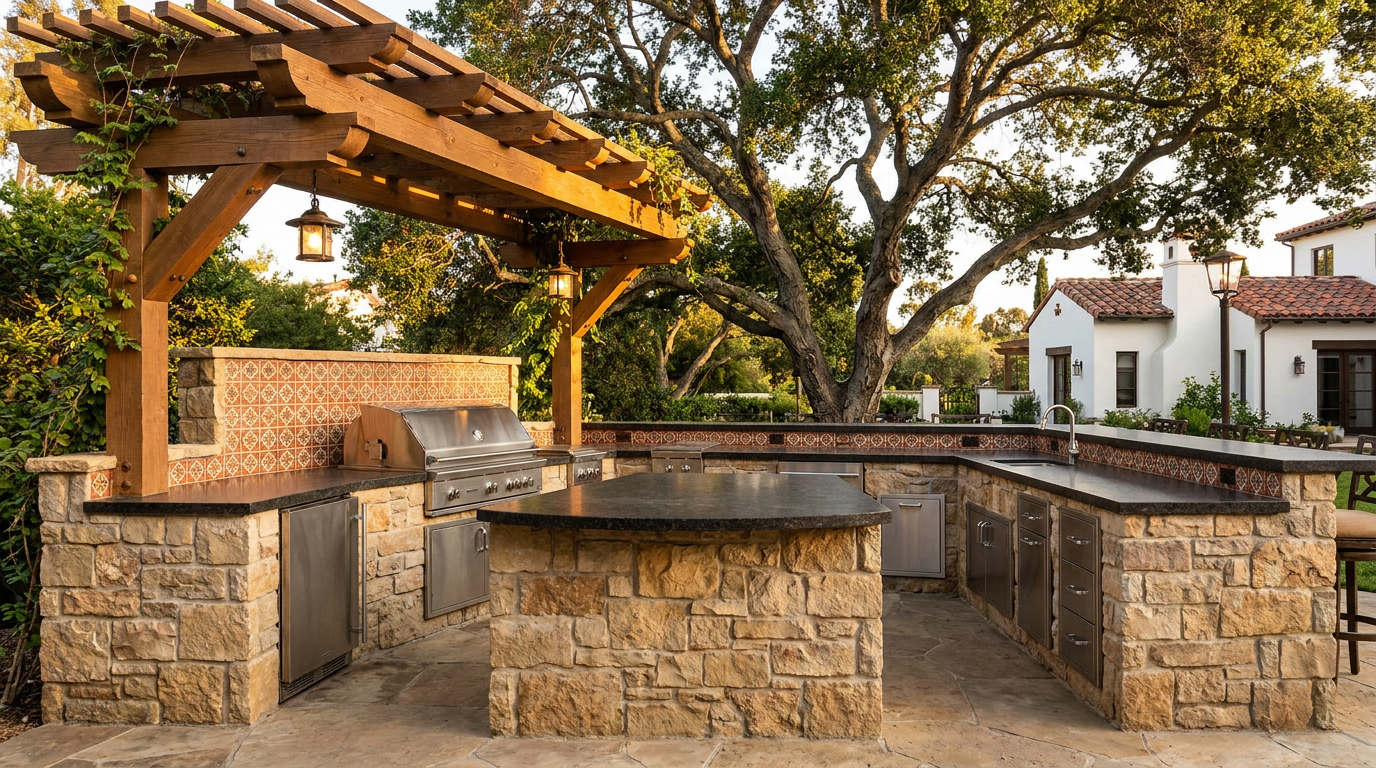
The palette the CDRC expects to see is consistent with the Lilian Rice vocabulary: hand-finished stucco on the cabinet body, Saltillo tile or clay-body tile on counter surfaces where appropriate, natural stone for the countertop, wrought iron in the hardware and any decorative elements. A stainless-steel outdoor kitchen with a powder-coated aluminum pergola above it would not pass CDRC review on a Spanish Colonial Covenant estate, and it should not — it belongs to a different neighborhood and a different century.
What this means in practice: the kitchen cabinet structure is typically stucco-finished masonry, not a modular stainless cabinet system. The countertop is quartzite, limestone, or a similarly appropriate natural stone — not a quartz composite that reads contemporary. The appliances are commercial-grade stainless and recessed into the masonry body, not the visual story of the kitchen. The grill, refrigeration, and sink are selected for performance and durability; the stucco, stone, and tile are selected for the Covenant.
The wrought iron detail — a pull, a door frame, a hanging element above the cooking station — is not decorative in this context. It is a material continuity signal. In a Covenant kitchen, the details that connect it to the house and the landscape are part of what the CDRC is evaluating.
The Scale Difference on a Two-Acre Lot
A suburban outdoor kitchen is designed for a patio that seats four to six people and lives in a yard that the kitchen visually anchors. A Covenant outdoor kitchen serves a different spatial reality.
The entertaining format on two-acre properties is different. Twelve people at a bar counter for Saturday evening is not unusual. A separate dining area for eight, a fire feature twenty feet away, and a covered structure that ties the kitchen to both — this is a normal Covenant program. The kitchen run that serves that space is not a four-foot-wide grill station. It is an eight- to twelve-foot primary cooking and prep run, often with a secondary prep station, and it is surrounded by patio that has room to breathe.
At this scale, the kitchen layout is as much an architectural decision as a functional one. Where it sits relative to the house sliders, how it relates to the fire feature, which direction the cook faces and what the view is from the cooking position — these are proportional and siting questions before they are equipment questions. A kitchen that seats eight at the bar counter, with a fourteen-foot covered shade structure behind it and a patio extending forty feet toward the pool, is designed differently than a six-foot kitchen module dropped into a thirty-by-thirty backyard.
This is also where the CDRC review is actually useful for a homeowner: the process requires you to think through the full three-dimensional composition — kitchen, structure, patio, planting — as a submitted design before construction begins. On a property where it is going to be built once and used for decades, that design discipline is not a bureaucratic inconvenience. It is the only way a project of that complexity gets built with the spatial logic intact.
Cost Range
Outdoor kitchens inside the Rancho Santa Fe Covenant typically run from $60,000 for a focused masonry kitchen without a covering structure, up to $180,000 or more when the scope includes a full-length run with premium stone counters, a covering structure that goes through its own CDRC review, a wood-burning or gas fireplace integrated into the kitchen program, and commercial-grade appliance packages.
The difference between those two endpoints is not primarily labor or quantity of stone. It is program complexity, the number of trades coordinating in one space (masonry, plumbing, gas, electrical, structural if the covering carries a load), and the degree to which the kitchen is designed as an architectural element versus a functional one.
CDRC drawing and review fees are inside our project scope. We do not bill them separately after the fact.
Related: Outdoor Kitchens & BBQ Islands · Full Backyard Remodels · Projects in Rancho Santa Fe · Outdoor Kitchen Permits in San Diego