La Jolla is one of the markets in San Diego County where the gap between a competent contractor and the correct one shows immediately. The gap shows up in the permit path — specifically, whether the contractor has ever run a California Coastal Commission submittal or presented to the La Jolla Community Planning Association. It shows up in the material selection — whether the stone and the surface treatment were chosen for the coastal environment or for a catalog photo. And it shows up in the finished product, specifically in whether the patio reads as an extension of the architecture or as something placed next to it.
Understanding what the job actually requires here makes the hiring decision easier.
What “Correct” Means in La Jolla
A correct patio contractor in La Jolla is not a contractor who is good at hardscape and willing to work in the zip code. The distinction is more specific than that.
Coastal Commission experience means the contractor has run CCC Coastal Development Permit submittals — not directed a homeowner to the Commission’s website, not subcontracted the permit prep to a permit expediter who has never seen the job site, but personally coordinated the pre-application meeting, prepared or collaborated on the narrative and the drawings, and managed the response to comments. The CCC review window for coastal hardscape and patio work on La Jolla bluff-adjacent parcels can run months. A contractor who has not been through that process is going to estimate the wrong timeline, and the wrong timeline on a $100,000 patio project is not a minor miscommunication.
LJCPA experience means the contractor has appeared before the La Jolla Community Planning Association — prepared a presentation, responded to community questions, understood the role the advisory review plays in shaping the Development Services response. LJCPA review is not regulatory, but it carries weight in the planning process and projects that arrive at LJCPA without a clean, professional presentation lose time they did not need to lose.
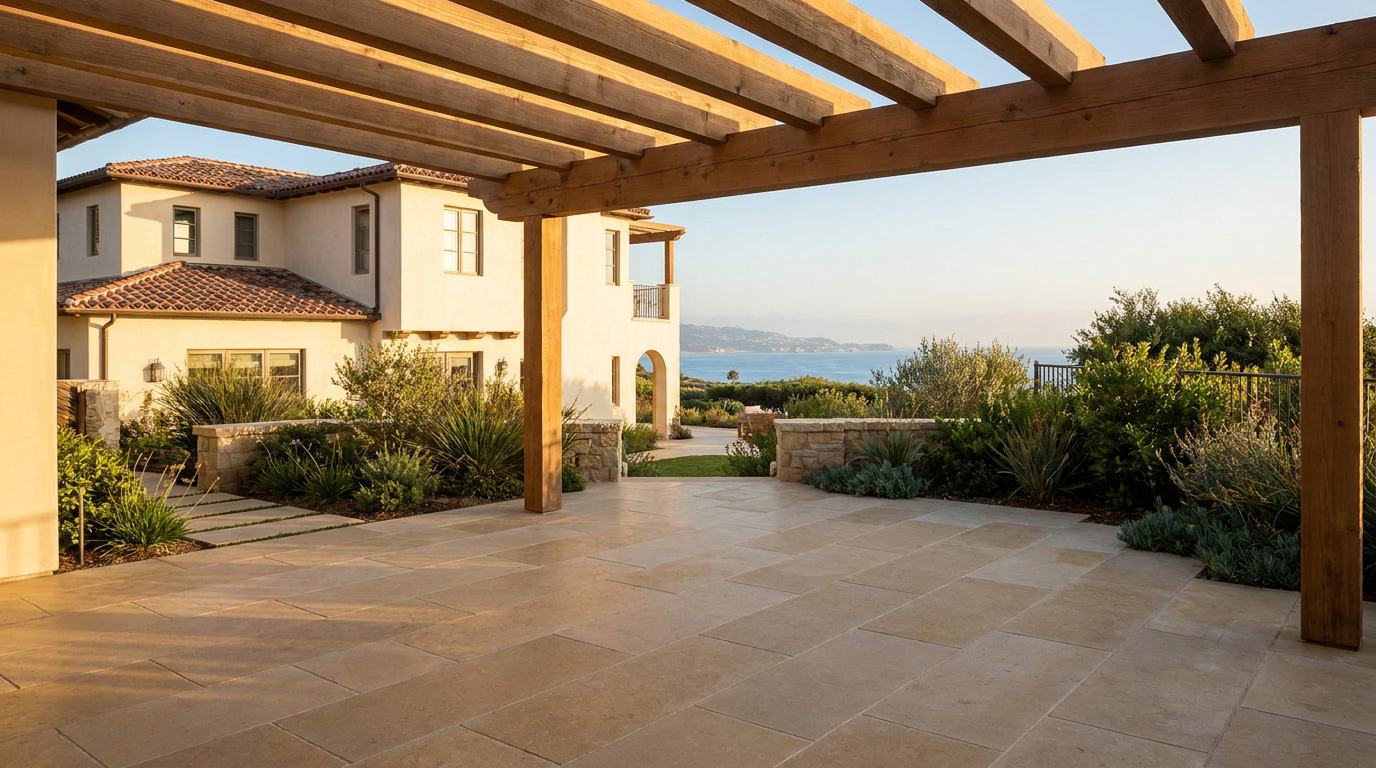
Coastal material specification means the contractor specifies hardware, fasteners, sealers, and surface treatments for the marine environment, not for the inland baseline that shows up in most standard construction documents. A patio built with standard galvanized hardware and untreated stone in Bird Rock will tell you what it needed within three to four years.
The Architecture Determines the Patio Material — Not the Other Way Around
La Jolla is architecturally diverse in a way that makes blanket material recommendations useless. The patio that reads correctly on a Spanish Revival Muirlands estate reads incorrectly on a contemporary flat-roof rebuild in Bird Rock. The material that belongs in La Jolla Farms under an ocean-exposed cantilever structure is not the material that belongs in a Hidden Valley canyon lot under a mature canopy.
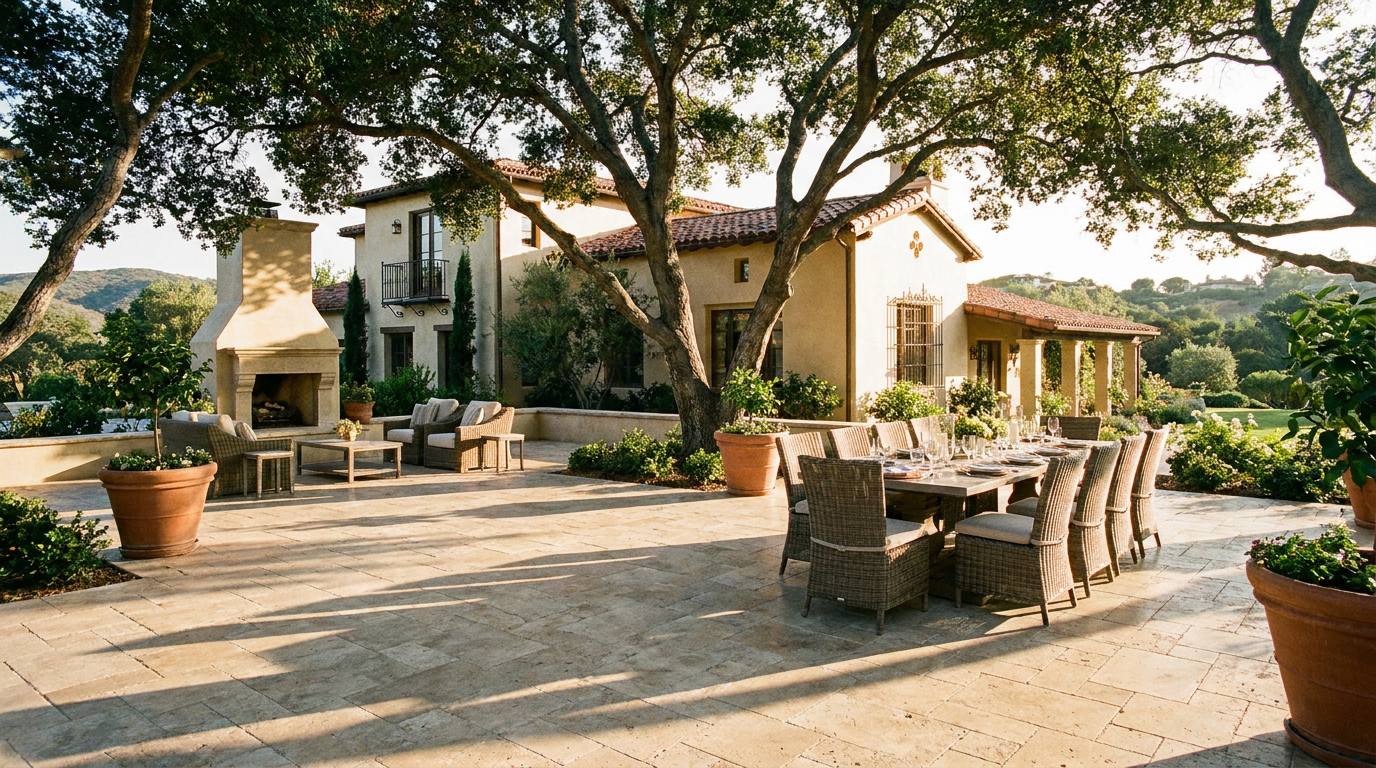
A Spanish Revival Muirlands home — the large-lot, architect-signed estates in the neighborhood’s mid-century and older stock — asks for hand-set stone, warm-toned natural material, and structure details in cedar or forged steel. The patio surface vocabulary should extend the language of the house rather than introduce a new one. Large-format contemporary porcelain does not belong there, regardless of its technical specification. Limestone in a cross-cut or bush-hammered finish, set in a pattern that respects the geometry of the architecture, belongs.
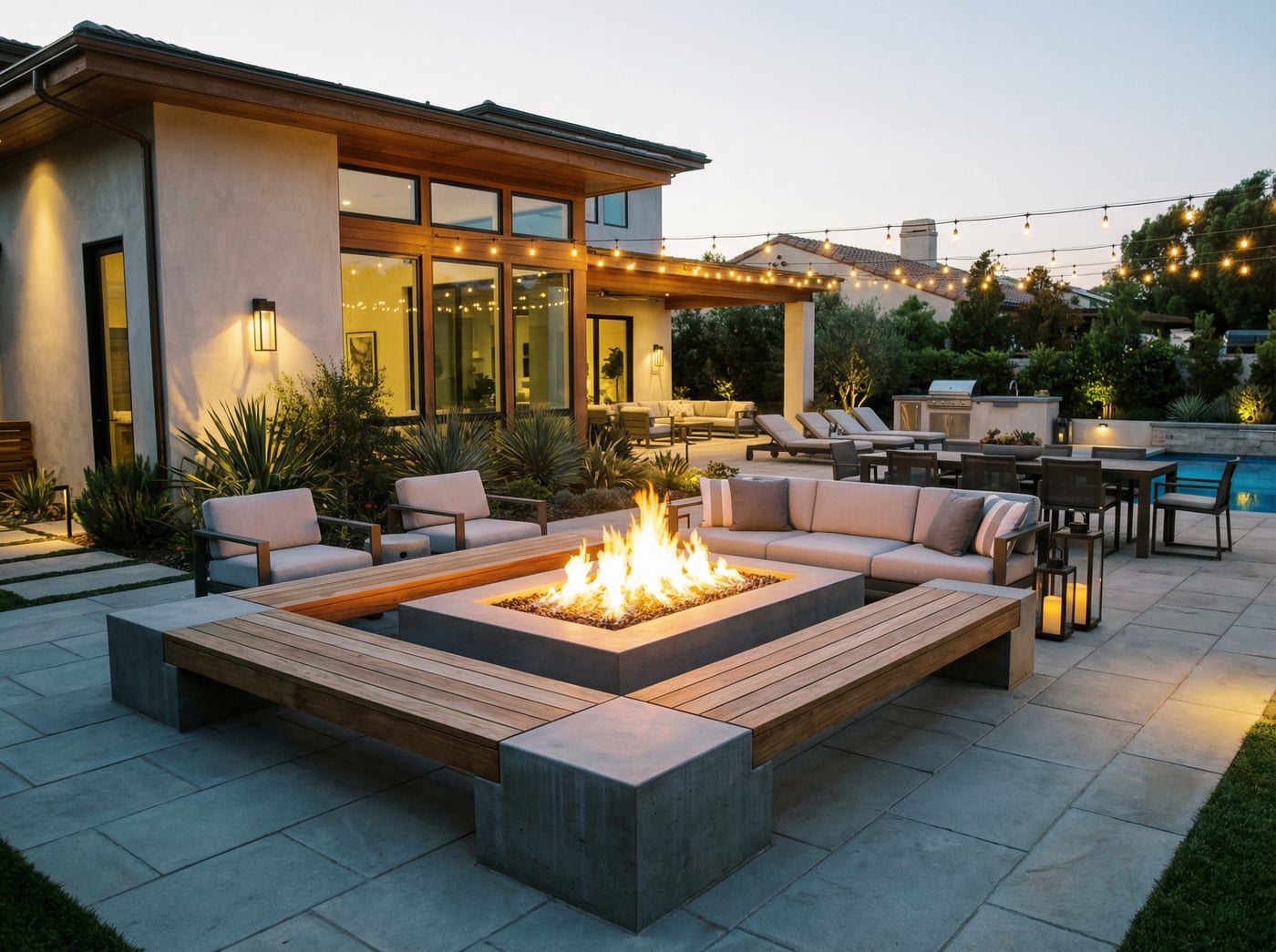
A contemporary La Jolla Farms rebuild on a bluff-edge lot with a glass-and-steel architectural language asks for something different. Large-format material — in stone, in concrete with a carefully selected aggregate, or in a high-specification porcelain with appropriate coastal ratings — reads correctly against that architecture. A travertine patio in a tumbled finish that would look at home in the Muirlands reads as architectural mismatch on a contemporary bluff-edge home.
The design process has to start with the house and work outward. A contractor who shows you three material options without first walking every room of the house and identifying the architectural family it belongs to is not doing the right design process for La Jolla.
Questions to Ask Before Hiring
Before committing to a patio contractor for a La Jolla project, there are specific questions that reveal whether the contractor is the right one for the work.
Do they pull California Coastal Commission permits themselves? Not “do they know what the CCC is” — do they run the submittals, manage the pre-application coordination, and carry the project through the post-approval appeal period in their own scope? Or do they plan to ask you to handle it, or hand it to a permit runner who will not know the project?
Have they presented to the LJCPA? Not as audience — as the presenting party on a specific project. What was the scope? What feedback did the board have? How did the project move from LJCPA review to Development Services approval? The answer to these questions tells you whether the contractor understands the advisory review environment in the LJCPA boundary, or whether they understand what it is in the abstract.
Can they provide La Jolla project references? Not testimonials — property owners in the neighborhood who are willing to let you walk the finished project. In a market where the finished patio is visible to the architecture, the neighbors, and the view, a project walk is a more useful reference than a five-star review.
What is the coastal material specification for this project? A contractor who does not immediately address the hardware grade, the sealer selection, the fastener spec, and the stone treatment for coastal exposure is not thinking about what the coastal environment actually requires.
Cost Context
Patio and hardscape projects in La Jolla typically run from $30,000 for a focused patio replacement on a Bird Rock parcel in a straightforward material, up to $120,000 or more for a full-footprint hardscape scope on a Muirlands or La Jolla Farms property with view-preservation design, CCC coordination, LJCPA presentation, and premium natural stone throughout.
The permit and process complexity in La Jolla — specifically the CCC and LJCPA layers — are not line items that vary by contractor preference. They are fixed requirements for the work in this jurisdiction, and any bid that does not include them is not a complete bid.
Related: Patios & Hardscape · Full Backyard Remodels · Projects in La Jolla · How to Hire a Landscape Contractor in San Diego · Best Patio Materials in San Diego