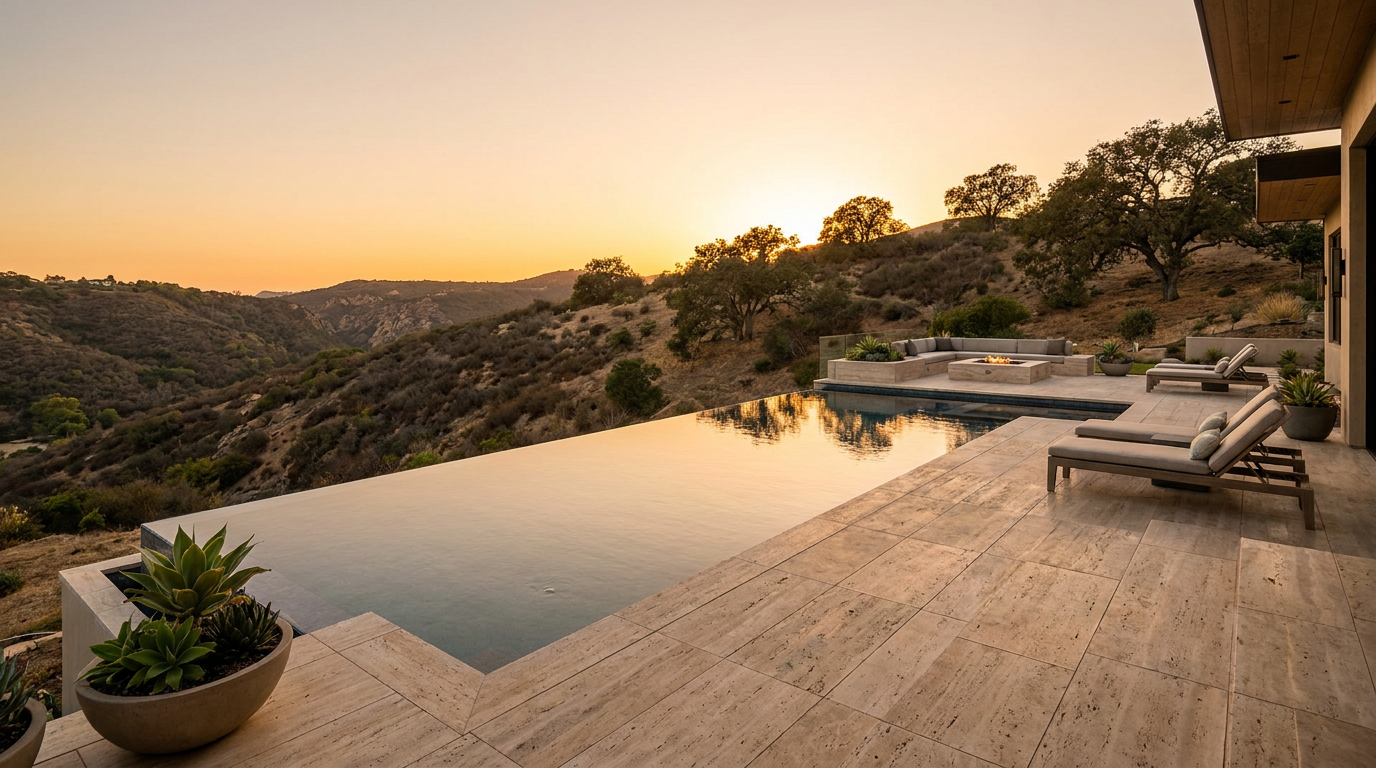
An infinity pool — also called a negative-edge or vanishing-edge pool — is the most visually striking pool design in residential construction and also one of the most technically demanding. The effect is simple to describe: the pool’s far edge disappears into the horizon, with water appearing to flow continuously off the edge. The engineering behind it is considerably more involved.
San Diego’s topography is one of the best in the country for infinity pools — hillside properties in La Jolla, Rancho Santa Fe, Del Mar, and the east county communities with canyon views are natural candidates. But the site requirements and construction complexity mean this is a decision that deserves clear expectations going in.
What an Infinity Pool Actually Is
The visual effect of an infinity pool relies on a structural system called the negative-edge catch basin. Here is how it works:
The pool’s overflow edge is lowered below the normal water level on the view side. Water continuously flows over this edge and falls into a catch basin (trough) below — concealed from view, positioned below the overflow edge. The catch basin collects the overflow water, and a return pump circulates it back into the main pool. The pool is constantly filled to the overflow level, so the water surface at the view edge appears to terminate at the horizon with no visible pool wall.
The “infinity” illusion is entirely dependent on the position and elevation of the overflow edge relative to the viewer’s sightline. From within the pool, looking toward the overflow edge, the water appears to extend to the view beyond — canyon, hillside, ocean, or open sky. From the pool deck and the seating areas, the same visual effect reads as the water “disappearing.”
Site Requirements
Not every San Diego property is suited to an infinity pool. The visual effect requires a meaningful grade change at the view edge of the pool. The catch basin must be positioned below the pool’s overflow edge, which requires sufficient grade drop on the view side to conceal the basin and its plumbing.
Properties with a flat lot do not work for a true infinity edge — there is no grade to conceal the catch basin. Properties with a few feet of grade change on one side can achieve a partial infinity effect. Properties with significant hillside or canyon drops are ideal — the catch basin can be concealed at the slope break, and the view beyond gives the infinity edge its full visual impact.
Site assessment before design: Before any design work proceeds on an infinity pool, a site assessment — including topographic survey if not already available — is essential. The grade at the view edge and the available depth below it determines whether a true infinity effect is achievable, or whether a modified or scupper-wall design is a better fit for the site.
Structural Complexity
An infinity pool requires significantly more structural engineering than a standard pool:
The overflow edge: The coping at the infinity edge must be set to an extremely precise elevation — within fractions of an inch — to produce an even overflow curtain across the full width of the edge. An uneven overflow edge produces an uneven water sheet that reads as a construction defect.
The catch basin: The catch basin must be sized to hold the volume of water that flows over the edge during normal wind and activity conditions, with adequate reserve capacity. An undersized catch basin runs dry during pool use, which draws air into the return system and damages the pump.
Structural reinforcement: The bond beam at the infinity edge bears the water load and must be engineered for that structural reality. In hillside sites, the pool structure is often cantilevered or supported on a stem wall that extends down the slope — a structural engineering requirement, not just a design decision.
Two separate pump systems: An infinity pool requires a circulation system for the main pool and a separate return pump system for the catch basin. These are two independent mechanical systems that must be balanced and controlled.
What SDLR Handles on an Infinity Pool Project
SDLR holds a Class B General Contractor license (CSLB #1139785) and specializes in the hardscape and outdoor living scope of pool projects. On an infinity pool, our scope covers:
The pool deck and surround: The deck material, the coping at the non-infinity edges, and all the hardscape surrounding the pool. For hillside infinity pools, the deck often wraps a retaining wall system — this is our core scope.
The infinity edge detail above the catch basin: The visual wall face below the overflow edge is in frame from the pool and the view side of the property. Stone veneer, tile, or smooth plaster on this wall are all in scope. This is one of the most visible material decisions on an infinity pool — a natural stone or tile-clad wall below the overflow edge is the difference between a refined finish and a utilitarian exposed concrete panel.
The catch basin surrounds: If the catch basin is accessible and visible from any part of the property, the finish of that space matters.
Integration with the broader outdoor living space: Most infinity pool projects we work on are part of a larger outdoor design — terraced hardscape levels, an outdoor kitchen or dining area positioned to take advantage of the view, shade structure, fire feature, and lighting. The infinity pool is typically the centerpiece of a larger outdoor living investment.
For the pool shell, overflow engineering, and pump systems, a C-53 licensed pool contractor is required. We work in coordination with experienced C-53 contractors on infinity pool projects.
Cost Reality
An infinity pool costs more than a standard pool at every stage:
Pool shell: The structural engineering, the precision of the overflow edge, and the catch basin system add meaningfully to the shell cost relative to a standard pool of equivalent size. A rough premium of 20–40% over a standard gunite pool of the same size is typical for the shell alone.
Pool deck and surround: Infinity pools are almost always located on sloped sites, which means retaining walls, terraced levels, and more complex hardscape to manage the grade change. The structural complexity of the site increases surround costs.
Mechanical systems: Two pump systems versus one, plus more complex controls and automation.
Total project reality: For a La Jolla or Rancho Santa Fe hillside infinity pool with full outdoor living integration — deck, coping, surround walls, outdoor kitchen, lighting — the combined scope is typically at the higher end of outdoor renovation investments. These projects are not for the homeowner who wants a pool; they are for the homeowner who wants a statement.
The View Is Everything
The most important design decision in an infinity pool is the orientation of the overflow edge. The edge must face the view that makes the visual effect meaningful — a canyon, a hillside, an open sky, or a water view. An infinity edge facing a neighbor’s fence accomplishes nothing.
If your property has a genuine view on at least one side and sufficient grade to conceal the catch basin, an infinity pool is worth considering seriously. If the property is flat or the views are limited, a standard pool — possibly with sheer descent water features or a raised spa — will deliver more visual impact per dollar.
We are happy to walk a site and give an honest assessment of whether the topography supports an infinity design before any design investment is made.
Related: Pool Decks & Poolside Hardscape · Full Backyard Remodels · Patios & Hardscape · Projects in La Jolla · Projects in Rancho Santa Fe · CSLB license verification · Eldorado Stone veneer products