San Diego’s evenings are one of its defining qualities. The temperature drops just enough to be comfortable, the air settles, and the backyard becomes the best room in the house. But a pool without lighting ends at sunset. With the right lighting, it extends for hours.
Lighting is consistently the investment that most changes the evening use pattern of a San Diego pool — more than heating, more than water features, more than any other single decision. A well-lit pool and surround at 8pm in October looks like a resort. An unlit one is invisible.
Here is what the different pool and surround lighting systems involve, what they cost, and how to layer them effectively.
LED Pool Lighting
Overview: Submerged LED fixtures mounted in the pool shell that illuminate the water from within. Modern LED pool lights replace the older halogen and incandescent fixtures that were standard through the 1990s and 2000s.
LED vs. older halogen: The upgrade from halogen to LED is compelling on every dimension. LED pool lights draw 75–80% less energy than comparable halogen fixtures, run cooler (which reduces demand on the pool chemistry), last significantly longer (50,000+ hours versus 1,000–4,000 hours for halogen), and produce a higher-quality light output in a broader range of colors.
Color-changing vs. white: This is the most common question in pool lighting. Color-changing LED pool lights can produce the full spectrum — blues, greens, purples, reds, amber — and can be programmed through a pool controller or smartphone app to cycle through colors, hold a single hue, or synchronize with music.
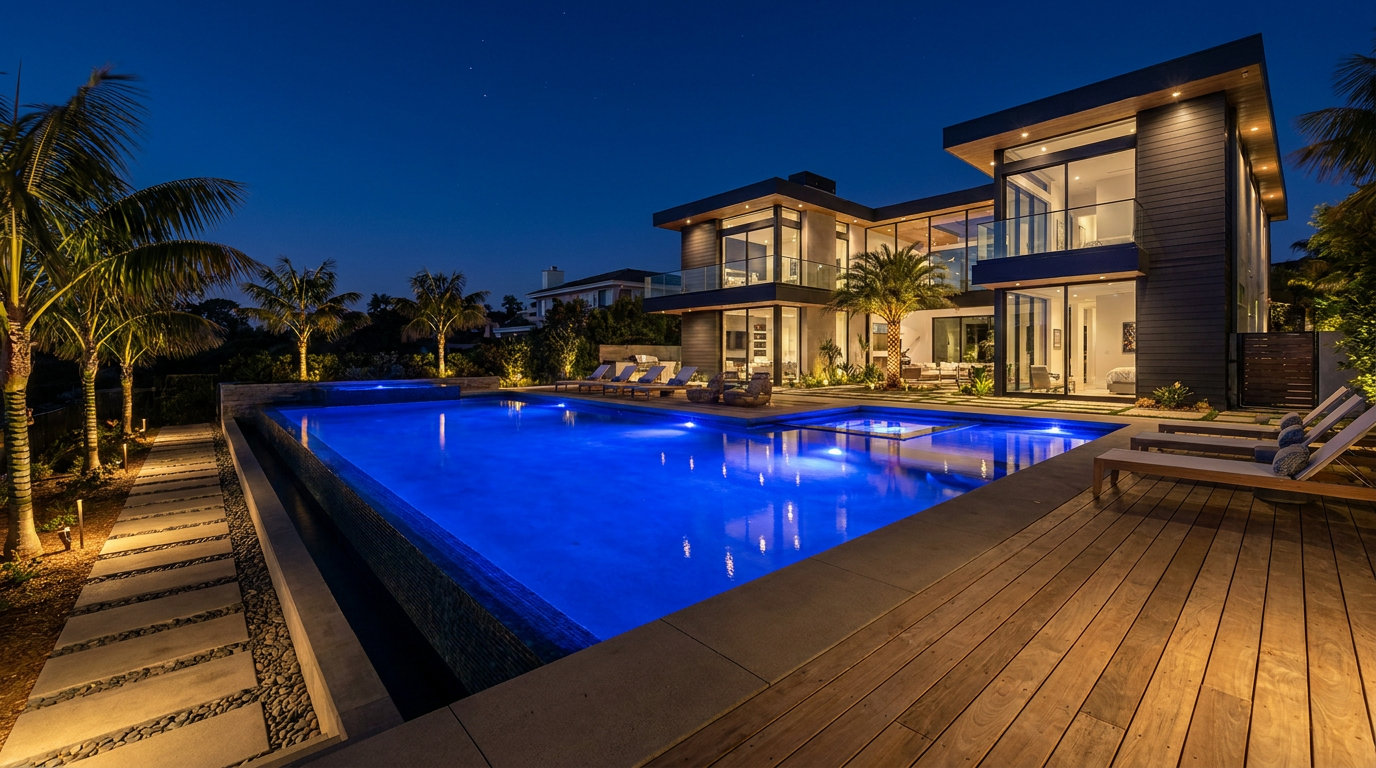
White LED pool lights produce a clean, neutral-to-warm white that reads as more architectural and refined. The water appears crisp and clear. Blue and white-blue tones produce the classic “resort pool” look — the deep blue glow visible from indoors that signals a pool is in use in the evening.
Our general observation: color-changing LED lights get used in their static blue or blue-white mode 90% of the time. The color-change feature is novel and occasionally impressive for a party; white LED fixtures produce a more consistently elegant result without any management. Specify what your actual use will support.
Fixture count: Larger pools typically require multiple fixtures for even illumination. Pools with shallow areas, steps, or spa spillovers need fixtures positioned for each zone. The pool builder handles fixture count and placement as part of the shell design; the electrical hookup and control integration is contractor scope.
Cost: $600–$1,800 per LED fixture installed (new construction). Retrofitting an existing halogen fixture with an LED upgrade (using the existing niche): $400–$900 per fixture depending on niche compatibility.
Deck and Step Lighting
Overview: Low-voltage lighting fixtures integrated into the pool deck surface, step risers, and raised walls. These are typically low-profile bollard lights, recessed path lights, or step lights that provide visual direction and safety at the pool perimeter.
What they do well: Step and riser lighting addresses the single most important safety concern in pool evening use — the edge where the deck transitions to steps, and where steps transition to water. A pool deck at night without any step lighting is a trip hazard, particularly for guests unfamiliar with the layout or children coming out of the pool in the dark.
Beyond safety, step and wall lighting creates dramatic grazing-light effects at the pool perimeter — a low-mounted fixture washing light across a stone wall creates a texture and shadow that is genuinely beautiful. Deck lighting at the pool edge, positioned to wash light across the water, creates a completely different effect than pool lighting alone.
Specification considerations: All deck and step fixtures at or near the pool must be rated for wet locations and, for any fixture at or below the waterline or within the pool perimeter, must meet electrical bonding requirements per National Electrical Code Article 680. This is a safety and permit requirement, not a guideline.
Low-voltage (12V) landscape lighting systems using a transformer are typical for deck and step lighting. Quality fixtures from FX Luminaire or Kichler on a low-voltage system last significantly longer and produce better light than cheaper box-store alternatives.
Cost: $200–$500 per fixture installed for quality low-voltage deck and step fixtures.
Landscape and Ambient Lighting Around the Pool
Overview: The broader lighting of the outdoor space around the pool — trees, planting beds, architectural elements, vertical walls, and the transition zones between pool and the rest of the backyard. This is where the pool lighting system integrates with the full outdoor lighting design.
Uplighting: Fixtures mounted at grade level, aimed upward into trees, palms, or architectural features adjacent to the pool. An olive tree or a mature palm uplighted from below at the pool corner creates a scale and warmth that dramatically changes the outdoor experience at night. The tree becomes a sculptural element rather than a background object.
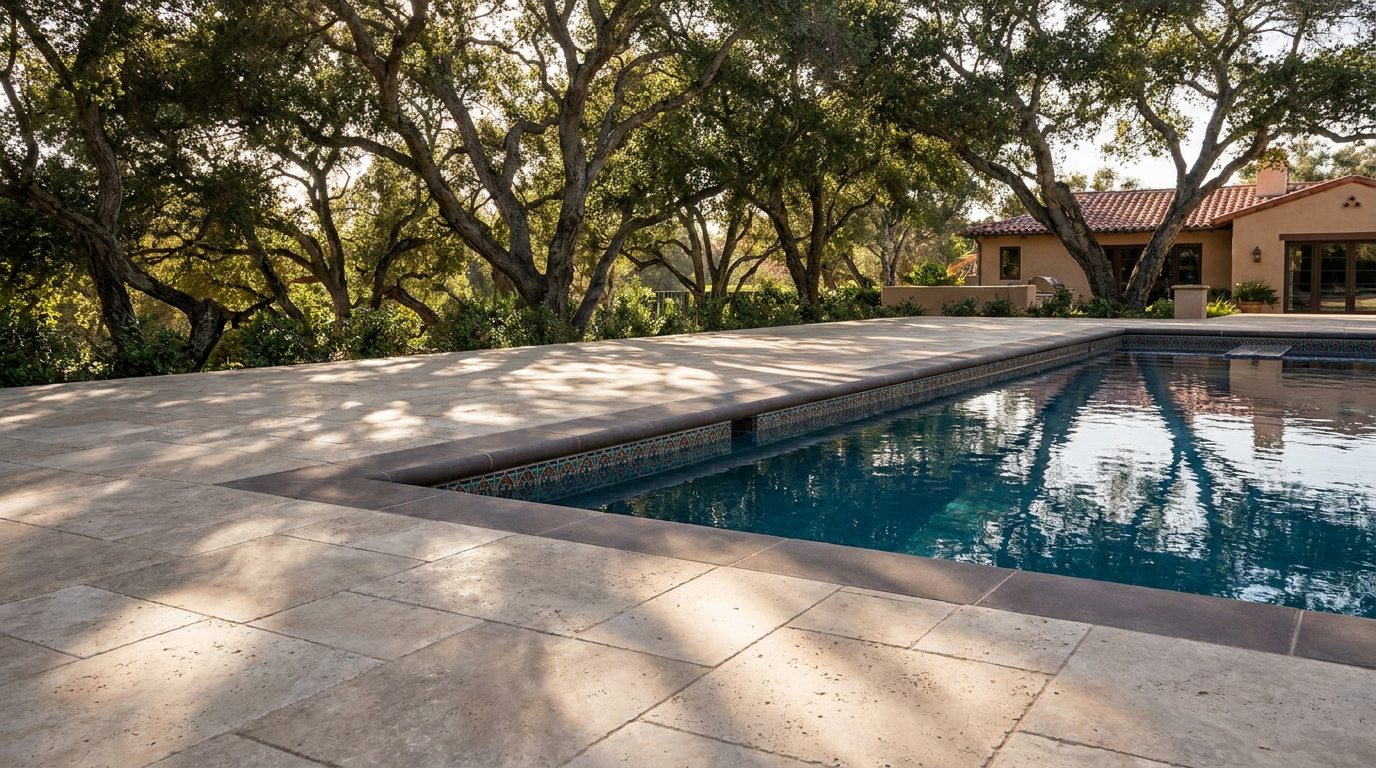
Downlighting and moonlighting: Fixtures mounted in trees or overhead structures that cast light downward through foliage, creating a dappled, naturalistic light effect on the deck and water surface. Moonlighting is the most subtle and most beautiful pool area lighting technique — it reads as natural rather than architectural, and it allows the pool to be well-lit without obvious visible fixtures.
Wall washing: Grazing fixtures that wash light across a textured wall surface — travertine, natural stone veneer, Eldorado Stone — reveal the texture of the material in a way that flat daylight does not. A stone coping wall or retaining wall adjacent to the pool washed with low-angle light becomes a focal element after dark.
Outlining and accent lighting: Fixtures that highlight the pool’s edge geometry, water feature elements, or key plantings. This is the difference between a pool that reads as dark with some lights in it and one that reads as an intentionally composed space.
Control systems: The most functional outdoor lighting systems are controlled through a single controller — either a dedicated landscape lighting timer/controller (FX Luminaire’s system is excellent) or integrated into the overall pool and outdoor automation system (Jandy, Pentair, and similar pool controllers have lighting control integration). Being able to set zones, schedules, and dimmer levels from a phone is not a luxury feature at this scale — it changes how consistently the lighting is used.
Cost for a full perimeter lighting system: $8,000–$20,000+ for a comprehensive LED landscape lighting installation around a pool and outdoor living space, depending on fixture count, fixture quality, and control system integration.
Lighting and Pool Water Features
Water features and lighting work together in ways that amplify both:
Sheer descents with LED illumination: A sheer descent backlit with a LED strip or positioned so the pool light illuminates the falling water from below turns a daytime architectural detail into a nighttime light fixture. The falling water sheet refracts the light in a constantly changing pattern.
Deck jets with laminar LED: Laminar deck jet nozzles with integrated fiber optic or LED illumination send light through the water arc — the jet appears to glow in a steady color that holds even as the arc moves. Multiple illuminated deck jets at night are genuinely spectacular.
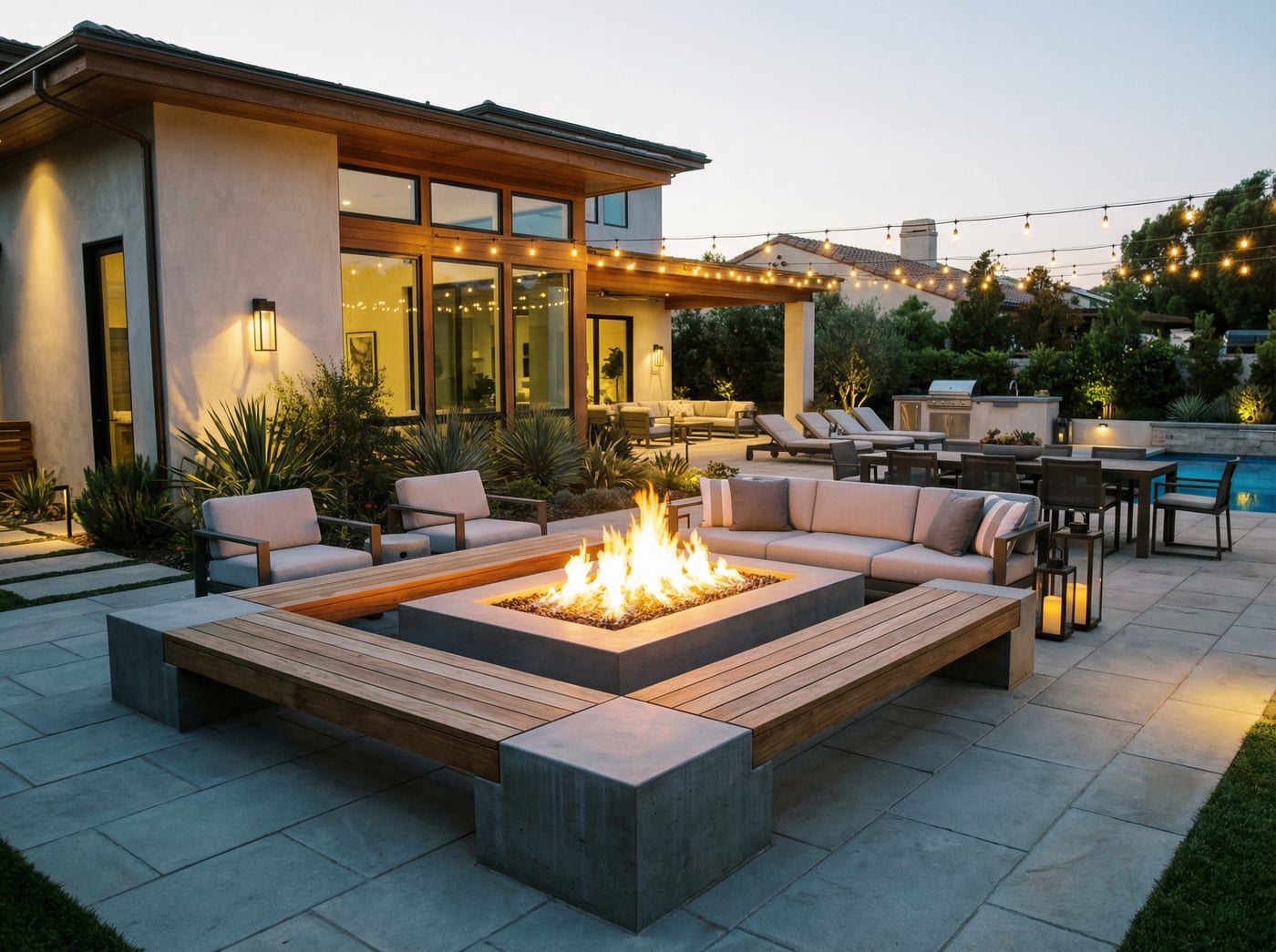
Fire and water: A fire feature adjacent to the pool — fire pit, fire bowl, or outdoor fireplace — creates the most compelling combination of effects in a San Diego backyard. The warm amber of the fire against the blue-lit pool water, the reflections across both surfaces, the sound of the water feature and the visual rhythm of the fire — this is the result that homeowners describe years later when they talk about what their backyard feels like in the evening.
Lighting is not a late-stage add-on. The conduit runs and electrical rough-in happen before the deck is set. Fixture positions — particularly for uplights, in-grade fixtures, and step lights — need to be in the design before construction starts. Retrofitting lighting into a finished deck means demolishing and resetting paver areas or cutting channels in concrete.
Plan the lighting with the same care as any other design decision, and do it at the beginning.
If you want to talk through lighting for your pool and outdoor space — what a layered system would look like, what the fixture count and zones would be — that is part of the design conversation we have at the beginning.
Related: Pool Decks & Poolside Hardscape · Full Backyard Remodels · Landscape Lighting · Fire Pits & Fireplaces · Projects in La Jolla · Projects in Del Mar · FX Luminaire landscape lighting · Kichler outdoor lighting