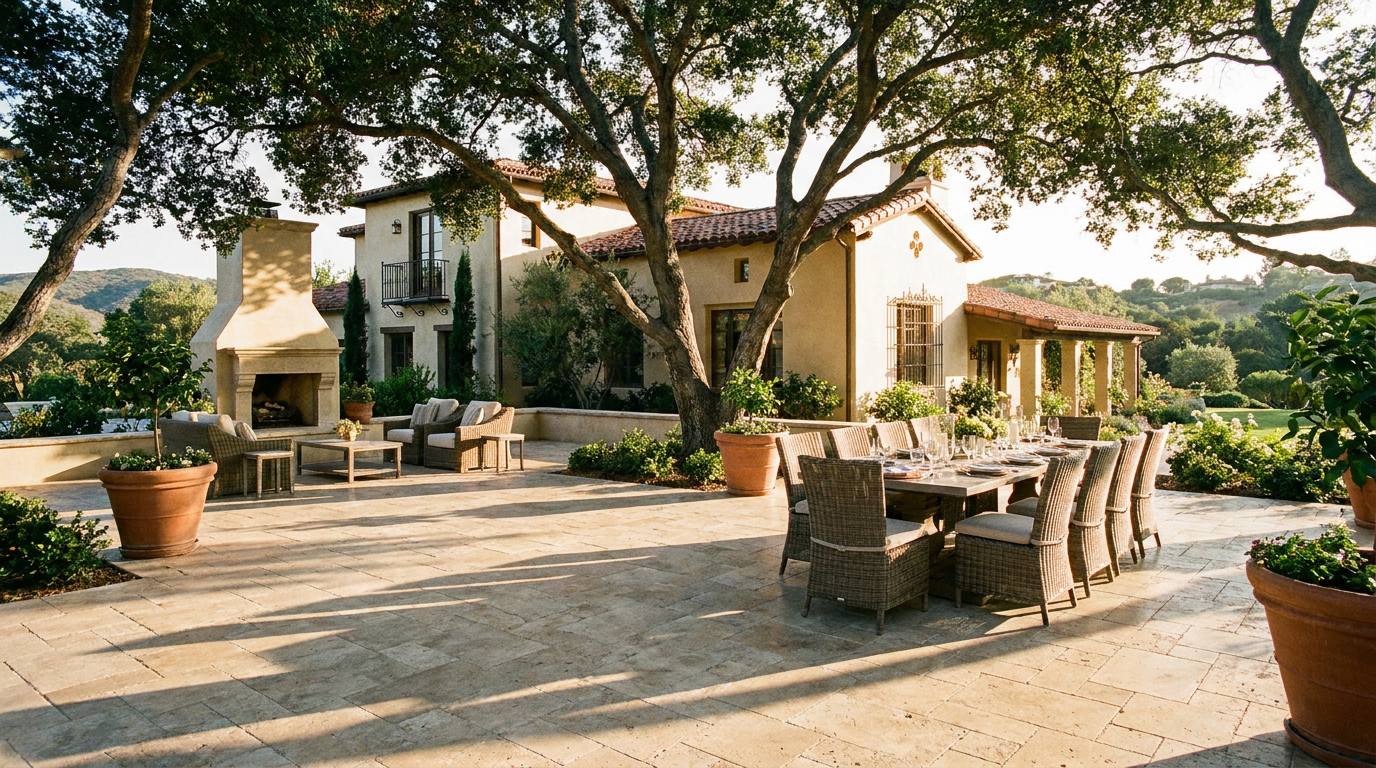
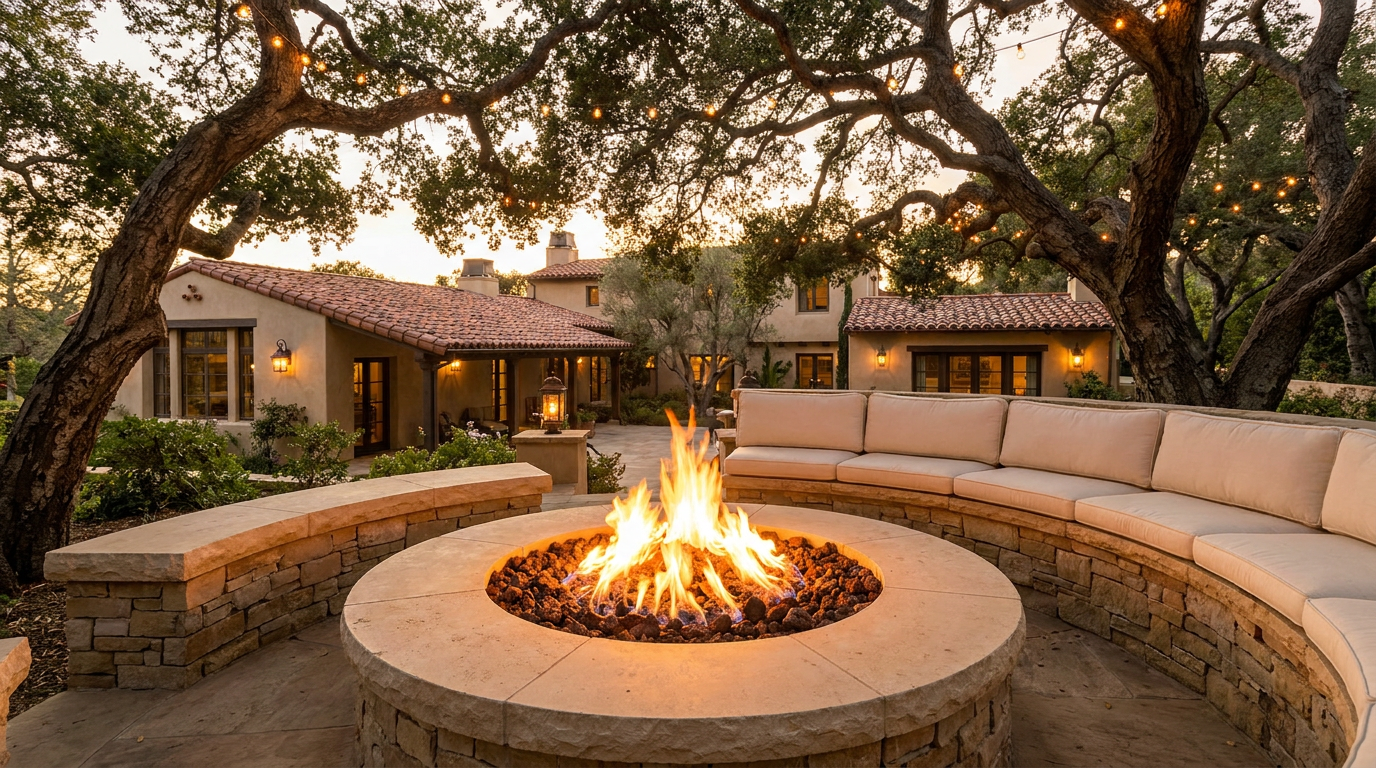
The fire after sunset in the Covenant
There is a specific quality to a Rancho Santa Fe evening that a fire extends by an hour. The inland air cools fast after the sun drops behind the hills — faster than coastal properties, noticeably so by October and through March — and the terrace that has a properly designed fire feature becomes the room that holds the gathering after the meal. The one without it empties.
A fire pit on a Covenant property is also a Covenant Design Review Committee conversation. Materials, clearances, gas line routing, and sometimes even the style of the ignition system are inside the review. We build the submittal as scope.
Gas or wood: the Covenant answer
Wood-burning fire features in Rancho Santa Fe require defensible-space awareness that a gas feature does not. The CDRC and fire district requirements around wood combustion have tightened in recent years, and on a property with mature oak canopy overhead, the spark-travel calculation is not abstract. Gas is the specification we recommend on most Covenant properties for that reason — cleaner ignition, no ash management, no ember risk under the oaks, and the ability to control the fire from the terrace without getting up.
Gas sizing matters. An undersized gas line produces a fire that looks correct in the showroom and looks inadequate on a cool October evening in RSF. We size the line to the BTU demand of the feature at the burner spec we are installing, not to a generic guideline. The number is on paper before the trench is cut.
Stone, clearances, and the CDRC material board
The material that reads correct in the Covenant for a fire feature is the same language that reads correct for the rest of the outdoor hardscape: cut limestone, handfinished stucco over a concrete block core, hand-placed natural stone, or COR-TEN steel where the architecture has already moved in that direction. The version that reads wrong is an artificial-stone-veneer wrap over a concrete block shell with grout joints that telegraph the block pattern beneath. CDRC will read the material board carefully; so will every neighbor who attends the hearing.
Clearances are structural, not aesthetic. Oak root zones, eave overhangs, overhead utilities, and setback from property lines all constrain placement. We map those constraints before we design the feature, not during installation.
Sunken, grade-level, or raised
Sunken fire pits — where the seating descends into the terrace and the fire sits below grade — are among the most requested features on Covenant estate programs. They work on the large flat terraces and semi-flat lawns that many RSF properties have between the main entertaining area and the outer landscape. The sunken format puts the fire at sight-line level from a low seat, shields the feature from the inland wind that picks up in the afternoon, and allows a taller surround height without the visual dominance of a raised structure.
Grade-level pits with a surrounding seat wall are the alternative on properties where dropping into the grade is complicated by the soil profile or the drainage plan. A seat wall in the same stone as the patio edge creates a coherent set piece rather than a standalone feature.
Raised fireplaces — outdoor hearths with a proper firebox, mantel, and chimney — are the right answer when the architecture calls for a vertical focal point and the budget and the program support one. On a Spanish Colonial estate, an outdoor fireplace in plastered block with a clay tile cap reads as if it was always there.
Defensible space and the oak overhead
Covenant parcels fall inside wildfire-aware jurisdiction, and the fire feature itself is the ignition point the plan is built around. We design clearances, seating placement, and the overhead shade structure (if any) to meet Cal Fire defensible-space guidance without removing the oak canopy that defines the property. The two goals are reconcilable. The design has to prove it.
Every fire feature we build includes a 10-Month Walk-Through: we return after the first wet winter and hot summer, walk the gas connections, the stone joints, the drain behind the fire feature, and the clearances with you. Anything the seasons have exposed gets corrected.
Licensed and insured general contractor, operating under Mike’s Class B license — CSLB #1139785.