
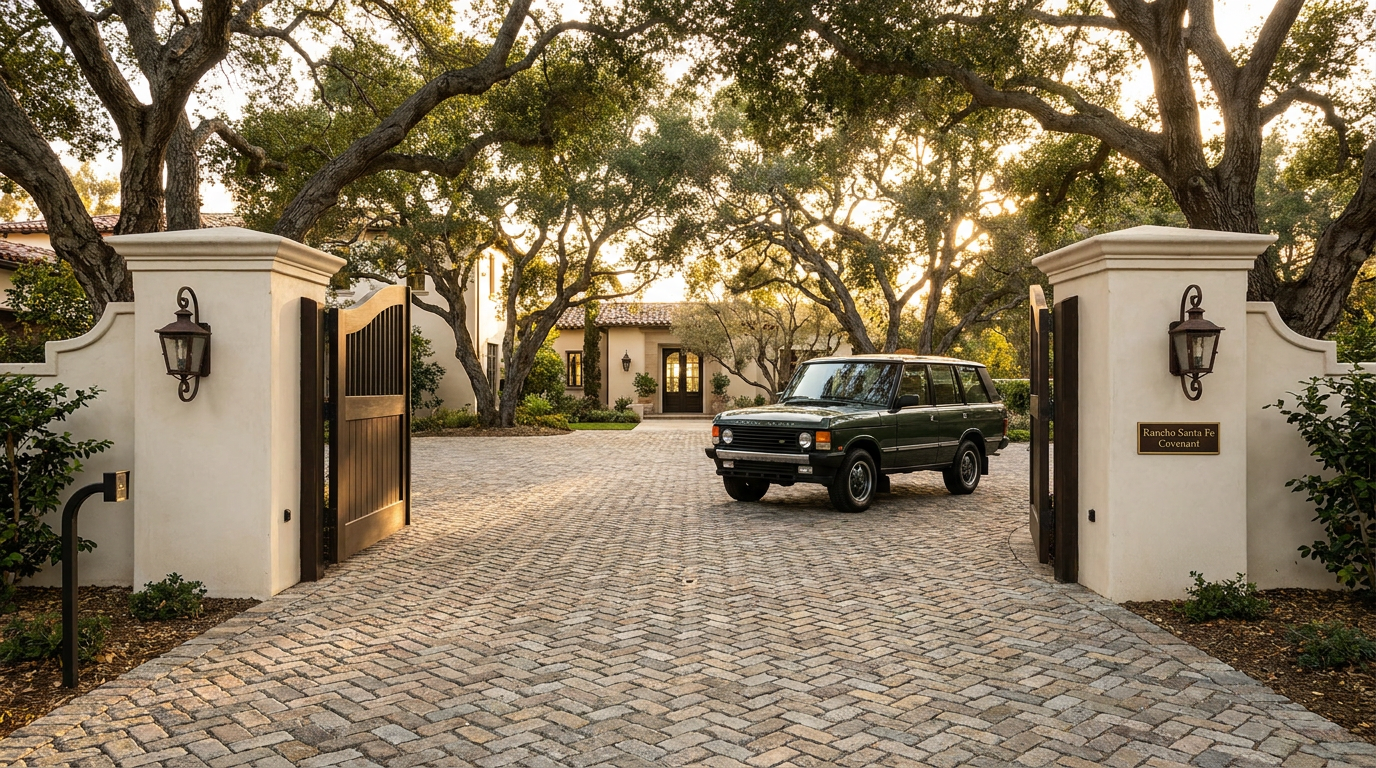
The arrival at a Covenant property
The first thing a Covenant property shows you is the approach: the gate at the road, the driveway under the oaks, the motor court at the house. That sequence is the estate’s introduction, and on a property at Rancho Santa Fe prices, it sets the expectation before a single detail of the house is visible. A correctly designed and installed driveway and motor court reads as belonging — as if it was laid when the house was built, or as if whoever laid it understood what the property was and built accordingly.
A poorly specified entry surface reads immediately as a compromise. Exposed aggregate that has lost its finish after two winters. Asphalt with edges that have crumbled. Concrete that has cracked across the center because it was poured without proper joint placement and base preparation. At this address level, that is not a neutral first impression.
CDRC review and what it covers
The Covenant Design Review Committee reviews driveway and motor court material, color, and finish as part of its exterior materials review. Exposed aggregate, certain concrete finishes, and the full range of paving stone products are on the approved-materials matrix with varying levels of review required. We prepare the CDRC concept submittal, including the material sample board, and run the review as part of the scope. We do not begin a driveway installation without CDRC sign-off.
Materials that belong at the Covenant
Cut stone and formal paving. The highest-finish specification for a Covenant motor court is hand-set cut stone or a large-format formal paver laid in a running bond or herringbone pattern in a warm cream or sandstone tone. Granite sett pavers in a cobblestone pattern read correctly on an estate that takes its cues from the Lilian Rice-era Spanish Colonial — they have weight, they have history, and they look correct next to a plastered gate column. Large-format concrete pavers at a premium specification — 24x24, hand-tumbled edges, cream or warm sand color — are the approachable version of the same result.
Decomposed granite. DG is the traditional Covenant driveway material and it is still appropriate on the right property — specifically, on a long approach driveway through mature oak canopy where a hard surface would require trenching and compaction inside the root zones, and where the naturalistic character of DG under the trees is architecturally correct. Stabilized DG with a proper polymer binder holds up through winter and does not rut under vehicle loads. Unstabilized DG does neither. We install stabilized.
Poured concrete. A broom-finish or lightly exposed-aggregate concrete driveway is not the CDRC’s preferred surface on primary Covenant entries, but it is workable on secondary access, maintenance paths, and motor court surfaces that are not the primary arrival. Color-integrated concrete in a warm earth tone, poured with proper joint placement and edge detailing, is a clean result that the committee will approve on the right application.
Asphalt. Not appropriate for a Covenant motor court or primary driveway visible from the street. Asphalt is a maintenance and surface material that reads outside the RSF vernacular. We do not propose it inside the Covenant boundary.
Vehicular drainage design
A motor court without correct drainage is a problem that appears the first February. Water that pools on a paver surface migrates into the base course, cycles through wet and dry, and produces base failure that shows up as settlement and cracking within three to five years. Every Covenant motor court we design includes engineered vehicular drainage: surface slope to drain, channel drains or area drains sized for the winter rain event, and a base course that handles the load and the water movement correctly.
Decomposed granite driveways under oak canopy present a specific drainage challenge: the DG surface must drain without eroding and without directing water toward the oak root zones. The grading plan accounts for this from the design stage.
Oak canopy and the root-zone constraint
The approach driveways on most Covenant properties run under mature oak canopy. Root zones extend far beyond what is visible at the surface. A driveway resurfacing or expansion project that grades, excavates, or compacts inside a protected root zone will damage the tree over the following three to seven years. We identify root zones before any driveway scope is designed and either work around them or use permeable installation methods where root-zone proximity is unavoidable.
Licensed and insured general contractor, operating under Mike’s Class B license — CSLB #1139785.