Why Covenant owners choose artificial turf
A two-acre Rancho Santa Fe property is a lot of outdoor surface area to maintain. Irrigation in a drought-aware county, mowing schedules coordinated around the pool and the entertaining areas, the persistent dead zones under the oak canopy where real grass cannot grow reliably — these are not small maintenance considerations on a property at this scale. Artificial turf addresses all of them when it is installed correctly and specified for the conditions.
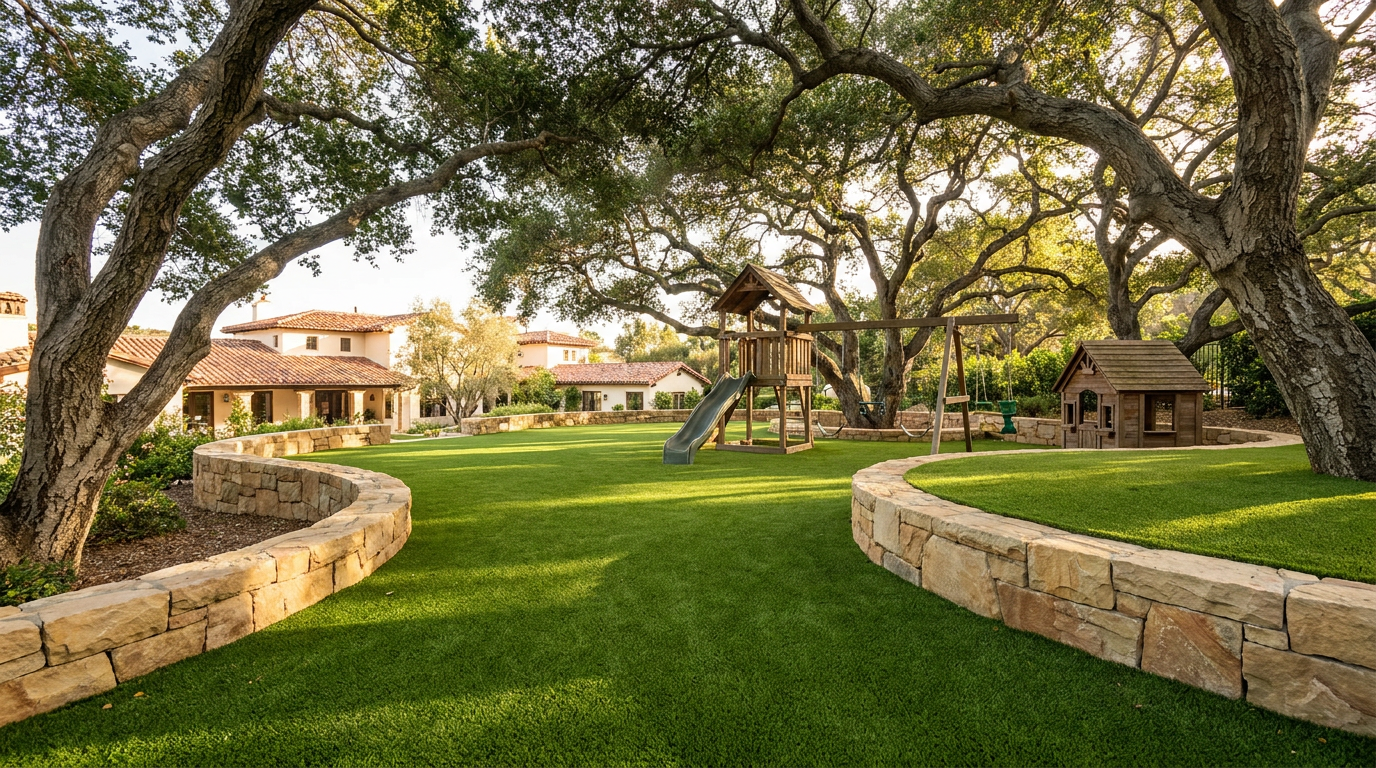
The most common application on a Covenant estate is a children’s play area: a defined zone at the back of the property or between the pool and the lower terrace where children can run, tumble, and use the space aggressively without destroying a lawn. Families with young children in the Covenant consistently cite the play area as the highest-use outdoor element on the property — higher than the pool on a Wednesday afternoon in October, higher than the entertaining patio on a Sunday.
The second common application is under the oak canopy, where real turf fails. Coast live oaks create a root zone that competes with shallow grass roots for moisture and nutrients, and the canopy shade reduces sunlight to a level most grass species cannot thrive under. Artificial turf installed over a permeable base that doesn’t disturb the root zone gives those areas a finished appearance without the maintenance fight.
CDRC review and what it covers
Exterior landscape materials on a Covenant property go through the Covenant Design Review Committee. For artificial turf, this means the color, finish, and perimeter edge treatment are included in the material board review. The CDRC has approved artificial turf installations on Covenant properties; the key is presenting the specific product — pile height, color, density, blade shape — alongside a realistic photograph of how it looks installed in a comparable setting.
We prepare the CDRC submittal, select the product for CDRC presentation, and run the review as scope.
Root zones and why they constrain the installation method
Oak root zones extend far beyond the drip line of the canopy — often 1.5 to 2 times the crown spread — and they are sensitive to any change in the soil above them. Compaction from equipment. Grade change from soil removal. Impermeable barriers that stop water infiltration. All of these damage roots over time in ways that don’t show immediately. The tree does not tell you about the root damage for three to seven years, and by then it is not correctable.
Artificial turf installed over a conventional crushed rock base with a weed-barrier membrane and concrete or aluminum edging is not appropriate inside an oak root zone. The correct installation in a root-zone-adjacent application uses a permeable aggregate base without compaction equipment near the protected zone, hand-tamped or roller-compacted at minimal pressure, with a permeable backing turf product that allows water and gas exchange with the soil below. We consult the arborist in writing when the turf installation is inside or adjacent to a protected zone.
Infill selection for inland heat
Rancho Santa Fe in August is not coastal San Diego. The ambient temperature on a full-sun turf area can run 20 to 30 degrees above the air temperature if the infill is conventional crumb rubber. On a children’s play area, that surface temperature is a safety concern.
We specify heat-mitigating infill for all Covenant play areas: silica sand and organic cork blends, or Envirofill, which holds significantly lower surface temperatures than crumb rubber while providing adequate cushioning and drainage. We test infill surface temperature on sample material in the client’s actual sun conditions before the product is ordered.
What a Covenant turf installation costs
A well-specified artificial turf installation on a Covenant property runs between $15,000 and $45,000 depending on square footage, site access, the base preparation required, root-zone mitigation, and infill specification. The product at the Covenant level is not a box-store turf — it is a high-density, natural-looking product from manufacturers like FieldTurf, ForeverLawn, or Bella Turf that holds its color and blade geometry for a decade of use. We do not install products that will look worn in four years on a Covenant estate.
Licensed and insured general contractor, operating under Mike’s Class B license — CSLB #1139785.