
The locals call it The Island, and once you have been there you understand why. Mission Trails Regional Park closes off the east. The Santee corridor pinches the north. Mission Gorge Road marks the southern edge where the canyon drops away toward the river. The fourth side — the one that opens toward Scripps Ranch and the mesa — is the only terrestrial connection to the rest of San Diego, and even that reads as a narrow corridor rather than a wide-open boundary. The result is a neighborhood that developed on its own terms: quiet streets, a trail network that connects to one of the largest urban parks in the country, and rear yards that in many cases face not another fence but the particular San Diego wildland edge where scrub oak and sage hold the slope all the way to the park boundary. Tierrasanta has been lived in for fifty years by people who understand exactly where they are. The backyards have not always kept pace with that understanding.
The property profile
Tierrasanta was developed from the mid-1970s through the early 1990s, the majority of it before 1985, which places it in a different generation from the South Bay master-plan communities and gives it the corresponding character: established canopy, settled infrastructure, streets that were not master-planned to an inch but were laid according to the topography they found. The housing stock is a mix of California Ranch and transitional contemporary — long, low profiles with wide rear elevations, double-car garages, and the generous rear-elevation window lines that characterized 1970s and 1980s San Diego residential design. The neighborhood lacks the ornamental Mediterranean vocabulary of Otay Ranch; it is more sober, more material-honest, more about the relationship to the landscape than about architectural signaling.
Lot sizes average 7,000 to 11,000 square feet, with the canyon-rim lots on the park-adjacent edges running larger when the property line is set back from the canyon face. Those canyon-rim parcels are the ones that carry the address’ most specific design opportunity: a rear elevation facing open space that extends for miles, a view that the house was oriented to capture, and an outdoor program that can actually meet the setting if it is designed for it.
There is no HOA in most of Tierrasanta in the conventional master-plan sense. The neighborhood falls under the City of San Diego’s permit jurisdiction with no HOA architectural review overlay, which means the design authority on a Tierrasanta project rests with the property owner, the city permit requirements, and — on the canyon-adjacent lots — the fire-hardening requirements that apply to the wildland-urban interface.
Soil and climate
The soil profile in Tierrasanta is predominantly silty clay loam on the interior lots and in the mesa areas, transitioning to sandy loam and decomposed granite on the park-adjacent slopes where the native material is closer to the surface. The silty clay loam is less dramatically expansive than the heavier clay of the South Bay, but it retains moisture and compacts under load, and it rewards the same base-preparation disciplines: proper excavation depth, moisture conditioning, compaction in lifts, a correctly specified aggregate base, and a setting bed appropriate to the surface above it.
On the canyon-rim lots, the slope-to-park relationship creates a drainage dynamic that needs to be understood before the patio program is designed. Water that moves off the rear of the house pad and encounters a grade change toward the canyon will follow that grade unless it is intercepted and redirected. On lots where the grade drops sharply from a rear patio to the property line, a drainage plan that captures surface flow before it reaches the slope is both a functional requirement and a condition of any structural permit for a rear-yard project.
The microclimate in Tierrasanta runs warmer than the coast and cooler than El Cajon — the park and the canyon provide air movement that the more closed suburban neighborhoods to the west lack. It is one of the few central San Diego neighborhoods where a morning fog burn-off happens early and the afternoon is reliably clear from April through October, which makes the outdoor-living calendar longer than most residents realize.
Permits and jurisdiction
Tierrasanta is within the City of San Diego. Permits for outdoor work are handled by the City of San Diego Development Services department. The applicable permit categories are structural (patio covers, pergolas, outdoor kitchens above the square-footage exemption), electrical, gas, and mechanical. There is no county overlay and no HOA architectural review requirement on most parcels, which simplifies the review path relative to the South Bay master-plan communities.
On canyon-rim and park-adjacent lots, a fire-overlay determination is part of the pre-design due diligence. The California Department of Forestry and Fire Protection maintains a State Responsibility Area map, and properties within that SRA — or within the local Very High Fire Hazard Severity Zone as mapped by the City of San Diego — are subject to Cal Fire defensible-space guidelines and the additional requirements of Chapter 7A construction on new structure work. We confirm the fire-overlay status for every Tierrasanta lot before the design phase begins. For canyon-adjacent lots in particular, it is not a step that can be deferred to the permit submittal stage — it shapes the material specification, the setback logic, and the overhead structure decisions from the first drawing.
Design character
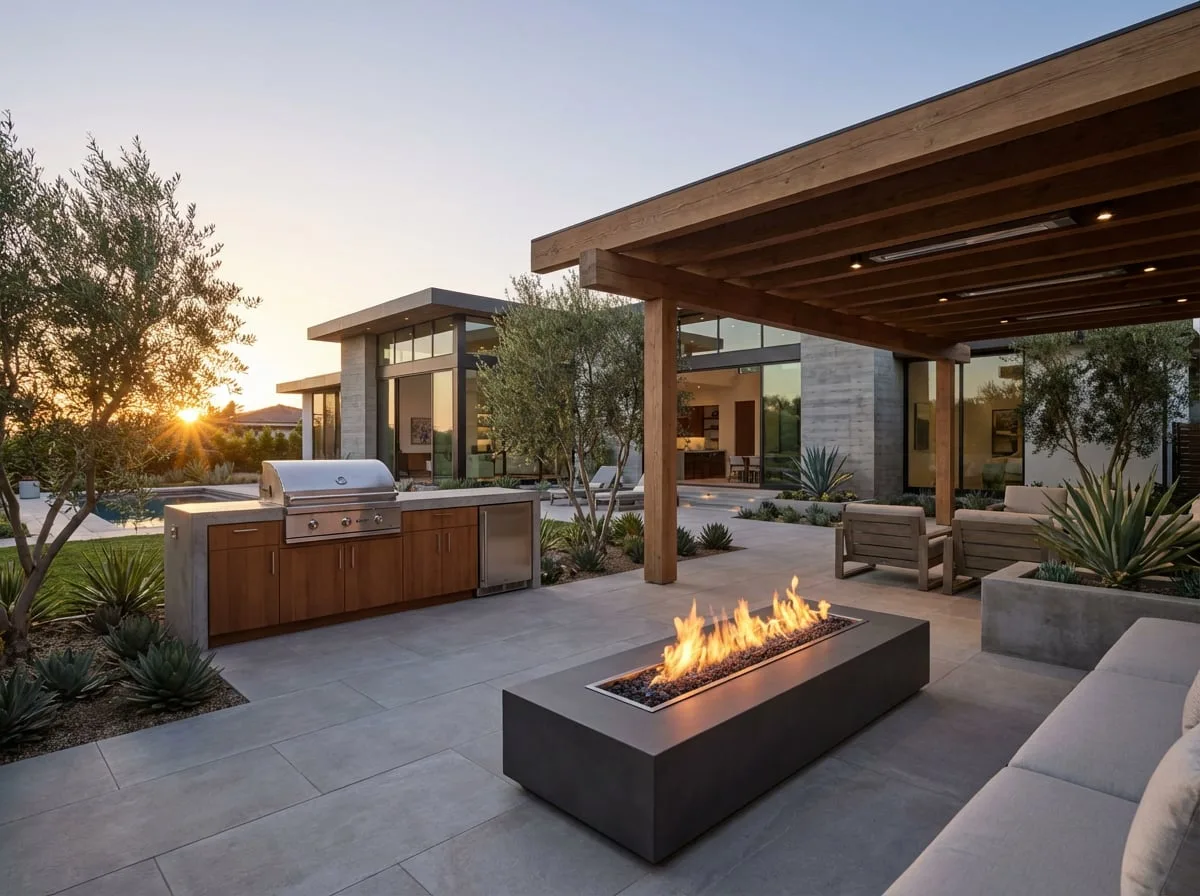
The California Ranch and transitional contemporary houses of Tierrasanta are among the most outdoor-room-ready residential architectures in central San Diego. The wide rear elevation, the direct sliding-door connection to the rear yard, and the horizontal roof lines invite an outdoor program that extends the house rather than decorates its exterior. What reads correctly here is not the ornamental Mediterranean vocabulary of a newer master-plan community but the more straightforward material language of good California residential construction: concrete pavers or natural stone in a clean format, timber shade structures with simple joinery, fire features built in masonry that matches the house rather than performing a different architectural script.
On the canyon-rim lots, the design organizing principle is the view rather than the enclosure. An outdoor room designed to close off a canyon-rim lot reads as a missed opportunity. The move is to design the room so its furniture, fire feature, and shade structure face the open space — to create a platform that captures the park edge rather than turning away from it. This requires a specific kind of spatial discipline: knowing where the view is, what frame height captures it correctly, and how to site the fire feature so the seating program faces both the fire and the distance.
Fire-hardening requirements on canyon-adjacent lots are a design input, not an obstacle. Ember-resistant vents, ignition-resistant materials at the house interface, defensible-space planting in the Zone 0 and Zone 1 bands — these have been incorporated into well-designed Tierrasanta outdoor rooms for years, and a competent contractor has been doing it that way long enough that the compliant version and the beautiful version are the same project.
Where SDLR fits
Tierrasanta is a City of San Diego jurisdiction, which means the permit process is familiar and the review path is straightforward relative to the county and HOA complexity of the South Bay communities. What it adds in its place is the fire-overlay due diligence on the canyon-adjacent lots and the specific design discipline that a park-facing rear elevation requires.
We confirm fire-overlay status, applicable SRA classification, and defensible-space requirements for every canyon-adjacent Tierrasanta lot before the first drawing is produced. That determination shapes the material specification — what overhead structure materials are specifiable, what clearances are required between combustible elements and the house, what the Zone 0 hardscape-to-planting ratio looks like — and it is more useful as a design input than as a permit-phase discovery.
The interior Tierrasanta lots, without canyon adjacency, are a more straightforward scope: a mid-sized silty clay loam site, no HOA, City of San Diego permit path, and a California Ranch or transitional contemporary house that is architecturally compatible with a broad range of outdoor-room vocabularies. The design latitude is real; the base-preparation discipline is the same as anywhere in San Diego’s inland neighborhoods.
Either Gio or Mike is personally on every project. The 10-Month Walk-Through applies to every Tierrasanta scope — returning after one winter to walk the canyon-adjacent lots and confirm that the drainage plan, the structural setbacks, and the base preparation have all performed as designed is particularly meaningful on properties where the topographic conditions are real variables.
For context on adjacent neighborhoods with overlapping character, the La Mesa and Rancho San Diego pages cover East County residential lot realities in detail. The Mission Hills page covers the older urban San Diego neighborhoods to the west.
The outdoor services we bring to Tierrasanta
Canyon-rim Tierrasanta projects often begin as full backyard remodels where the organizing idea is the park-facing view and the structural work is the platform that supports it. Interior lots may approach the program with a narrower scope. Within either frame, we build outdoor kitchens, patios and hardscape, fire pits and fireplaces, pergolas and shade structures, retaining walls, artificial turf, landscape lighting, pool decks, and drainage and grading. On canyon-adjacent lots, fire-feature design and the overhead structure material specification are coordinated with the fire-overlay requirements as a standard part of the design process.
Frequently asked
Is my Tierrasanta lot in a fire hazard zone?
The City of San Diego has mapped Very High Fire Hazard Severity Zones within city limits, and a portion of Tierrasanta — particularly the lots that back to Mission Trails Regional Park and the canyon edges to the north and south — falls within or adjacent to that mapped zone. The Cal Fire State Responsibility Area is a separate and potentially overlapping designation. We confirm the applicable fire-overlay status for every canyon-adjacent lot as part of the pre-design due diligence, before any drawings are made. This is not a permit-phase check — it is a design-phase input that changes what we specify and how we set back structures.
What does defensible space actually mean for my outdoor design?
Zone 0, extending 0 to 5 feet from the house, should be non-combustible — concrete, stone, or masonry surfaces, no wood mulch, no combustible planters against the house wall. Zone 1, from 5 to 30 feet, allows plants and planting but with specific spacing, pruning, and species criteria that reduce the probability of fire travel toward the house. An outdoor room designed within those zones — with hardscape in Zone 0, fire feature at an appropriate setback, and overhead structure in materials that meet the ignition-resistant standard — is fully compliant and, in our experience, consistently better-designed than one that ignores the zones. The constraints focus the design.
There is no HOA in Tierrasanta — does that mean I can build anything?
The City of San Diego permit requirements still apply. Structural permits are required for patio covers and pergolas above certain square-footage thresholds, electrical permits for lighting and kitchen circuits, and gas permits for built-in appliances. The fire-overlay requirements apply on canyon-adjacent lots regardless of HOA status. And on any lot, the city’s setback rules govern how close to the property line structures can be placed. The absence of an HOA removes one review body from the process — it does not remove the permit requirement or the fire-overlay compliance obligation.
What is the design difference between a canyon-rim lot and an interior lot in Tierrasanta?
The canyon-rim lots are organized by the view. Every design decision — where the seating program sits, how the fire feature is positioned, what height the overhead structure runs to, where the planting edge falls — should be evaluated against how it affects the relationship to the open space beyond the property line. The interior lots have no such organizing constraint; they are conventional San Diego residential lots where the design’s job is to create a functional, well-proportioned outdoor room in relationship to the house. Both types of lot reward a deliberate design process, but the canyon-rim lots reward a specific kind of spatial thinking that the interior lots do not require.
References available on request
We do not publish client testimonials. When a project is complete, we invite future clients to speak directly with the homeowners who have lived in the finished work. Out of respect for our clients’ privacy, their homes never become our showroom — instead, we share written references and a detailed photographic record of completed work during your discovery conversation.
When you are ready
If your Tierrasanta property faces the park and the outdoor room has never matched the view — or if the yard simply needs to be resolved at the level the house deserves — we would like to hear about it. A first conversation is thirty minutes, by phone or on the yard, and there is no cost to begin.
Licensed and insured general contractor, operating under Mike’s Class B license — CSLB #1139785. Verify any California contractor’s active standing through the CSLB license lookup.