
A community that has been lived in
Rancho Bernardo reads differently than most of San Diego, and a homeowner who has been here a while feels it before they can describe it. The yards are older and the trees above them are older still. Mornings start cool under the oaks, and by three the air along a west-facing patio is a full ten to fifteen degrees warmer than anything on the coast. Hawks work the ridgelines. A sprinkler head ticks somewhere two houses over. The neighborhood hums in a way that only happens when the same families have come and gone through the same front doors for thirty and forty years.
It is an inland North County community — warmer afternoons, real seasonal swing, long dry summers that test any outdoor surface under sun. The landscape has depth to it. Mature camphors and jacarandas, podocarpus hedges that have grown into walls, original 1970s lawns softening into something closer to garden. Concrete that has settled. Redwood fences on their third or fourth generation of pickets. The texture of a place that has watched the rest of San Diego get newer around it.
The homeowner in Rancho Bernardo rarely wants to reinvent a yard. They want to respect what is already here — the grade the house was sited on, the shade the trees have earned — and to thread a remodel through it that feels as if it always belonged. A patio that matches the bones. A kitchen under the pergola the family actually uses. Lighting that makes the property breathe at night. The result should look less like a renovation and more like the yard finally catching up with how the family has always wanted to live in it.
The property profile
Rancho Bernardo is sprawling. What reads as a single community is actually a set of distinct sub-neighborhoods, each with its own streetscape, era, and architectural habit.
Oaks North is the 55-plus community on the north side, single-story plans, intimate lots, and a resident culture that values quiet. The Trails sits east, with larger parcels and the feel of a semi-rural enclave. Bernardo Heights runs south of Bernardo Heights Parkway around its own country club and carries some of the tightest exterior review in the community. Westwood is the original 1970s heart of RB, cul-de-sac streets, ranch plans, and long-tenured families. Seven Oaks is another 55-plus sub-community with its own HOA. Rancho Bernardo West fills in to the west with a mix of eras.
Lot sizes span roughly 0.15 to 0.75 acre. Build eras run from the early 1970s straight through the 2010s, which means you can cross one street and move thirty years in architectural time. Several HOAs operate across the community, each with its own architectural review process and its own governing CC&Rs. No two adjacent projects are necessarily inside the same review body. A remodel plan that works on one street may need different paperwork two blocks away.
Soil and climate
Rancho Bernardo soil is a mixed profile — decomposed granite under most of the older hillside tracts, with clay pockets in the flatter, lower-elevation neighborhoods and genuine expansive clay showing up in scattered locations. Drainage is not automatic. A patio poured without regard to where the water actually goes in a February storm is a patio that will telegraph the soil underneath it within a few winters.
The inland climate is the other variable. Afternoon surface temperatures on a west-facing pool deck or an open turf field can run well above anything a coastal installer is used to specifying for — light-colored pavers, lighter-gauge turf infill, and shade planning become material choices, not decorative ones. Mature landscape in the older neighborhoods adds a second layer: root systems under existing hardscape, canopy shade that changes where planting will actually thrive, and decades-old irrigation that rarely matches the program a new remodel will need.
Permits and jurisdiction
Most of Rancho Bernardo is inside the incorporated City of San Diego, which means the permitting path runs through City of San Diego Development Services rather than the County. Structures over permitted area thresholds, retaining walls above the code height, pool and spa work, gas and electrical runs for outdoor kitchens, and any grading that moves meaningful dirt all trigger their own reviews.
On top of the City, Rancho Bernardo is one of the most HOA-dense communities in the county. Bernardo Heights Community Association, Seven Oaks HOA, and Oaks North HOA each operate formal architectural review, and many sub-neighborhoods within those umbrellas carry their own sub-association ARCs with additional submission requirements. Exterior review is common — color palette, material, height, setback, roof line of any shade structure, and fence detail all get examined before a permit is even worth filing. We treat the HOA review as a first-class part of scope, not an afterthought. Submitting to the City before the ARC has signed off is how a project loses months it did not have to lose.
Design character
Rancho Bernardo has a layered design vocabulary because it was built across four decades.
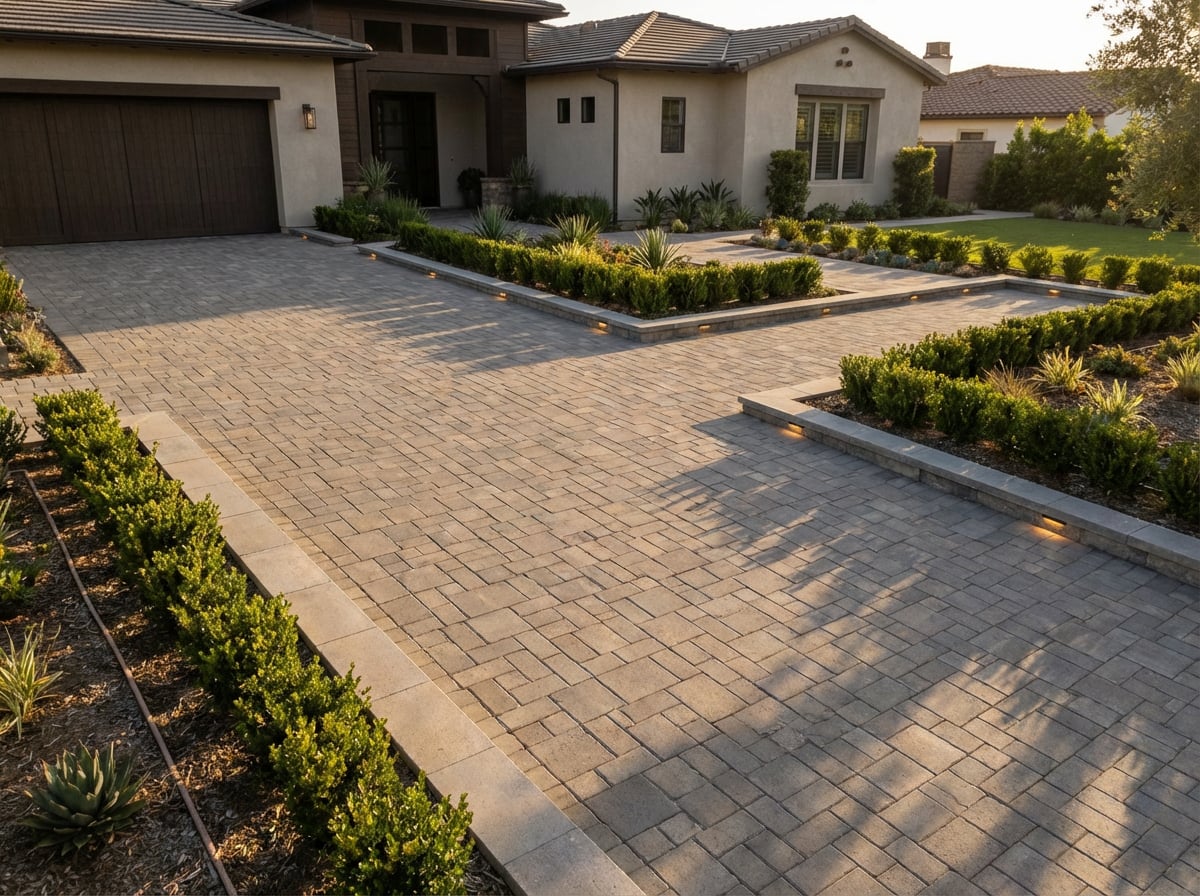
The original 1970s Westwood and Rancho Bernardo West tracts carry mid-century ranch bones — low horizontal roof lines, deep eaves, sliders onto broad rear patios, and a quiet relationship between the house and the lot. The best remodels in these neighborhoods are refreshes, not reinventions: paver or hand-set stone replacing the original washed-aggregate, a pergola that respects the existing roof plane, a planting program that lets the mature trees keep their role.
The newer 1990s and 2000s tracts in Bernardo Heights and parts of Seven Oaks lean Mediterranean and Spanish Colonial — stucco volumes, tile roofs, arched openings — where the outdoor palette can move toward warmer stone, plaster-finished walls, and a quieter, more architectural line along retaining edges.
The 2010s-era homes scattered through the community and the most recently renovated interiors push a contemporary transitional direction: clean geometry, softer material contrast, integrated lighting, and shade structures with engineered detail rather than ornament.
Older neighborhoods reward respectful refresh. Newer tracts reward elevation within palette. A remodel that fights the era of the house is a remodel that looks wrong the day it finishes.
Where SDLR fits
We run projects in Rancho Bernardo as true design-build, under a single scope that includes both the HOA architectural review for your sub-community and the City of San Diego Development Services permitting process. Two approval tracks, one coordinated plan, one set of drawings submitted once.
Gio and Mike are personally on every project — the first conversation, the site walk, the design review, the build. Our Field Lead runs the day-to-day on the ground with twenty-five years behind him, and the same crew that breaks ground also puts the final light in at handover. No sub-contracted relays, no account manager between you and the founders, no handoff where the plan quietly changes shape.
Ten months after we complete your project — after a wet winter, a hot September, and the first real year of use — we come back for The 10-Month Walk-Through. We inspect every square foot of our work with you, joint by joint, and handle anything the seasons have exposed, on our dime. Almost nobody in this industry does this. It is exactly why we do.
We plan our Rancho Bernardo projects months ahead, in a short list each year. By design, not by dispatch.
Services we run in Rancho Bernardo
- Full backyard remodels
- Outdoor kitchens and BBQ islands
- Patios and hardscape design
- Fire pits and fireplaces
- Pergolas and shade structures
- Retaining walls and seating walls
- Artificial turf installation
- Landscape lighting
- Pool decks and poolside hardscape
- Drainage and grading
Frequently asked
How does HOA review work when I am in Bernardo Heights, Seven Oaks, or Oaks North?
Each association runs its own architectural review committee, and each has its own submission packet, color and material palette, height and setback limits, and review cadence. We prepare an ARC-ready drawing set for your specific sub-community — elevations, material call-outs, planting plan, lighting scope — and submit under one coordinated package. Sub-neighborhood ARCs inside the larger associations sometimes add a second review layer. We build that into the schedule up front rather than discovering it midway through.
What material choices actually matter for inland Rancho Bernardo heat?
Pool deck surface temperature is the first one. Darker pavers and unmodified concrete can reach afternoon temperatures that are genuinely uncomfortable to stand on barefoot. We specify lighter-value paver systems, shell-blended concretes, or hand-set stone with real thermal mass when the exposure is west or southwest. For turf, the infill spec matters as much as the blade — cooler-running infills and the right gauge of backing make a measurable difference on a July afternoon. Shade structures are not decoration here; they are part of how the yard actually gets used for half the year.
We have a mid-century ranch from the original Westwood tract. How do you approach a refresh?
Quietly. The bones of those homes — long horizontal roof line, deep eaves, slider-first rear elevation — already want a specific outdoor language. We tend to replace the original washed-aggregate with paver or large-format stone in a warm neutral, introduce a pergola that respects the existing roof plane rather than competing with it, hide the lighting inside the architecture, and let the mature trees keep their role in the composition. The result should look like the yard the house was always meant to have.
Do the Oaks North and Seven Oaks 55-plus communities have special considerations?
Yes. Lot sizes are often more intimate, single-story plans limit the places a structure can visually sit without dominating the elevation, and residents understandably value low noise and short construction windows from their neighbors. We plan the build with tighter site protection, define clear work-hour windows, and sequence the noisier phases (demo, saw cuts, compaction) into defined days we coordinate with you and, where appropriate, with the association in advance.
What does a typical Rancho Bernardo project budget look like by sub-neighborhood?
It depends more on scope and lot condition than on the ZIP. A focused refresh on a Westwood or Oaks North lot — new hardscape, a shade structure, lighting, and planting — tends to land in the $50,000 to $120,000 range. A coordinated remodel on a Bernardo Heights or Seven Oaks property with outdoor kitchen, pool deck integration, and retaining work typically runs $150,000 to $300,000. Larger Trails parcels with full grading, structure, and planting programs can run above that. We do not take on small-scope work, and we do not price-match.
How does this compare to working in 4S Ranch or Poway?
4S Ranch is newer, more uniform, and dominated by one large master-plan HOA with a tightly-defined palette — the design work is about elevation within the palette rather than respecting thirty-year-old bones. Poway sits under its own City of Poway permit jurisdiction with looser HOA density and larger, often sloped lots — grading and drainage tend to dominate the scope. Rancho Bernardo sits between the two: older, more layered, more HOAs to coordinate, and more variety in what each street wants a remodel to look like. The communities share inland heat; they do not share process.
How close are you to neighborhoods like Santaluz?
Rancho Bernardo, 4S Ranch, Santaluz, and Poway sit inside the same inland North County working radius for us. We plan projects in all four as part of the same year, and the same crew moves between them. By design, not by dispatch.
Do you handle permits?
Yes. Permitting and HOA review are inside our scope on every Rancho Bernardo project. We prepare the drawings, submit to the relevant City of San Diego Development Services counter and to your sub-community’s architectural review committee, respond to plan-check and ARC comments, and schedule inspections. You sign. We do the walking.
References available on request
We do not publish testimonials. When a project is complete, we invite future clients to speak directly with the homeowners who have lived in the finished work, and during discovery we are glad to walk you past completed projects in the neighborhoods where they sit. You can verify Mike’s active Class B general contractor standing any time through the CSLB license lookup.
When you are ready
If your Rancho Bernardo property is ready for a real plan — not a quote on the back of an envelope, not a crew rolling a truck on Thursday — we would like to hear about it. A first conversation is thirty minutes, by phone or on your yard, and there is no cost to begin. We will listen, we will tell you what we see, and we will tell you honestly whether we are the right firm for the work.
Licensed and insured general contractor, operating under Mike’s Class B license — CSLB #1139785.