
A Saturday morning, behind the gate
There is a specific quiet to a Fairbanks Ranch morning. The guard at the gate knows the cars. The eucalyptus along the entry drive has been there long enough to belong. By the time your coffee is cool enough to drink, a neighbor has already taken a horse down the bridle trail, a pair of egrets has worked the edge of one of the three private lakes, and the only traffic noise you will hear for the rest of the day is your own gravel.
It is the kind of morning that makes a Saturday at home feel like a day at a private club. Nobody is arriving. Nobody needs to. The tennis courts and the clubhouse are a short walk, the trails run behind the hedge line, and the property itself does most of the entertaining. You put breakfast out on a terrace that reads as part of the house. Grandchildren find the grass. By noon there are eight cars in the motor court and nobody has raised their voice to be heard.
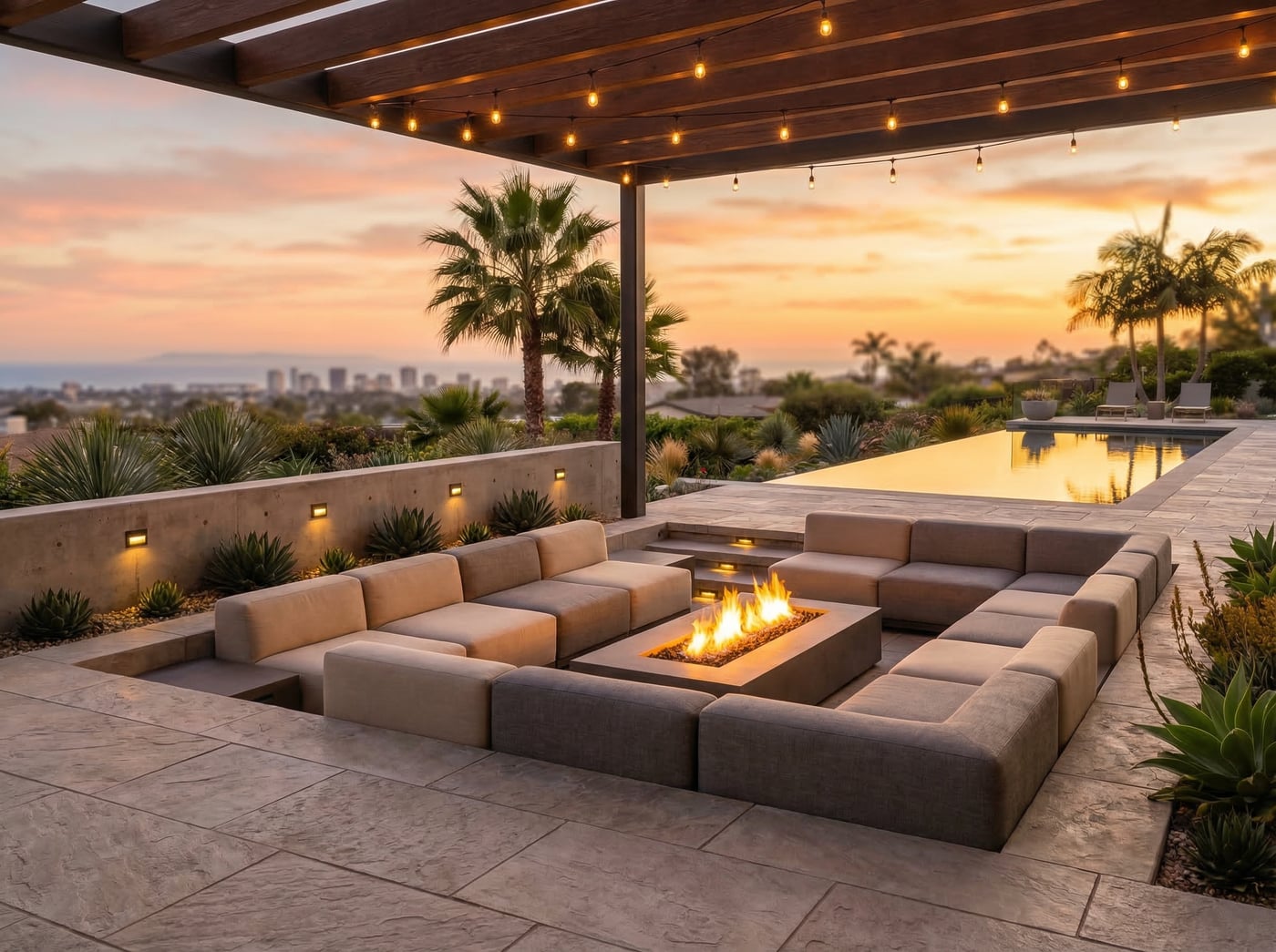
A home in Fairbanks Ranch is not something you open for an event. It is something you live in. The right outdoor footprint is the part that proves it — a terrace that holds a dinner for twenty without feeling staged, a pool edge your grandchildren can use barefoot, a shade structure that does not creak under the first Santa Ana. Quiet in the morning. Unmissable when it matters. That is the assignment.
The property profile
Fairbanks Ranch is a gated, master-planned community of roughly 343 custom estates on the west side of the San Dieguito River valley. The community sits on ground that was once part of Douglas Fairbanks and Mary Pickford’s 1920s ranch — the equestrian heritage is not decoration, it is how the place was laid out. Private bridle trails weave between the parcels. The stables and paddocks are woven into the community plan, not bolted onto its edge. Three private lakes anchor the lowest part of the land and shape drainage for everything above them.
Lot sizes run from roughly half an acre to two-plus acres. Home values cover a very wide range — an entry Fairbanks Ranch property clears several million dollars, and the top of the market sits comfortably in the tens of millions. Architecture is custom, scale is generous, and the streetscape is deliberately restrained: low signage, mature planting, deep setbacks.
Owners here expect discretion as a default. Staff, stylists, contractors, and delivery drivers work to the same standard. On a project of this scale the homeowner’s experience of the build matters at least as much as the finished photograph.
Soil, climate, and water
The ground across Fairbanks Ranch is mixed. Large swaths of the community sit on decomposed-granite alluvium — fast-draining when undisturbed, but prone to dust and migration under traffic and irrigation if the base is not properly sized. Pockets of clay loam appear along the lower elevations and near the lake margins, and those pockets behave very differently under load. A hardscape detail that performs on a DG pad on the west side of the community can crack on a clay pad a hundred yards downslope.
The planting palette that actually thrives is Mediterranean and Southern California native — olive, live oak, pepper, sycamore, coast rosemary, salvias, agaves, manzanita — with selective tropical accents in protected courtyards. Inland coastal climate: dry summers, mild wet winters, occasional frost in the low pockets, and real Santa Ana exposure for a few days a year.
Drainage across a one- or two-acre parcel is engineered, not assumed. Surface flow, subsurface French drains, and lake-adjacent tie-ins all have to be designed before the first patio is cut.
Permits and jurisdiction
Fairbanks Ranch is unincorporated, which means the building and grading permits go through San Diego County Planning & Development Services, not a city office. County plan check, county inspection, and — for anything that touches grading, retaining, pool shell, gas, or structural shade — county sign-off. The workflow is predictable once you have run it, and slower than a city workflow if you have not.
The second, non-negotiable layer is the Fairbanks Ranch Country Club HOA Architectural Review Committee. Every exterior project — hardscape footprint, structures, lighting, planting program, material palette, even color — is submitted and reviewed before any work begins. The ARC packet standard is serious: site plan, elevations, material samples, planting schedule, and often a story-pole exercise on the property itself. Review windows are scheduled, not sped up.
Discretion clauses appear in the community’s operating culture as much as on paper. On-site deliveries, dumpsters, portable facilities, and crew parking are coordinated with the guard gate in advance. Vendor lists are issued. Start and stop times are honored. A builder who treats the gate as a detail discovers, quickly, that the gate treats the builder as a detail.
Design character
Fairbanks Ranch architecture sits on four main axes: Mediterranean, Spanish Colonial, French country, and contemporary Mediterranean. The outdoor vocabulary follows the house. Hand-troweled stucco and smooth integral-color stucco. Cut limestone and travertine. Terracotta, hand-glazed tile, and cantera stone on feature walls. Clear cedar and Accoya on pergolas and trellises. Wrought iron and dark-bronze steel on railings, gates, and light fixtures.
The scale of a Fairbanks Ranch parcel asks for restraint, not volume. A half-acre terrace handled as a single sea of paver reads as parking lot. The same half-acre broken into rooms — dining terrace, lounging terrace, pool apron, shade pavilion, planting garden — reads as estate. Stone walls become seating. Changes of level become invitations. The planting program is the quiet hero: a mature olive in the right place does more for the finished photograph than any hardscape detail.
The properties that age well here share one thing. They look as if they have always been there. The materials were not chosen to impress; they were chosen to last. The result is a yard that belongs to the house, and a house that belongs to the land.
Where SDLR fits
A Fairbanks Ranch project is not an install. It is a design-build engagement that runs for months, on a property the owner expects to keep for decades. We write the scope accordingly.
The County PDS plan-check process and the Fairbanks Ranch ARC submission are inside our scope — we prepare the drawings, assemble the material samples, run the ARC packet, respond to review comments, and carry the project through inspection. Guard-gate coordination is a standard operational item on our projects here: vendor pre-registration, daily crew manifests, delivery windows, dumpster placement, and end-of-day site condition are agreed with the community before the first truck rolls.
Both founders are personally involved. Gio or Mike is on your property for the first conversation, the program brief, the material review, and the pre-construction walk, and remains reachable by cell throughout the build. A single crew runs the work from first cut to final clean. Our Field Lead, with twenty-five-plus years of high-end outdoor build experience, runs the day-to-day on the ground.
Ten months after completion we come back. The Ten-Month Walk-Through is a fine-toothed inspection of every square foot of our work — after a wet winter, a hot September, and the first real wear the property has seen. Anything that needs attention gets attention. No invoice. It is how an estate-grade relationship is supposed to end.
Discretion is assumed. Names, addresses, photographs, and details of the work stay off any channel without the homeowner’s explicit consent.
Services we run in Fairbanks Ranch
Estate-scale remodels typically combine several of the scopes below into a single coordinated plan. We write one set of drawings and one schedule, and a single crew executes all of it.
- Full backyard remodels
- Outdoor kitchens and BBQ islands
- Patios and hardscape design
- Fire pits and fireplaces
- Pergolas and shade structures
- Retaining walls and seating walls
- Artificial turf installation
- Landscape lighting
- Pool decks and poolside hardscape
- Drainage and grading
Neighboring communities we also serve: Rancho Santa Fe, Santaluz, and Olivenhain.
Frequently asked
How does the Fairbanks Ranch ARC review actually work?
Every exterior project is submitted to the Fairbanks Ranch Country Club HOA Architectural Review Committee before work begins. The packet typically includes a site plan, elevations, a material and finish schedule, a planting schedule, and lighting details. Larger projects may require story poles on the property. Reviews are scheduled, not expedited. We assemble, submit, and carry the packet through review as part of our scope.
What does discretion look like on-site during the build?
Branded vehicles and signage are kept off the property when the homeowner prefers. Crew manifests are pre-registered with the guard gate. Deliveries are scheduled in agreed windows. Dumpsters and portable facilities are placed where the community and the homeowner prefer, and screened. The property is cleaned at the end of every working day. Photographs of completed work are never shared without written consent.
How is guard-gate coordination handled?
Every vendor and crew member working on your property is registered with the gate in advance. We provide the community office with a daily manifest, a point of contact, and the vehicle list. Material deliveries are scheduled into the community’s preferred windows. The gate is a partner on the project, not a hurdle.
Do you accommodate equestrian parcels?
Yes. On properties with paddocks, stables, arenas, or bridle-trail frontage, we design and sequence the work to keep horse access, turnout, and trail connections uninterrupted. Fencing, footing transitions, and gate details are coordinated with the homeowner’s trainer or barn manager before construction begins.
What is a typical budget for a Fairbanks Ranch remodel?
Full outdoor remodels on Fairbanks Ranch parcels generally run from the low six figures well into the mid-to-high six figures, with the upper envelope on estate-scale work. A focused refresh of an existing footprint can land lower; a coordinated estate remodel with kitchen, shade structure, pool-deck integration, a mature planting program, and full lighting sits higher. We publish a specific number only after we have walked the property.
How does Fairbanks Ranch compare to the Covenant in Rancho Santa Fe?
They are different communities with different governance. Fairbanks Ranch is a gated, guard-controlled HOA community with its own ARC. The Covenant in Rancho Santa Fe is ungated but governed by one of the oldest and most rigorous design-review associations in California, with a stricter posture on rural character, signage, and site lines. Both require real packet discipline. Neither rewards a builder who has not run their process before.
How is drainage handled on lake-adjacent parcels?
Parcels that fall toward the three private lakes sit at the bottom of the community’s watershed. Surface runoff, subsurface drainage, and any tie-ins near the lake edge are designed with the lake hydrology in mind, and coordinated with the HOA where the scope touches common area. We grade, drain, and plant with the lake margin as a governing constraint, not an afterthought.
Can the property be occupied during construction?
Almost always, yes. We work a defined zone, protect the rest of the property, and reset the site at the end of every day. On estate-scale remodels we also coordinate a weekly access plan with the homeowner and household staff so the family’s routine is preserved.
References available on request
We do not publish testimonials. When a project is complete, we invite future clients to speak directly with the homeowners who have lived in the finished work. Out of respect for our clients’ privacy, their homes never become our showroom — instead, we share written references and a detailed photographic record of completed work during your discovery conversation. It is the old-fashioned way to vet a builder, and on this kind of work it is still the best.
When you are ready
If the property is in Fairbanks Ranch and the scope is serious, we would like to hear about it. A first conversation is thirty minutes, by phone or on the property, and there is no cost to begin. We will listen, we will tell you what we see, and we will tell you honestly whether we are the right firm for the work.
Licensed and insured general contractor, operating under Mike’s Class B license — CSLB #1139785.