
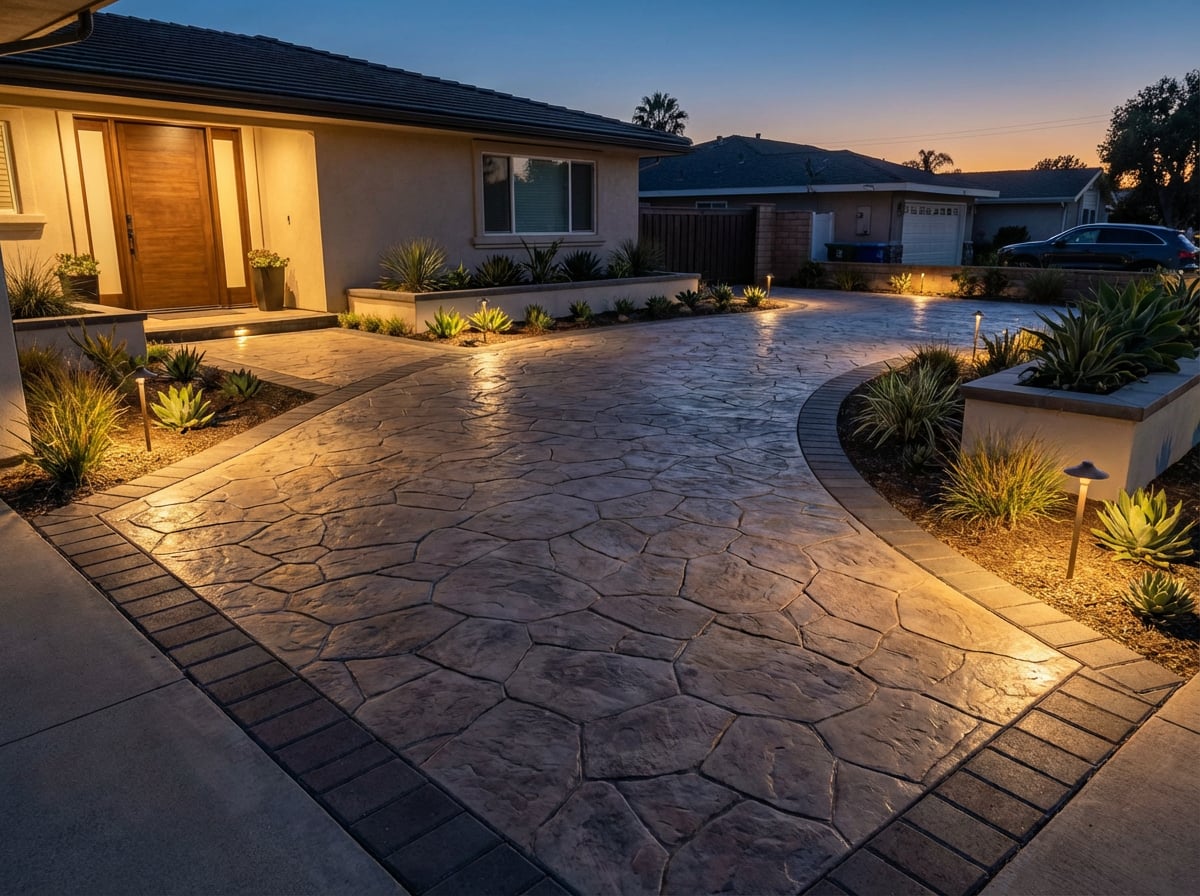
A Fletcher Hills afternoon, honestly
The valley holds the heat. That is the first thing any El Cajon homeowner learns about their own yard — that the sun sits on the east side of the county in a way it does not sit over La Jolla or Point Loma, that a July afternoon at three o’clock reads hotter up here than the number on the phone, and that the shade pocket under a mature pepper tree is not a luxury but a piece of operating infrastructure. By five, the light softens and turns the color of weak honey. By seven, a dry breeze comes down off the hills and the yard becomes the room you actually want to be in.
If you live up in Fletcher Hills, you already know what a good east-side yard feels like — a long patio that takes the last hour of sun, a shade structure sited to catch the breeze, a pool deck that does not burn a grandchild’s foot in September. The Santa Ana weeks in October are the test. The February rains are the other test. A yard that holds both is a yard worth building.
This page is for the homeowner on a Fletcher Hills view lot, a Bostonia parcel with room to breathe, or a Rancho San Diego-adjacent property where the pool deck is tired and the structure behind the house was never really finished. You want the outdoor footprint to match the home. You have time to do it properly. You would rather wait for the right crew than hire the one that can start Monday.
El Cajon’s property profile
El Cajon is not one market. The submarket that matters for work at our tier is Fletcher Hills — the west side of the city, rising toward the La Mesa border, with lots that run 0.3 to 0.75 acres, view parcels that look across the valley, and a housing stock that ranges from well-kept 1960s ranch homes to newer custom builds set back from the street. This is where the premium El Cajon work sits. These are the properties where restraint and craft read louder than size.
Bostonia, on the northeast side, pushes into larger-lot territory — deeper parcels, more horse-property lineage, a looser street grid. Crest, sitting above the valley floor at elevation, carries its own view-parcel and fire-overlay realities. The unincorporated edges that fold into Rancho San Diego on the south bring an even more generous lot footprint and a different permitting posture — county rather than city.
HOA presence across El Cajon is limited. Most parcels are governed by city setback and coverage rules rather than a private review board, which shortens the design-approval window and broadens what a good design can actually do on the property. That is an advantage. It also means the responsibility for a restrained, property-appropriate outcome sits with the builder and the homeowner, not with a design committee. We take that seriously.
Soil and inland heat
East County soil is not one thing. Fletcher Hills sits on decomposed granite over clay — a surface that drains fast in the upper layer and then slows dramatically once water hits the clay beneath. The practical consequence is that drainage solutions designed for a coastal lot do not translate. Sub-slab gravel depths, French drain sizing, and the way a retaining wall weeps in a wet February all have to be engineered for the two-layer profile. The valley floor around Bostonia and central El Cajon shifts toward clay loam — heavier, slower-draining, and less forgiving of a patio poured without proper base prep.
Inland heat is the other governing variable. Material temperatures on a 95-degree September afternoon matter more than they do seven miles west. Darker pavers, dense stone, and lower-grade artificial turf can run surface temperatures well above air temperature — uncomfortable on a pool deck, unusable on a turf lawn a child plays on. Material selection for an El Cajon yard starts with color reflectance and thermal mass, not just aesthetics. We specify accordingly.
Permits and jurisdiction
Properties inside the incorporated city of El Cajon are reviewed by the City of El Cajon Community Development Department, which handles planning, building plan-check, and inspections. Setback verification, hardscape coverage, pool-deck and structure permits, retaining-wall engineering above the non-exempt threshold, and any electrical or gas work under a kitchen or lighting scope all route through that office. We prepare the drawings, submit, respond to plan-check comments, and schedule inspections on your behalf.
Parcels on the unincorporated edges — the addresses that are postally El Cajon but legally county land, which tend to cluster along the Crest, Bostonia, and Rancho San Diego peripheries — are reviewed by San Diego County Planning & Development Services. The process is similar in substance, different in form and fee schedule, and fire-overlay zones add a layer of review that the city does not always impose. Properties in or near wildland-urban interface zones are also subject to Cal Fire defensible-space requirements — clearance distances, non-combustible surfaces, and ember-resistant construction that affect where and how we site fire features and overhead structures. A ten-minute address lookup at the start of a project saves a ten-week surprise in the middle of it. We do that lookup before we write the proposal.
Design character
The architecture of the older El Cajon stock is honest: California Ranch, mid-century builds, post-war tract homes that have been loved into something more particular, and a growing layer of newer custom homes on the Fletcher Hills ridge. The outdoor design character that reads right here is restrained, horizontal, and rooted in the site — long patio runs, low seating walls, shade structures that sit down into the roofline rather than fighting it, and planting programs that lean on drought-native and California-adapted species rather than the lusher palette a coastal lot can support.
What reads wrong on a Fletcher Hills view parcel is tract-developer finish. Thin veneer stone applied like stickers to a pilaster. A pergola cut from dimensional lumber that bows in a single summer. A pool deck finished in a color that looked fine in a showroom and fights the house every hour between noon and sunset. These are the details that quietly separate a yard from a property. The remedy is not more budget. The remedy is discipline at the material level and a build team that knows which joint has to be invisible and which one has to be deliberate.
We design for the property you actually own. A 0.4-acre view lot asks for one kind of siting. A deep Bostonia rear yard asks for another. The shared rule is that the yard should answer the house it sits behind — not audition for a different one.
Where we fit in El Cajon
Our office is in La Mesa, twenty minutes from most of the work we do in El Cajon — a short drive on the 8, up the 125, or across Fletcher Parkway depending on where your property sits. That proximity is operational, not a sales line. It means the same crew that is on your property Monday is on the same property Tuesday. It means our Field Lead and one of the founders — Gio or Mike — are personally on your job, not a rotating cast of subs.
We work across San Diego County by design, not by dispatch. Projects are planned months ahead and scheduled against a short list. A client who needs the patio poured this weekend is not our client. A client who wants the right patio poured — once, by the right hands, with the grading, structure, kitchen, lighting, and planting coordinated under one plan — is exactly the client we were built for.
Every project we deliver carries The 10-Month Walk-Through. Ten months after completion, we return to your property and inspect every square foot of our work with you — joints, grading, finishes, structures, irrigation, lighting. Anything that needs attention gets attention, on our dime. It is the part of the business that almost nobody in this industry does, which is exactly why we do it.
Services we deliver in El Cajon
Every El Cajon project is scoped as a full remodel or as a coordinated piece of one. The full menu we build includes full backyard remodels, outdoor kitchens and BBQ islands, patios and hardscape design, fire pits and fireplaces, pergolas and shade structures, retaining walls and seating walls, artificial turf installation, landscape lighting, pool decks and poolside hardscape, and drainage and grading. Planting and irrigation are built inside our full remodels rather than sold standalone. Neighboring pages worth reading alongside this one include La Mesa, Mount Helix, and Rancho San Diego.
Frequently asked
Is Fletcher Hills really a different budget conversation than the rest of El Cajon?
In practice, yes — though the distinction is scope more than zip code. Fletcher Hills parcels tend to carry more hardscape surface area, more structure, and a heavier grading and drainage scope because of the topography and the view-siting the lots invite. That drives project totals into the higher end of our typical range — often $150,000 to $300,000, occasionally above — while a comparably sized remodel on a flatter Bostonia or central El Cajon lot can land lower simply because the site cost is lower. We do not take on small-scope work, wherever the property sits.
How does inland heat change your material selection?
It tightens it. On a pool deck we weigh surface temperature as seriously as we weigh slip rating and color match — that usually means lighter-toned, wet-cast pavers or a travertine with a closed face, rather than a darker concrete paver that can run thirty degrees above air temperature by mid-afternoon. For artificial turf, we specify higher-grade products with heat-dissipating infill and lighter blade tones, and we set honest expectations about which turf you do not want on a south-facing El Cajon lawn in August. Cedar and Accoya outperform darker tropical hardwoods in the inland sun. These are not preferences. They are decisions made with a thermometer.
We have a sloped view lot. What does retaining and drainage look like here?
On a Fletcher Hills or Crest view parcel, retaining and drainage are the first conversation, not the last. We design to the two-layer soil profile — decomposed granite over clay — which means weep systems, sub-drains, and aggregate depths are sized for a surface that drains fast above and slow below. Wall heights above the non-exempt threshold require stamped engineering and a permit, which we handle. We favor a combination of segmental wall systems and, where the property allows a quieter architectural line, COR-TEN steel. The rule is simple: we do not build hardscape on top of a drainage problem.
We are rebuilding an existing pool deck. Do we need a permit?
Usually yes. A tear-out-and-replace pool deck in incorporated El Cajon routes through the Community Development Department for plan check and inspection, and the scope often pulls in adjacent work — bonding and grounding, equipment-pad electrical, drainage routing to the street or a subsurface system — that has its own permit and inspection sequence. We prepare the drawings and manage the full permit process as part of the scope. On the unincorporated edges, the same work routes through San Diego County PDS.
How do HOAs factor in?
For most of El Cajon, they do not. The premium pockets of the city — Fletcher Hills, Bostonia, Crest — are largely HOA-free, which means the governing layer is city setback and coverage rules rather than a private architectural committee. There are exceptions: a handful of newer gated developments carry CC&Rs with design-review requirements. We confirm at the address level during our first site visit and build the approval timeline into the proposal if a board review is required.
Can you work cleanly in the older tract neighborhoods?
Yes, and most of our El Cajon work does. The older tract stock west of the 125 and through the central valley was often built on a tight lot with limited side-yard access — which changes how material stages, how demo leaves the site, and how long a day’s dust envelope lasts. We walk access before we scope. We protect the house, the neighbor’s fence line, and the interior floor path every day of the build. We clean at the end of every day. This is not a promise. It is how the crew runs.
Who is on site day to day?
A single crew from first cut to final clean, led by our Field Lead, with Gio or Mike personally involved in every project. You have both cell phones from the first call. There is no account manager. There is no handoff. The relationship is part of the product, not a feature of it.
How far ahead do we need to start the conversation?
Earlier than most homeowners expect. We schedule a short list of projects each year. A typical El Cajon project that signs in spring breaks ground later in the calendar; a project that wants a specific season on site should begin the design conversation six to twelve months ahead. That timeline is not a constraint we apologize for — it is the reason the work lands.
References available on request
We do not publish testimonials. When a project is complete, we invite future clients to speak directly with the homeowners who have lived in the finished work, and during discovery we will walk you past completed East County projects in person. On this kind of work, it is still the best way to vet a builder.
When you are ready
If your property is in Fletcher Hills, Bostonia, Crest, the central valley, or the unincorporated edges of El Cajon — and the scope is a serious outdoor remodel built to last — we would like to hear about it. A first conversation is thirty minutes, by phone or on your yard, at no cost. We will listen, we will tell you what we see, and we will tell you honestly whether we are the right firm for the work.
Licensed and insured general contractor, operating under Mike’s Class B license — CSLB #1139785.