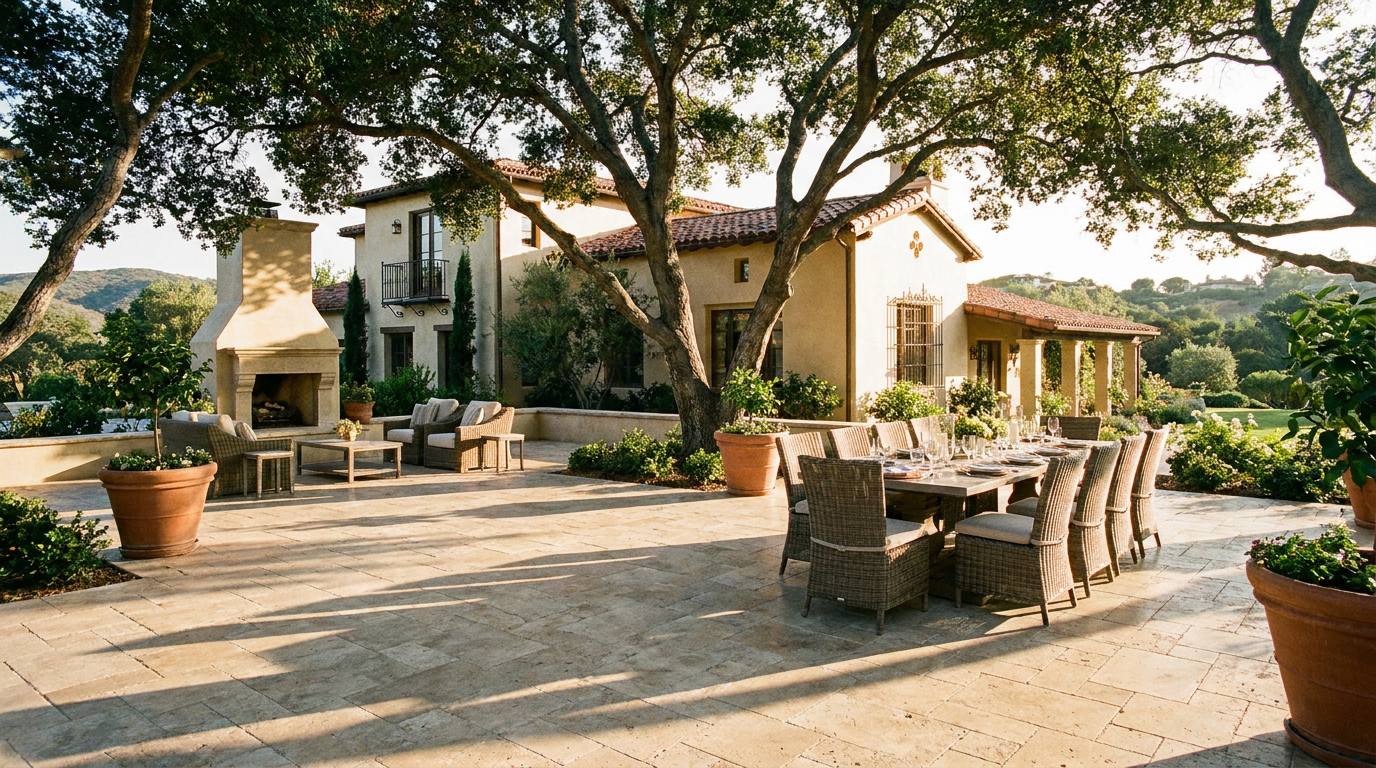
Del Mar homeowners entertain well. The village runs at a particular rhythm — dinner outside in July when the horse track is running and the nights stay warm, a fire going in the back on a Tuesday in November because the patio is the best room in the house. The demand for an outdoor kitchen is genuine. The challenge is that Del Mar village lots are not large, and the kitchen that reads as belonging on a small lot is fundamentally different from the entertainer-scale kitchen that belongs on a two-acre Rancho Santa Fe Covenant property.
Nobody writes about right-sizing as a design discipline. It is the right discipline for Del Mar outdoor kitchens.
The Village Lot Problem
A typical Del Mar Village lot is five to eight thousand square feet. The house takes up a significant share of that. The backyard — the portion that an outdoor kitchen is competing for space with — is often twenty-five to thirty-five feet deep and forty to fifty feet wide.
In that space, the outdoor kitchen is not the anchor. It is one element in a composed outdoor room that has to include a dining or seating area, a path of circulation, and some planted element that keeps the space from reading as a concrete yard with furniture. A kitchen run that eats twelve feet of a thirty-foot-deep backyard, with a bar that extends another four feet into the traffic path, leaves nothing for the rest of the program.
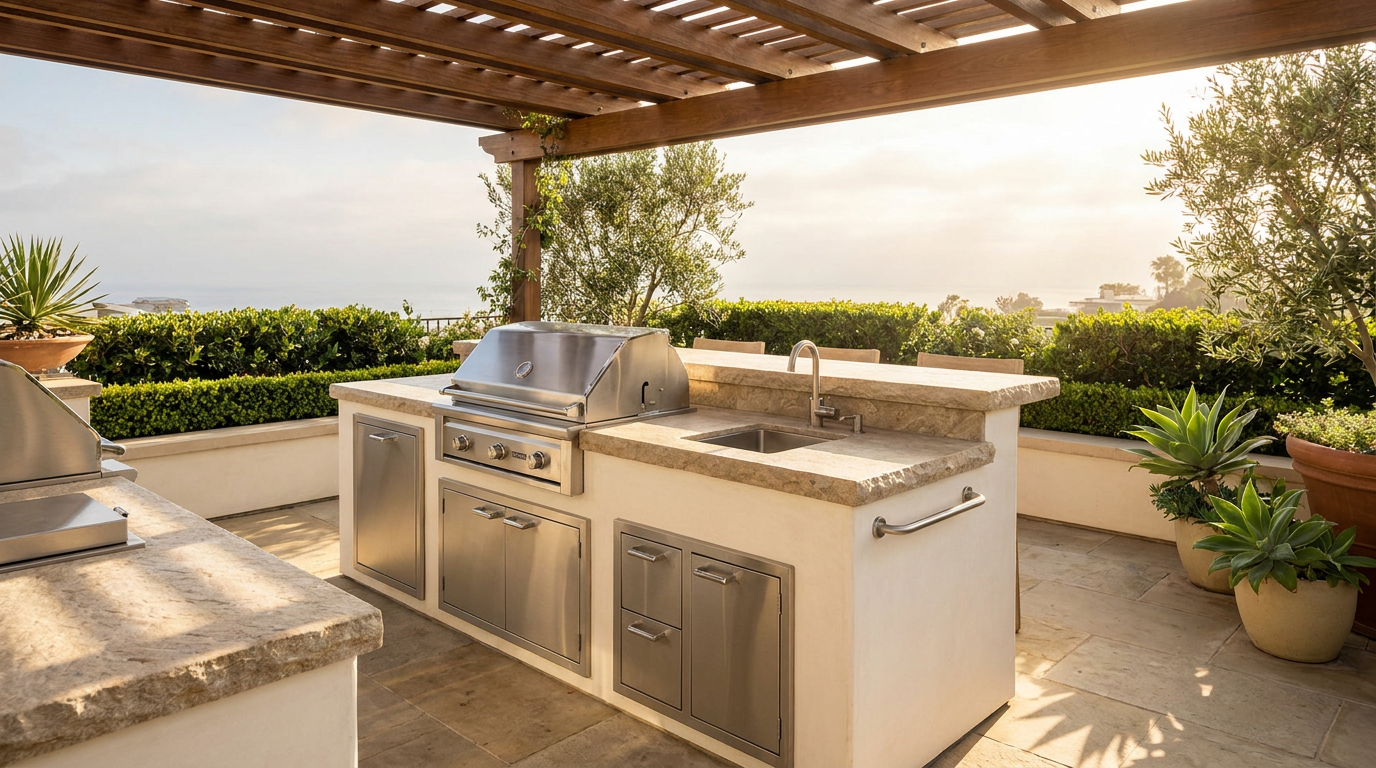
The right kitchen for a Del Mar Village lot is a compact run — typically twenty-four to thirty-six inches of grill, a built-in refrigeration unit, and a counter that doubles as bar seating for four rather than eight. The goal is not to minimize the kitchen because the lot requires compromise. The goal is to design a kitchen that is complete in a smaller footprint — where every element earns its place and nothing is included because it was available.
A compact outdoor kitchen done correctly does not feel small. It feels considered. The proportion between the kitchen, the dining surface next to it, and the patio around it is what makes a small-lot outdoor space read as designed rather than as crowded.
DRB Visibility and Material Considerations
Del Mar’s Design Review Board reviews exterior work visible from the public right-of-way. An outdoor kitchen on the back of a Village property is typically not directly in view from the street — but the structure above it, if there is one, and the wall or screen that frames it, often are. Material selections for any element with street visibility are part of the DRB submittal and need to be consistent with Del Mar’s design tradition.
Del Mar’s village vernacular is coastal cottage and Mediterranean — clay tile, hand-trowelled stucco, natural materials in warm tones that read as belonging in a coastal California town. A stainless-and-black-aluminum outdoor kitchen visible from the right-of-way reads as commercial, not residential, and will draw comment at DRB. A stucco-finished masonry cabinet body in a tone consistent with the house, with a natural stone counter and recessed stainless appliances, reads as residential and architecturally coherent.
The design logic is also practical: the DRB’s interest in what reads from the street is the same logic that makes the kitchen feel private in the backyard. A hedge or wall that blocks the kitchen from the street view also creates the enclosed quality that makes outdoor dining in Del Mar feel separated from the neighborhood around it rather than performed for it.
Salt-Air Stainless: Why Grade Matters Here
Stainless steel is the standard material for outdoor kitchen appliances and cabinet frames everywhere. What is not standard is the grade of stainless specified for the environment the kitchen is actually in.
201 stainless is a common cost reduction in outdoor kitchen products. It holds up reasonably well in inland environments. In a Del Mar Beach Colony yard, a block from the sand, 201 stainless begins to show surface rust within a season or two. The chloride content in the salt air attacks the lower-nickel-content alloy at a rate that is visibly different from what the same product experiences twenty miles inland.
304 stainless is the typical minimum specification for outdoor kitchen products marketed as coastal-appropriate. In most Del Mar locations — the Village, the Heights — 304 with proper surface care holds adequately.
316 stainless is the specification for Beach Colony properties and for any kitchen within a very short distance of the ocean. The molybdenum addition to the 316 alloy provides meaningfully better chloride resistance. The cost difference between a grill enclosure built in 304 and one built in 316 is real. The performance difference in a salt-heavy environment is also real, and it shows up before the warranty expires.
Beyond the cabinet and appliance grade, every piece of hardware — the fasteners, the hinges, the handle attachments, the electrical conduit connections — needs to be specified for coastal exposure. A stainless-grade grill in a cabinet where the internal fasteners are standard zinc-plated steel is not a marine-grade outdoor kitchen. The coastal specification applies to the entire assembly.
Beach Colony Scale: A Different Program
The Beach Colony properties sit at the other end of the Del Mar outdoor kitchen spectrum. Lots are still not large by the standards of Rancho Santa Fe or La Jolla Farms — but the program expectations are different, the budget assumptions are different, and the finish level the neighborhood expects is uncompromising.
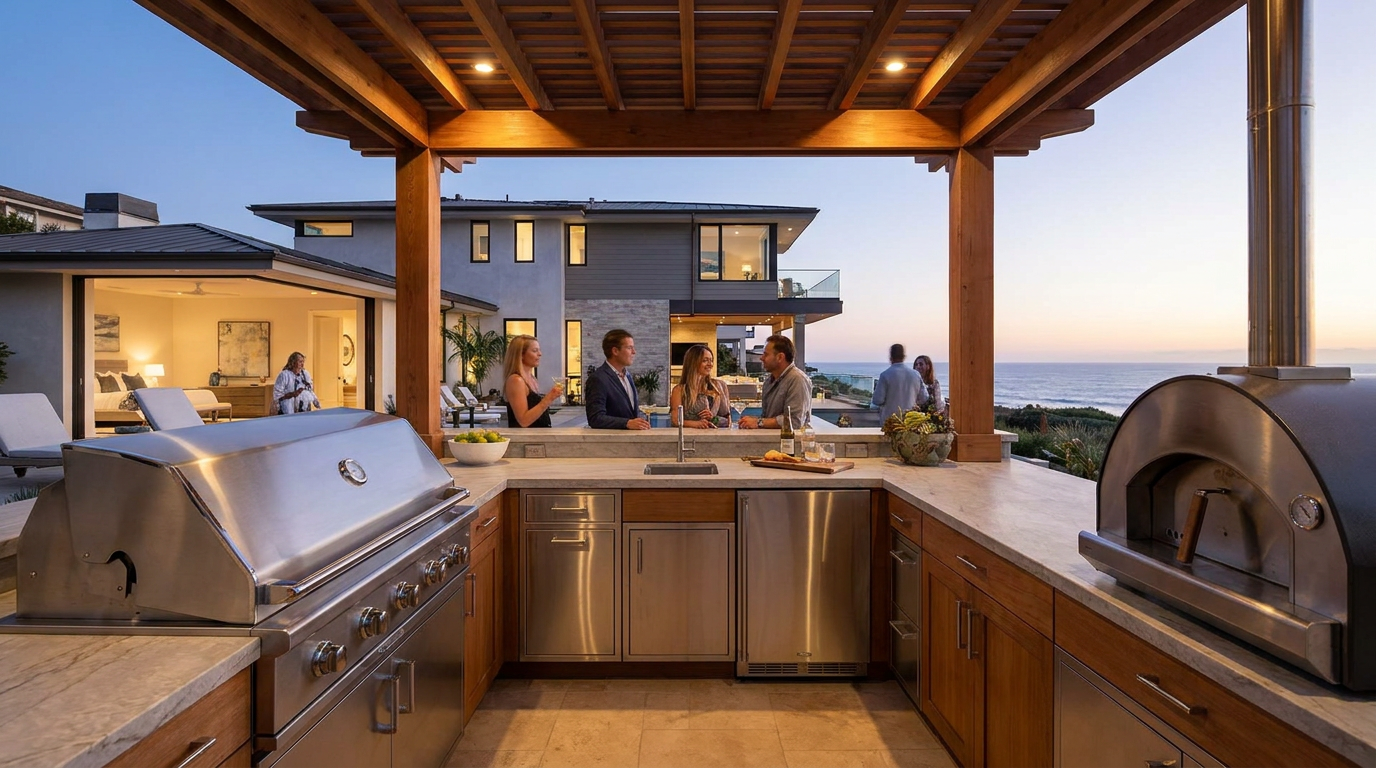
Beach Colony outdoor kitchens tend toward larger runs — a six- to eight-foot primary cooking station with a grill, side burner, and refrigeration, often with a secondary prep counter that extends the hospitality surface toward the dining area. The countertop is typically a high-specification natural stone — quartzite, granite with a low-porosity characteristic, or marine-grade concrete with a proper sealer — rather than the standard outdoor stone product. The appliance package is commercial-grade.
The CCC permit layer, which applies to most Beach Colony parcels, also shapes what can be built and where. A permanent kitchen structure within the coastal setback may require a Coastal Development Permit, and the design has to accommodate whatever conditions of approval the Commission attaches to the permit. We plan for that from the first design meeting on Beach Colony work, not after the drawings are done.
Cost Range
Del Mar outdoor kitchens typically run from $35,000 for a compact right-sized village kitchen in a stucco-finished masonry cabinet body with a natural stone counter and standard coastal-spec appliances, up to $120,000 or more for a Beach Colony kitchen with a full-length run, premium stone, commercial-grade appliances in 316 stainless, a covering structure, and CCC coordination.
The wide range is not a reflection of variable quality. It reflects the genuine difference in program scope and material specification between a Village lot kitchen designed for six and a Beach Colony kitchen designed for twelve at a finish level the street and the neighborhood notice.
Related: Outdoor Kitchens & BBQ Islands · Patios & Hardscape · Projects in Del Mar · Outdoor Kitchen Permits in San Diego